A house cleaning estimate comes down to one question: how many labor hours will your home take to reach a clean, maintainable state? Square footage, bathrooms, the type of clean, the home’s condition, pets, how often you book and local wages all feed that answer. This guide shows how each factor moves the number, with worked examples, so you can read any quote, ours or anyone else’s, and know why it says what it says.
TL;DR
- Home size is the biggest lever, but bathrooms, kitchen condition and the type of clean (standard, deep, move-out) change the hours more than most people expect.
- The condition of the home on arrival is the most common reason a quote changes. Describe it honestly when you book.
- A first visit usually costs more than recurring visits, because the crew is resetting the home to a baseline.
- Recurring schedules typically cost 10 to 15% less per visit than one-time or irregular service.
- In the Washington, DC area, local labor rates push prices above the national average.
Table of Contents
- How a cleaning estimate is built
- Factor 1: Home size and layout
- Factor 2: Bedrooms and bathrooms
- Factor 3: The type of clean
- Factor 4: The condition of your home on arrival
- Factor 5: Pets, children and household traffic
- Factor 6: Frequency
- Factor 7: Where you live
- Factor 8: Add-ons
- Our perspective: how we think about estimates
- How to get an accurate estimate: a checklist
- Red flags in a quote
- Book with a clear scope
- FAQ
- Sources
How a cleaning estimate is built
Behind every quote is a simple chain: the size and layout of the home, multiplied by the intensity of the service, adjusted for condition and extras, then priced at local labor rates. Companies present the result in one of two ways. Some quote a flat rate for the visit. Others bill by the hour. Our guide to flat rate vs. hourly cleaning walks through when each one favors you.
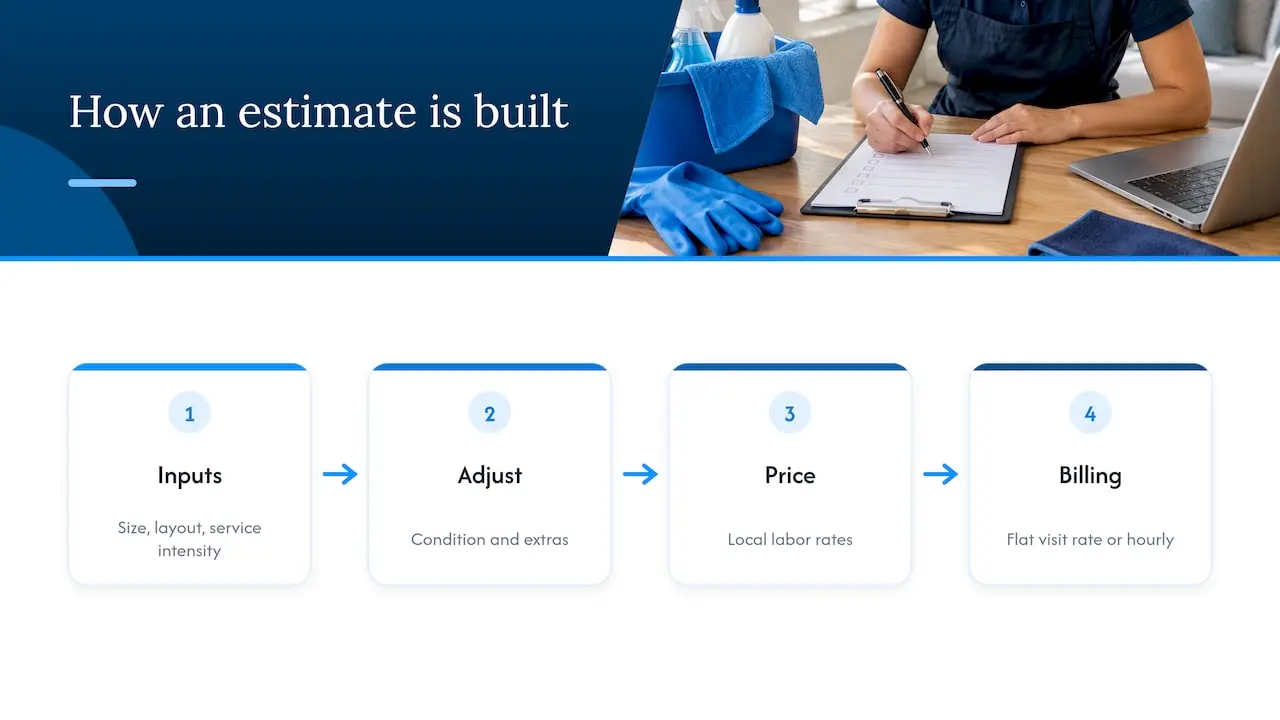
A flat rate is only as accurate as the information behind it. That is why a good company asks about bedrooms, bathrooms, pets and condition before it gives you a number. If it quotes you in one sentence with no questions, expect a revision later.
Factor 1: Home size and layout
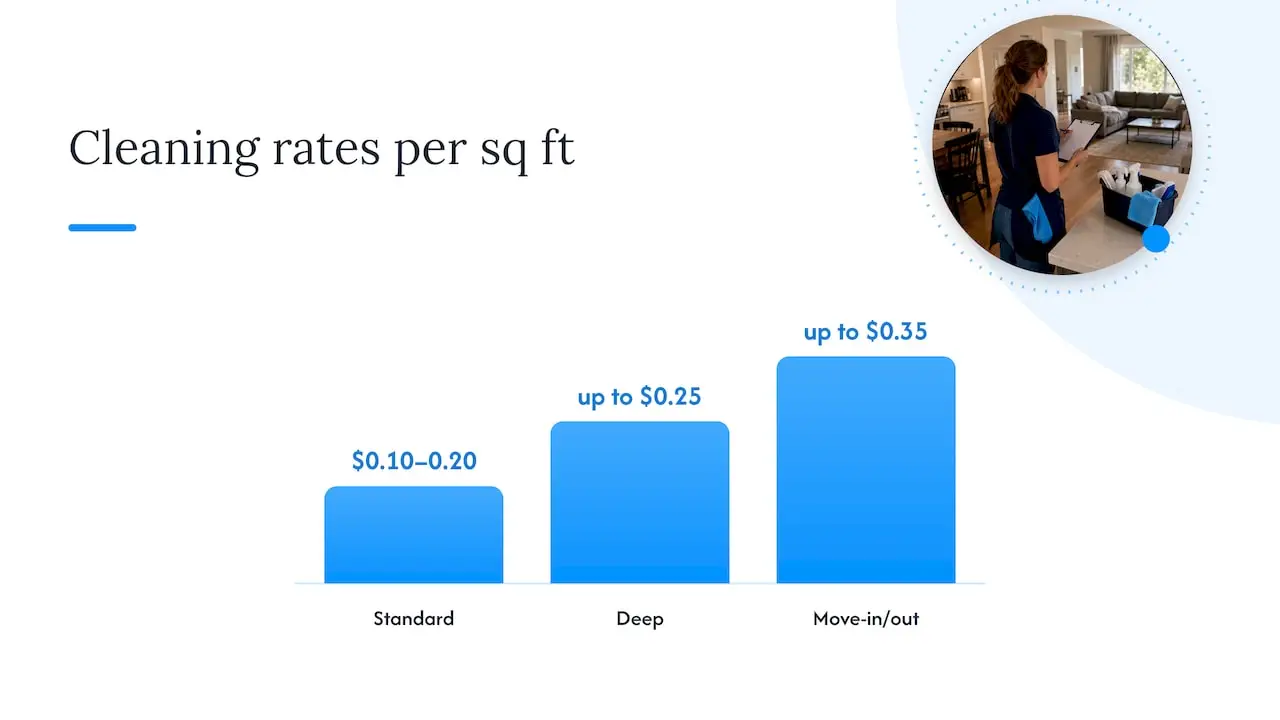
Square footage is the baseline. According to Angi, standard cleaning typically runs $0.10 to $0.20 per square foot, deep cleaning can reach $0.25, and move-in or move-out cleaning can reach $0.35 per square foot.
Here is what those ranges mean in practice. These are illustrations built from Angi’s published per-square-foot rates, not our prices:
| Home | Service | Rate used | Rough range |
|---|---|---|---|
| 1,000 sq ft apartment | Standard | $0.10 to $0.20 | $100 to $200 |
| 2,000 sq ft townhouse | Standard | $0.10 to $0.20 | $200 to $400 |
| 1,500 sq ft condo | Deep | up to $0.25 | up to $375 |
| 1,500 sq ft condo | Move-out | up to $0.35 | up to $525 |
Square footage alone misleads, though. A 2,000 sq ft home with large empty rooms takes less time than a 1,600 sq ft home with six small rooms, two kitchens’ worth of cabinets and a finished basement. Multi-level rowhouses, common across DC, add stair time and more transitions between floors, and Angi notes that home size and layout affect cleaning time in Washington’s rowhouses and townhomes.
Factor 2: Bedrooms and bathrooms
Bathrooms are the most labor-dense rooms in a house: tile, grout, glass, fixtures and toilets all need hands-on scrubbing. Angi reports that each additional bathroom typically adds $20 to $40 to a cleaning estimate.
That is why many companies price by bedroom and bathroom count instead of square footage alone. For a benchmark, LeadDuo’s 2026 pricing data puts a 3-bedroom, 2-bathroom home at $150 to $220 for a standard clean and $220 to $320 for a deep clean.
Kitchens work the same way. An oven, a fridge interior or heavily used cabinets turn a quick wipe-down into a longer task.
Factor 3: The type of clean
The service you pick changes the scope of work, and scope is time.
- Standard cleaning covers the upkeep: dusting, vacuuming, mopping, kitchen and bathroom surfaces. It assumes the home is already at a maintainable baseline. Our standard cleaning checklist lists what is typically in scope.
- Deep cleaning adds the detail work: baseboards, grout, inside appliances, buildup in corners and on fixtures. See the deep cleaning checklist for the room-by-room version.
- Move-in and move-out cleaning is done in an empty home, so crews reach inside cabinets, closets, drawers and appliances. For renters it often ties to a deposit, which is why we wrote a move out cleaning checklist.
If you are unsure which one you need, read standard vs. deep cleaning or deep cleaning vs. move out cleaning. Booking the wrong level is a common way to pay twice: a standard clean on a neglected home leaves the problem areas untouched, and a deep clean on a tidy home pays for work nobody needed.
For current deep clean figures, see what U.S. homeowners pay for a deep clean.
Factor 4: The condition of your home on arrival
This is the factor that causes the most friction. Care.com’s housekeeping guide reports that first-time cleanings often cost 20 to 30% more than recurring visits, because the first session is a reset that takes more labor than maintenance does, however clean the home looks.
Several things raise the hours:
- Buildup in showers, on stovetops or inside the oven
- Months without a professional clean
- Clutter that has to be moved before surfaces can be cleaned
- Heavy dust, which also ties to your HVAC. If you suspect the air itself is part of the problem, this explanation of why professional HVAC cleaning improves air quality shows how vents and ducts can keep recirculating dust that settles back on freshly cleaned surfaces.
The fix is honesty at booking. Tell the company when the last deep clean was, whether there are pets, and whether anything is unusually dirty. Photos help. A crew that arrives to a heavier job than described has to either do less than you expected or charge more, and neither feels good.
If your home has gone a long time without attention, consider a one-time reset before starting a schedule. We explain how in deep cleaning before recurring visits.
Factor 5: Pets, children and household traffic
Pet hair, litter areas, tracked-in dirt and kids’ spaces all add time. Two houses of the same size can need quite different hours if one has two shedding dogs and the other has none. Tell the company about each animal, because hair on upholstery, stairs and baseboards is slow work.
Pets also affect which products are appropriate. If you want gentler products, ask what the company uses, and look for the EPA’s Safer Choice label, which means every ingredient in a product has been reviewed for human health and environmental safety. The EPA also notes that indoor air pollution can be as high as outdoor levels and that children and people with asthma are among those most affected. Our guide to pet safe cleaning covers what to use and avoid, and green vs. regular cleaning covers the respiratory side. If anyone in your household has asthma or a chemical sensitivity, ask your doctor which products to avoid before you specify a cleaning product.
Factor 6: Frequency
How often you book changes the price per visit, because a home that is cleaned regularly never builds up much. LeadDuo’s benchmarks show recurring visits commonly earn a 10 to 15% lower cost per visit than one-time service.
Here is how that plays out on a hypothetical $200 visit, using the 10 to 15% range:
| Schedule | Visit price (illustration) |
|---|---|
| One-time | $200 |
| Recurring, 10% lower | $180 |
| Recurring, 15% lower | $170 |
Weekly and biweekly visits are shorter than monthly ones because less accumulates between them. A monthly schedule can feel like a repeated mini deep clean. If your budget allows, a shorter visit more often often keeps the home in better shape than a long visit less often.
Factor 7: Where you live
Labor is the largest cost in cleaning, so local wages carry through to your estimate. The Bureau of Labor Statistics reports that in May 2025 the mean hourly wage for building and grounds cleaning and maintenance workers in the Washington-Arlington-Alexandria area was $20.30, against $19.66 nationally for that category.
The gap looks small on paper, yet it understates what you pay, because insurance, supplies, travel and parking in the city add to the price. Angi puts the average for house cleaning in Washington, DC at $183, with most homeowners paying $129 to $237. The national figure Angi gives for a standard visit is $118 to $238, so a DC household should plan toward the upper end.
Travel matters too. Parking restrictions, building access rules and stairs in older DC rowhouses can all change how long a visit takes. Mention them when you book.
Factor 8: Add-ons
Add-ons are the extras beyond the standard scope. Common ones include inside the oven, inside the fridge, interior windows, laundry, and wall washing. Each one is a separate block of time. If you are curious about walls specifically, see when professionals wash walls and what it costs.
Ask for add-ons to be itemized. That lets you drop one to meet a budget, or add one only for the first visit.
Our perspective: how we think about estimates
We serve homeowners and renters across Washington, DC, Virginia and Maryland, and the same pattern comes up again and again: the surprises in a cleaning bill almost never come from the hourly rate. They come from a mismatch between what the customer pictured and what the home needed.
So we encourage three habits. First, pick the right service for the home’s state: standard for maintenance, deep for a reset, move-in or move-out for empty homes. Second, give us the plain facts at booking: bathrooms, pets, last professional clean, any problem areas. Third, treat the first visit as a reset and recurring visits as the savings.
One rule of thumb we find useful is the 80/20 idea: you keep up the daily surfaces, and a professional handles the detailed 20% that accumulates, such as baseboards, grout and hard-to-reach dust. Households that split the work that way pay for the labor that actually needs a professional crew.
We use eco-friendly products and our staff are trained and insured. If your household includes pets, children or anyone sensitive to strong products, tell us, and we will plan around it.
— Local
How to get an accurate estimate: a checklist
- Measure or look up your square footage. Listings and tax records usually state it.
- Count bedrooms, bathrooms and levels. Include basements and half baths.
- Pick the service type. Standard, deep, move-in or move-out.
- Describe the condition honestly. Note the last professional clean and any buildup.
- List pets and sensitivities. Include animals, allergies and product preferences.
- Choose a frequency. One-time, weekly, biweekly or monthly.
- Ask for add-ons itemized. Oven, fridge, windows and so on.
- Share access details. Parking, building rules, key or code, stairs.
- Confirm what is included. Ask for the written scope and what triggers a change.
If you are moving out and want to protect a deposit, book early. Our security deposit cleaning page explains the 48 to 72 hour booking window we recommend for DC, MD and VA.
Red flags in a quote
- No questions asked. A price with no questions about bathrooms, pets or condition is a guess.
- Vague scope. If you cannot tell what is included, you cannot compare quotes.
- A price far below others. Low numbers often assume a light job and grow once the crew sees the home.
- No mention of insurance. Ask whether the crew is insured before anyone enters your home.
- Pressure to decide on the spot. A fair estimate holds up while you compare it.
Book with a clear scope
We offer standard cleaning and deep cleaning for homes and apartments in Washington, DC, Virginia and Maryland, plus move-in and move-out cleaning. You can see the standard and deep cleaning services or go straight to online booking for move-in and move-out cleans. If you are not sure which fits, start from our Pure Homes Cleaning home page and tell us about your home.
FAQ
What is the biggest factor in a house cleaning estimate?
Square footage is usually the biggest single factor, since larger homes take more time and supplies. After that come bathrooms, the type of clean and the condition of the home. A small, very dirty home can cost more than a large, well-kept one.
Why is the first cleaning more expensive?
The first visit brings the home up to a maintainable baseline, which takes more labor than upkeep. Care.com reports the first-time fee is often 20 to 30% higher than recurring visits. After that, a recurring schedule keeps the work lighter.
Is $50 an hour too much for cleaning?
Not necessarily in the DC area. Crews carry wages, insurance, supplies and travel in that hourly figure, and the local wage for cleaning workers is only the worker’s share. Compare the scope and total per visit, not just the hourly number.
What is the 80/20 rule in house cleaning?
It means you keep up the high-traffic surfaces that make 80% of the visible difference, while a professional handles the detailed 20%, such as baseboards, grout and hard-to-reach dust. The idea is described by The Clean Home. It helps you avoid paying for routine chores while still getting the deep work done.
Does the price change if I have pets?
Often, yes, because hair, litter areas and tracked-in dirt add time. Tell the company about each animal when you book so the quote reflects the real job. It also lets them choose suitable products.
Sources
- How Much Does Professional House Cleaning Cost? | Angi
- How Much Does Professional House Cleaning Cost in Washington, D.C.? | Angi
- 2026 Service Pricing Benchmarks | LeadDuo
- How Much Does a Housekeeper Cost? | Care.com
- Occupational Employment and Wages in Washington-Arlington-Alexandria | BLS
- Safer Choice | US EPA
- Improving Your Indoor Environment | US EPA
- When to Hire a Cleaning Service? | The Clean Home