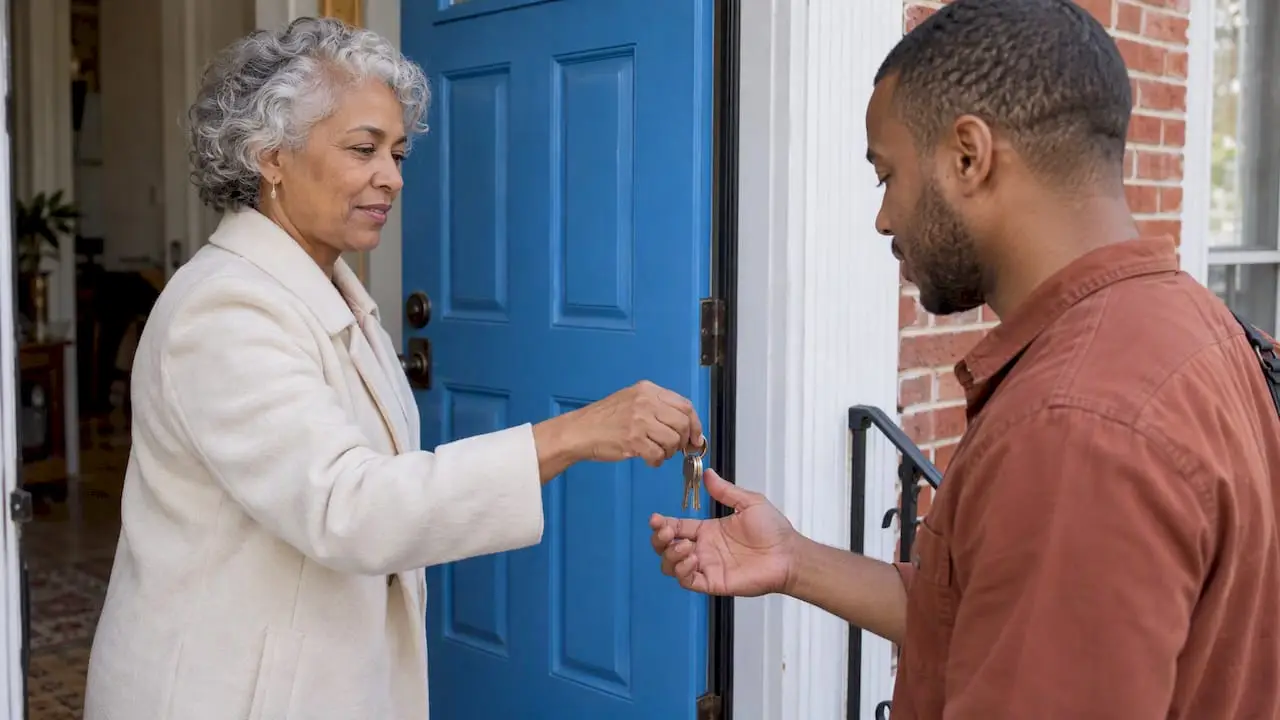
The safest way to let a cleaner into your home is to give the smallest amount of access for the shortest time, and to keep a record of who holds it. In practice that means a unique, changeable code or a labeled-free key kept in a controlled system, one door, a set service window, and a clear plan for what happens when the service ends or the cleaner changes. This guide walks through each choice, with the checks to run before you hand anything over.
TL;DR
- Prefer a changeable code (smart lock or lockbox) over a loose physical key, because you can change access without calling a locksmith.
- Give a cleaner access to one door and one time window, not the whole property at all hours.
- Never tag a key with your name or address, and ask the company how it stores and logs keys.
- Confirm the company is bonded, insured and screens its staff before any key changes hands.
- When service ends or a cleaner is reassigned, return keys and change every code that person knew within the same week.
Table of Contents
- Should you give a cleaner a key at all?
- Why changeable codes beat loose keys
- Set up lockbox and door codes the right way
- Give the least access that gets the job done
- What a careful company does with your key
- Check bonding, insurance and screening first
- Children, pets and other people in the home
- When service ends or the cleaner changes
- Keys on a move-out or move-in clean
- How we handle access at Pure Homes Cleaning
- Perspective: access is a decision, not a default
- FAQ
- Sources
Should you give a cleaner a key at all?
You have three realistic options: be home and let the cleaner in, leave a key or code, or use a lockbox or smart lock. None is wrong. The right one depends on your schedule and how comfortable you are with the company’s process.
| Option | Best for | Main risk | How to reduce it |
|---|---|---|---|
| You are home | First visit, trial clean | Needs your time | Use the visit to walk through the scope and the access plan |
| Physical key | Stable, long-term recurring service | A lost or copied key means rekeying | Unlabeled key, logged storage, return at end |
| Lockbox | Occasional or one-time visits | Code shared too widely or never changed | Unique PIN, change it regularly |
| Smart lock or keypad | Recurring service, several cleaners | Codes stay active after staff changes | One code per person where possible, delete on departure |
For a first clean, we suggest being home or at least reachable. It lets you see how the team works before you decide on a longer-term arrangement. Our page on choosing a cleaning service with one trial clean covers that approach.
Why changeable codes beat loose keys
A physical key is a permanent credential. If it is lost, copied or left in the wrong hands, the only fix is rekeying. A code can be changed in a minute. Home-access guidance for cleaning clients notes that smart locks and lockboxes with rotating codes are generally lower-risk than loose keys because access can be changed without a locksmith visit.
Some smart locks also keep an access history, which helps you confirm when your cleaner arrived and left. The Colorado Division of Real Estate notes that electronic lockboxes can track access times, dates and keyholder identity. Check your own model’s features before relying on a log.
If you rent, read your lease or ask your landlord before changing a lock or installing a keypad. Many leases restrict lock changes, and a move-out can mean restoring the original hardware.
Set up lockbox and door codes the right way
A lockbox is only as secure as its code habits. The Colorado Division of Real Estate advises people using lockboxes to change factory settings, use a unique PIN and change the code daily or at least weekly when contractors are working in a home. That guidance was written for real-estate lockboxes, so weekly changes may be more than a household needs for a standing cleaning. But the principles transfer:
- Change the factory code immediately. Default codes are widely known.
- Avoid obvious numbers. No birthdays, street numbers or 1234.
- Use a code only for the cleaner. Do not reuse your garage, alarm or Wi-Fi code.
- Change it on a schedule you can keep. After any cleaning-team change, after a missed or odd visit, and whenever the service ends.
- Mount the box out of sight and not on a door visible from the street if you can help it.
Alarm codes
If you have an alarm, give the cleaner their own user code instead of sharing yours. Most systems let you create and delete user codes, and many show which code armed or disarmed the system. Ask your alarm provider how yours works. Tell the cleaner exactly what to do on arrival and departure, including how long they have to disarm the system, so nobody triggers a false alarm.
Give the least access that gets the job done
Security people call this the principle of least privilege. One cleaning-industry resource describes it as granting cleaners the smallest amount of access necessary, such as one designated door during a defined service window. It is an information-security idea, not a cleaning regulation, but it fits a home well.
In practice:
- One entry point. Give access to the front door or the building lobby, not the basement, garage and side gate as well.
- A service window. Agree on arrival and departure times and ask the company to tell you if they change.
- Lock up the valuables. Put passports, spare keys, prescriptions, cash and documents in a closed drawer or safe. This protects you and the cleaner from any misunderstanding.
- Close off rooms that are not in scope. A shut door or a note makes the boundary clear. Our guide to cleaning notes for cleaners shows how to write instructions that are specific without being intrusive.
What a careful company does with your key
You are trusting a process as much as a person, so ask how it works. According to a home-access guide for cleaning clients, good practice with a physical key is to never label it with the homeowner’s name or address and to store it in a locked box or safe with a log that tracks which employee has it.
Questions worth asking before the first handover:
- Is the key tagged with my name or address? (It should not be.)
- Where is it kept between visits, and who can open that storage?
- Is there a written log of who has it?
- Will the same cleaner come each time, and what happens if they leave?
- If a key is lost, who pays for rekeying, and how fast will I be told?
- Can I use a code in place of a key?
A company that answers these without hesitation has thought about it. A vague answer is a reason to wait. Our list of questions to ask a cleaning service gives you the wider set, and our home access guide goes deeper on keys, codes and lockboxes.
Check bonding, insurance and screening first
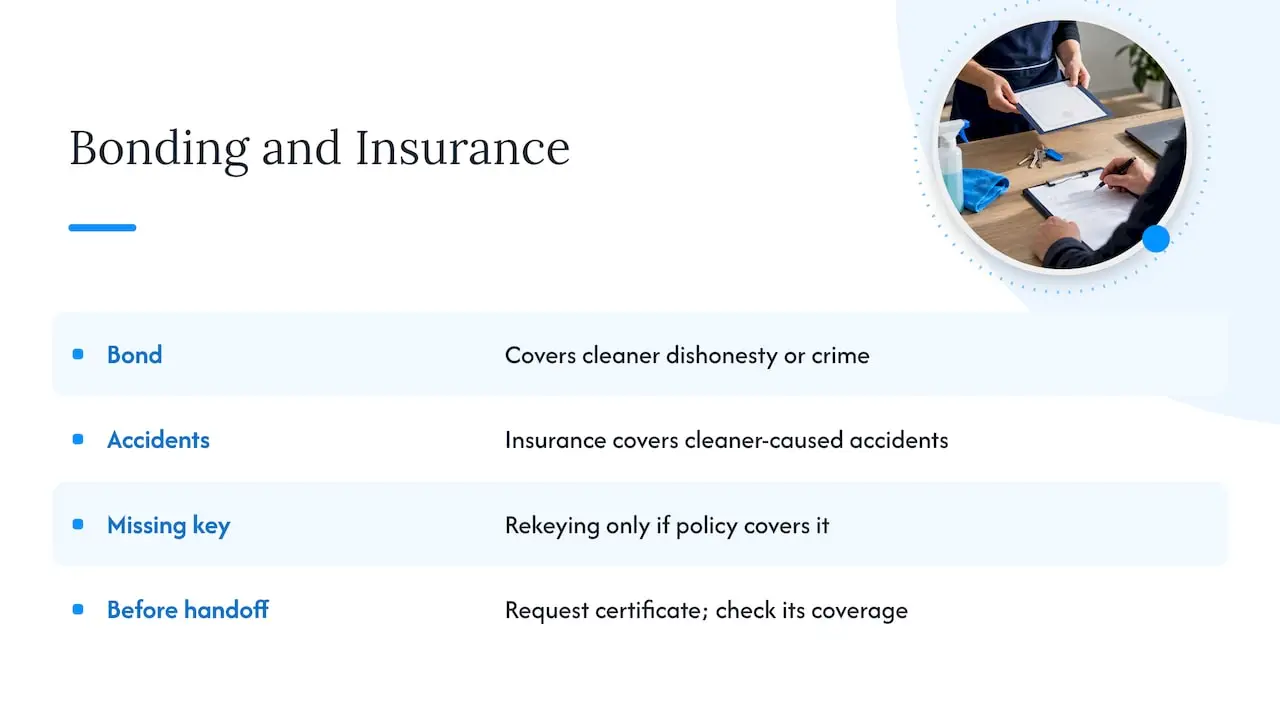
Handing over a key is a trust decision, so verify the basics before you do it. The Better Business Bureau advises homeowners to hire only businesses that are bonded, insured and run background checks on employees. It also explains the difference: a bond protects you against dishonest or criminal acts by cleaners, while insurance covers accidents, such as a cleaner forgetting to shut off a faucet or losing a key.
That last point matters here. If a key goes missing, insurance is what responds to the rekeying cost, but only if the policy covers it. Do not assume. Ask for the certificate of insurance and read what it covers. We explain how to do that in four certificate and bond checks and, for the DC area, in how to verify a cleaner’s insurance. For screening, see six questions to verify cleaner backgrounds.
Company or independent cleaner?
With an independent cleaner, you hold the whole relationship: key, insurance check, backup if they are sick. With a company, there is usually a process, a replacement and a record. Neither is automatically safer, but you should know who is accountable if something goes wrong. The tradeoffs are laid out in our comparison of an independent cleaner versus a company.
Children, pets and other people in the home
A few precautions make visits smoother for everyone:
- Tell the company about children and pets before the first visit, including any pet that may bolt through an open door.
- Secure pets. Put dogs in a room or crate with a note, or ask the cleaner to confirm where the pet is on arrival.
- Keep children’s items safe. Medications, small objects and anything fragile should be put away before the visit.
- Decide about being home. Some families prefer to be present for the first few cleans. That is a normal request.
- Use gentle products. Tell the team about sensitivities. We use eco-friendly products that are safe for families and pets.
If someone else will be in the home during the visit, such as a dog walker or a contractor, tell the cleaner so they are not surprised.
When service ends or the cleaner changes
This is the step people skip. When you stop service, return keys; after a staff change, change every code that person had within the same week. That advice comes from a cleaning-client guide rather than a regulator, but it is simple, cheap and sensible.
A short offboarding checklist:
- Ask in writing for the key to be returned, or for the company to confirm it has been destroyed or retired.
- Delete the cleaner’s user code from the alarm and smart lock.
- Change the lockbox code.
- If a physical key is unaccounted for and you cannot confirm what happened, rekey the lock.
- Note the date in your records.
When the company reassigns your clean to a new person, ask for the change to be flagged to you before the first visit, and give the new cleaner a new code if your system allows it.
Keys on a move-out or move-in clean
Move-out cleans have their own key logic, because the home is empty and the handover date matters. If you are renting, the keys usually go back to your landlord or property manager, not to the cleaner, so plan the order of events:
- Movers finish and the home is emptied.
- The cleaning team works while the space is clear.
- You walk through the finished home, ideally taking dated photos.
- You return keys and any fobs, garage remotes or mailbox keys to the landlord, and get that return confirmed in writing.
Before handing keys back, check that every door, window lock and storage-room key is accounted for, and that you have removed your own codes from any smart lock or alarm you installed. If a cleaner held a key for the job, confirm it is back with you before you submit the set to your landlord.
For the cleaning scope itself, see our move out cleaning checklist and, for deposit timing across DC, Maryland and Virginia, our page on security deposit cleaning. If you are moving in, the move-in cleaning checklist includes safety checks, and it is a good moment to change the locks or codes on a new home before anyone else uses them.
How we handle access at Pure Homes Cleaning
We serve homeowners and renters in Washington, DC, Virginia and Maryland, and access is one of the first things we talk through with a new household. We work with trained, insured staff, and we suggest that new clients start with a single clean where they can see how the team works and agree on how entry will happen. You can book a standard or deep clean or a move-in or move-out clean online, and note your access preferences when you do.
If you would rather not leave a key at all, say so. Being home, meeting the team at the door or using a changeable code are all fine starting points, and you can change the arrangement as trust builds.
Perspective: access is a decision, not a default
Most access problems we hear about are not dramatic. They are small lapses: a key that stayed with a cleaner who stopped coming, a code nobody changed, an alarm shared across three people. None of those are about bad intent. They come from not having a plan.
Our view is that clients should expect to be asked about access, and should expect a clear answer when they ask us. Choose the lowest-risk method that suits your routine, limit it to one door and one window, and write down what happens when anything changes. A good cleaning company makes that easy. If a company brushes the topic off, that tells you something about how it will treat the rest of your home.
— Local
FAQ
Is it safe to give my cleaner a key?
It can be, if the company is bonded, insured and screens its staff, and if the key is stored without your address on it. Where possible, a changeable code is lower-risk than a key because you can change it at any time. Start with a trial clean so you can see how the team operates.
Should the key have my address on it?
No. Guidance for cleaning clients says a key should not carry the homeowner’s name or address. If it is lost, nobody can tell which door it opens.
How often should I change my lockbox or door code?
Real-estate guidance suggests changing lockbox codes daily or at least weekly when contractors are working in a home. For a regular cleaning, a sensible habit is to change the code whenever the cleaner or company changes, when service ends and after anything unusual. Always change the factory default first.
What if a cleaner loses my key?
Ask the company to tell you right away and to explain what its insurance covers. If you cannot confirm where the key is, rekey the lock, since a lost key stays valid until you change it. Check the certificate of insurance before you hire to see whether key loss is covered.
Do I need to be home during a move-out clean?
Not always, but being there for the final walk-through is useful. You can check the result, take photos and confirm that all keys are accounted for before you return them to your landlord.
Sources
- The What, Why, and Risks of Using Lockboxes, Colorado Division of Real Estate
- BBB Tips: 7 tips for hiring a house cleaning service
- Cleaning Client Key Access Management: A Safe System
- Cleaning Service Key and Alarm Access Calls: Secure Intake Practices