
Hire cleaners who carry both bonding and insurance when you want protection from accidental damage and employee dishonesty alike. If you can only confirm one quickly, prioritize insurance for accident and injury risk, since that covers the more common claim. Either way, ask for a current certificate of insurance and bond documentation before anyone steps inside your home or building.
TL;DR:
- Insurance primarily covers accidental damage to property and injuries, making it essential for common incidents during cleaning services.
- Bonds protect against theft and dishonesty, with specific types like employee-dishonesty and performance bonds, involving longer claims investigations.
- Confirm coverage by requesting a current certificate of insurance and bond documentation before hiring, and verify their validity directly with insurers or surety companies.
- Most cleaning businesses carry a typical stack of coverage including CGL, workers’ compensation, auto, and employee-dishonesty bonds, with limits and endorsements affecting their protection scope.
- Relying solely on the label “bonded and insured” can be misleading; always review the actual documents and ask for proof before the service begins.
Table of Contents
- What does it mean for a cleaning service to be bonded?
- What does it mean for a cleaning service to be insured?
- Bonded vs insured: which one pays for what
- Insurance and bond coverages a cleaning company typically carries
- Types of bonds cleaners use and how a claim actually plays out
- What to ask for before you sign a cleaning contract
- How to verify coverage and file a claim if something goes wrong
- Where “bonded and insured” claims fall short in practice
- How Pure Homes Cleaning approaches bonded and insured hiring standards
- Why the checklist matters more than the label
- Pure Homes Cleaning: bonded and insured cleaners for your home
- Where to verify coverage details yourself
- Sources
- FAQ
What does it mean for a cleaning service to be bonded?
A surety bond is a three-party agreement: the cleaning company (the principal), the client or facility (the obligee), and a bonding company (the surety) that guarantees the principal will meet a specific obligation. If the company fails to do so, the surety compensates the obligee, then typically seeks repayment from the bonded company. The SBA’s surety bond guidance explains that bond type and procedures vary, and many public and private contracts require them before work begins.
Cleaning companies commonly carry a few bond types:
- Employee-dishonesty (crime) bond: covers theft or fraud by an employee while working in a client’s home or facility.
- Performance bond: guarantees the company will complete contracted work as agreed.
- License bond: required by some states or municipalities as a condition of operating legally.
Claims against any of these trigger an investigation by the surety, not an automatic payout. The SBA notes that a bonded business often owes indemnity to the surety once a claim is paid, which means bonding protects the client first and the bonding company’s money second.
What does it mean for a cleaning service to be insured?
Insurance is a different instrument entirely: it pays for losses the policy covers, up to its limits, in exchange for a premium. A few lines matter most for cleaning services:
- Commercial General Liability (CGL) covers bodily injury or property damage caused by the business’s operations, such as a cleaner breaking a window or a client tripping over a cord. The Insurance Information Institute notes that CGL typically excludes workers’ compensation, professional liability, auto accidents, and cyber incidents unless the policy is endorsed to add them.
- Workers’ Compensation covers medical costs and lost wages if a cleaner is hurt on the job, which matters to hirers because in many states an injured worker can otherwise pursue the property owner directly.
- Commercial auto, umbrella, and crime insurance round out the picture: auto covers vehicle accidents during travel between jobs, umbrella extends liability limits beyond a base policy, and crime insurance (sometimes bundled with a fidelity bond) addresses theft that a CGL policy would not touch.
Bonded vs insured: which one pays for what
The two protections solve different problems, and a few scenarios make the split obvious.
- A cleaner knocks over and shatters a vase. This is a liability claim, filed against the CGL policy, since it involves accidental property damage from normal work.
- A cleaner takes jewelry from a nightstand. This is a bond claim, since dishonesty and theft usually fall outside standard liability coverage and instead trigger the employee-dishonesty bond.
- A company no-shows for a contracted move-out clean, costing a tenant their deposit. This is also a bond issue, specifically a performance bond, if one exists in the contract.
Claims against insurance tend to move faster because the insurer pays directly, subject to limits and exclusions. Bond claims involve more investigation, since the surety wants proof before it pays and often wants repayment from the company afterward. Contracts frequently require both precisely because they close different gaps, and the two rarely overlap in what they cover.
Insurance and bond coverages a cleaning company typically carries
A cleaning business built for both residential and facility work usually holds a specific stack of coverage rather than one blanket “policy.”
- CGL for bodily injury and property damage during cleaning work.
- Workers’ Compensation for employee injuries on the job.
- Commercial Auto for vehicles used to travel between appointments.
- Crime or Employee-Dishonesty coverage for theft by staff.
- Umbrella or Business Owner’s Policy (BOP) to extend limits or bundle property and liability coverage.
Limits come in two forms: per-occurrence caps what a single incident pays, while aggregate caps what the policy pays across a full year. Endorsements matter as much as the base policy. Being named as an additional insured extends certain protections to the client, and a waiver of subrogation stops the insurer from pursuing the client after paying a claim. The SBA’s business insurance guide recommends comparing quotes from licensed agents and considering a BOP when it fits the business’s risk profile.
Pro Tip: Ask specifically whether you can be added as an additional insured on the CGL policy before signing a contract, not after a claim arises.
Types of bonds cleaners use and how a claim actually plays out
Beyond the general definitions, it helps to know where these bonds show up in practice. An employee-dishonesty bond pays out when a background-checked employee still steals from a client, something ordinary insurance rarely addresses. A performance bond guarantees a job gets finished as promised, common on larger commercial contracts. A license bond exists because a city or state requires it, protecting the public rather than any single client.
- The SBA maintains a surety bond agency directory to help small businesses find bonding support, and it guarantees certain contract bonds to make bonding more accessible.
- A bond claim generally starts with a formal notice to the surety, followed by an investigation before any money moves.
- Because the bonded company often has to indemnify the surety afterward, a bond functions as a guarantee of an obligation, not a quick cash settlement for the client.
What to ask for before you sign a cleaning contract
Vetting a cleaning company takes a few direct requests, not a background check on your part.
- Ask for a current certificate of insurance (COI) showing CGL limits, effective dates, the insurer’s contact information, and whether the company will add you as an additional insured.
- Request bond documentation, including the bond number, the surety’s name, the bond type, and exactly which obligations it covers.
- Ask about hiring practices: background checks, key control if you’ll be handing over house keys, on-site supervision, and how the company handles incident reporting.
- Ask for references from clients with similar homes or properties, and confirm how disputes or damage claims were resolved.
If you’re vetting a company for a move-out clean specifically, pairing these questions with a move-out cleaning checklist helps confirm the scope of work lines up with what the contract promises.
How to verify coverage and file a claim if something goes wrong
Reading a COI is only the first step. Confirm what it says by calling the insurer or broker listed on it, since a COI is a summary document that can be outdated or, in rare cases, fabricated. The Insurance Information Institute recommends confirming effective dates, covered operations, and any additional-insured endorsement directly with the carrier rather than taking the paper at face value.
If damage or theft happens:
- Photograph the damage or missing items immediately and note the date and time of the cleaning.
- Contact the cleaning company first, then the insurer or surety listed on the documentation you collected before hiring.
- Understand that insurers pay claims subject to policy limits and exclusions, while sureties investigate before resolving a bond claim, so neither process is instant.
Where “bonded and insured” claims fall short in practice
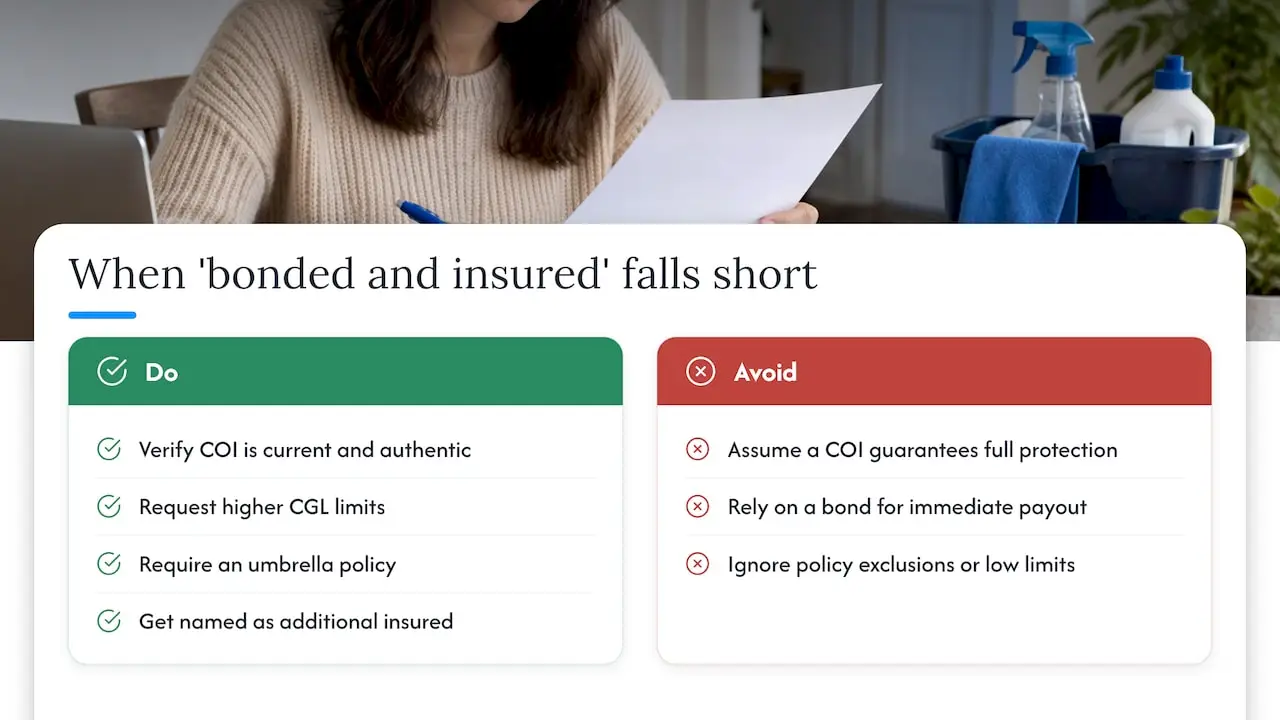
The phrase sounds like a guarantee, but a COI can be out of date or, less often, forged, and low limits or narrow exclusions can leave real gaps even when coverage technically exists. Bonds rarely produce a fast payout: the client may still need to document the loss and wait through an investigation. The SBA notes that a bond guarantees an obligation rather than functioning as an automatic payment to the customer, which is worth remembering before assuming “bonded” means “covered no matter what.” For higher-value homes or commercial contracts, ask for higher CGL limits, an umbrella policy, or a contract clause naming you as additional insured.
How Pure Homes Cleaning approaches bonded and insured hiring standards
Pure Homes Cleaning provides insured staff across its Standard Cleaning, Deep Cleaning, Move In Clean, and Move Out Clean services, built for households that want documentation without chasing it down after the fact. Online booking can remove the back-and-forth of scheduling calls, and clients may request proof of coverage as part of the booking conversation rather than after a problem occurs. Pairing insured staff with clear service scopes can give homeowners a straightforward way to compare what they’re being promised against what they’re paying for.
Why the checklist matters more than the label
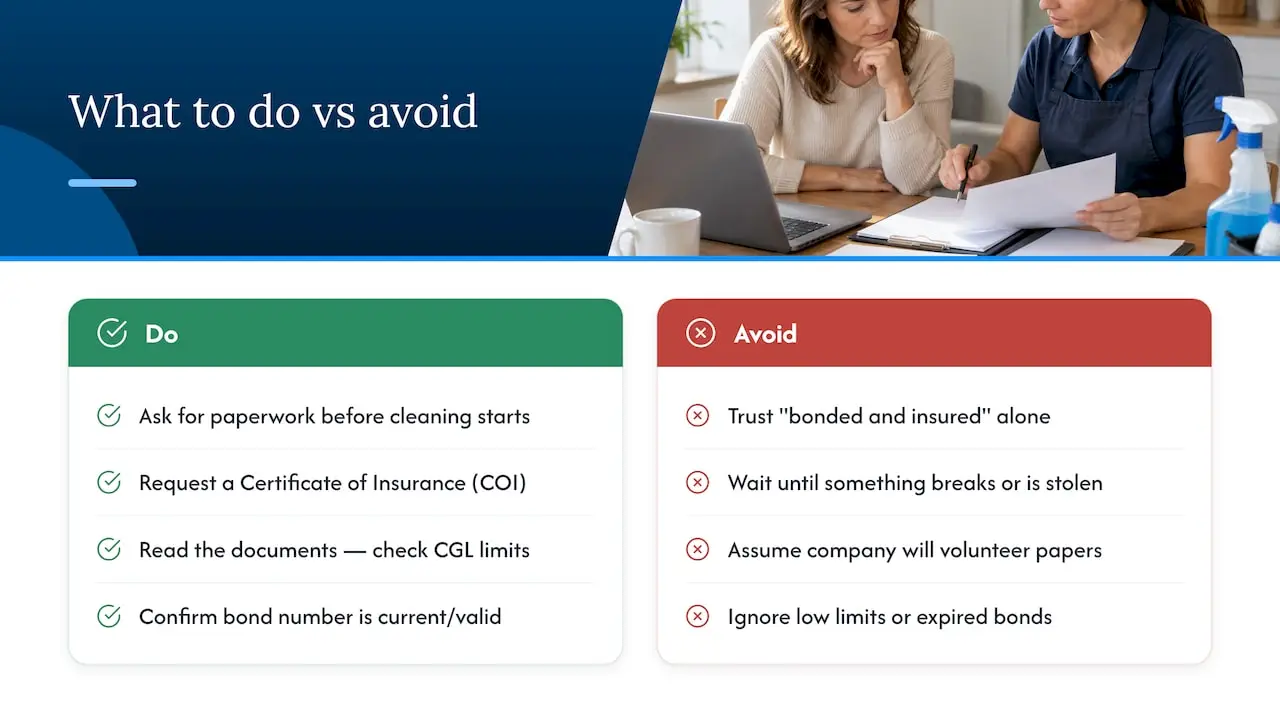
The phrase “bonded and insured” gets treated as a stamp of approval, but the more useful skill is knowing which document answers which question. Insurance protects against accidents; bonds protect against dishonesty or unfinished work. Most homeowners never ask to see either one, and most companies never volunteer them unprompted, which is backwards given how little effort a COI request takes.
The conventional advice to “always hire someone bonded and insured” undersells the real work, which is reading the documents rather than trusting the label. A low CGL limit or an expired bond number defeats the purpose just as thoroughly as having no coverage at all. If you take one thing from this guide, make it this: ask for the paperwork before the cleaning starts, not after something breaks or goes missing. That single habit does more for your protection than any phrase printed on a company’s website.
— Local
Pure Homes Cleaning: bonded and insured cleaners for your home
Pure Homes Cleaning offers insured staff, online booking, and customizable cleaning plans across Standard Cleaning, Deep Cleaning, Move In Clean, and Move Out Clean, so you can request coverage documentation as part of the booking process instead of tracking it down separately.

- Browse Standard Cleaning and Deep Cleaning options to match the service to your home’s needs.
- Book an appointment and ask about certificate of insurance and bond details during scheduling.
- Confirm what supplies or equipment the cleaning team brings so the contract scope is clear from the start.
Where to verify coverage details yourself
- The SBA’s surety bond overview explains bond types and lists a bonding agency directory.
- OSHA’s cleaning industry guidance covers hazard and training expectations for contracted cleaning work.
- The Insurance Information Institute’s CGL explainer breaks down what general liability does and doesn’t cover.
Sources
- Commercial general liability insurance | III
- Surety bonds – Small Business Administration
- Cleaning Industry – Overview | Occupational Safety and Health Administration
FAQ
Should your cleaning person be bonded and insured?
Yes, especially if you want protection against both accidental damage and employee theft, since insurance and bonding cover different risks. If you have to choose one first, insurance covers the more frequent scenario: accidents and property damage during a cleaning visit.
How much does it cost to get bonded and insured for a cleaning business?
Costs depend on the business’s size, location, and the specific coverage and bond types chosen, so these vary widely with no single published figure. The SBA recommends comparing quotes from licensed agents to find pricing that matches the actual risk profile of the work.
What does it mean if a cleaning company is bonded?
It means a surety has guaranteed the company will meet a specific obligation, such as not stealing from a client’s home or finishing a contracted job. If the company fails, the surety pays the client and then typically seeks repayment from the company, according to SBA guidance.
Is it better to be bonded or insured?
Neither replaces the other, since bonds guarantee specific obligations like honesty or contract completion, while insurance pays for accidental damage or injury. Most contracts and careful homeowners ask for both because each closes a gap the other doesn’t cover.