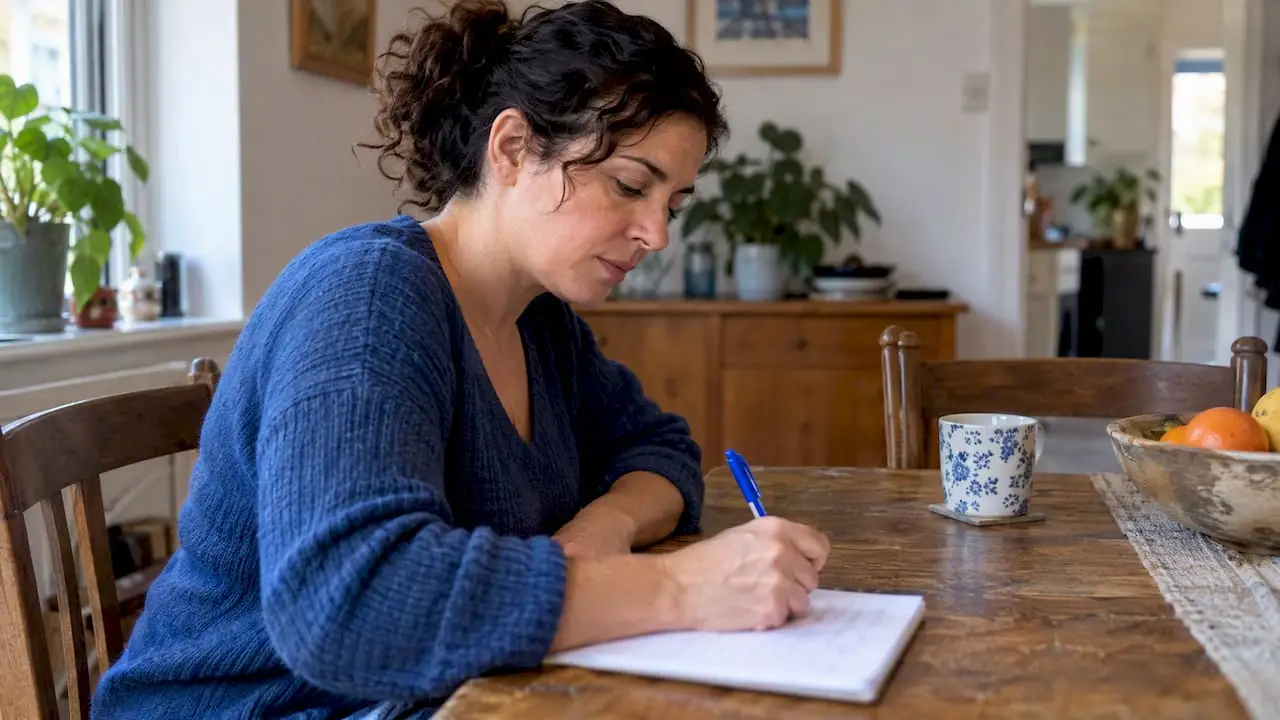
Good cleaning notes are short, labeled and specific: how to get in, what to skip, what to focus on, and what is unsafe or fragile. Put the permanent details in one written home guide, keep one-time requests in a separate short note, and send feedback within a day of the visit. Below you will find what to include, a template you can copy, and example wording for the notes people find hardest to write.
If you are a homeowner in Washington, DC, Northern Virginia or Maryland, this is the page to read before your first visit or after a cleaning that missed the mark.
TL;DR
- Keep permanent instructions (access, pets, surfaces to protect, skip areas) in one home guide, and send one-time requests as separate short notes.
- Use clear labels and keep the whole guide under about two pages, or it will not be read on site.
- Name products to avoid and say why. Never ask a cleaner to mix products, and flag pets clearly.
- Give feedback within 24 hours: what went well, what to change, then thanks.
- Choose a cleaning company that is insured and trained, so you are not the only safeguard.
Table of Contents
- Why written notes beat verbal instructions
- Two kinds of notes: the home guide and the visit note
- What to put in your home guide
- A copy-ready template
- One-time visit notes: how to word them
- What to write about disinfecting
- Our perspective: notes are how a good clean stays good
- How to give feedback that improves the next visit
- Notes for special jobs: deep cleans and moves
- Book a clean with notes that get read
- Mistakes that make notes fail
- FAQ
- Sources
Why written notes beat verbal instructions
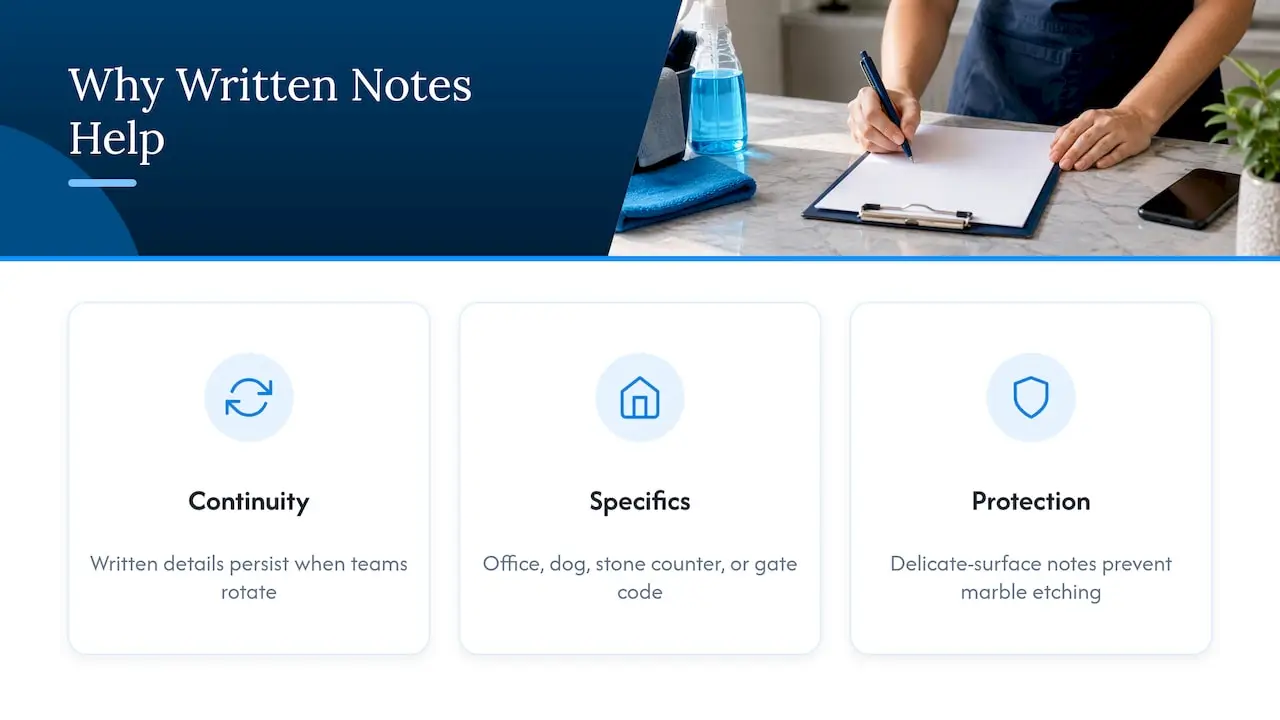
Cleaners rarely see the same home with the same brain twice. Teams rotate, schedules shift, and a request you made out loud in March is gone by June. A written guide stops what one cleaning-operations guide calls the “broken telephone” effect of repeated verbal instructions: the details persist no matter who arrives.
The same source points out that no two properties are alike. One client wants the office skipped, another has a dog that must stay inside, one home has a stone counter that needs special care, and another has a gate code. Those details feel small until they go wrong.
Notes also protect you. A cleaner who is told which surfaces are delicate does not have to guess, and a guess is how a marble countertop gets etched or an alarm gets set off. When a cleaner is trained and insured, written notes are the other half of the safeguard: the company brings the skill, you bring the facts about your home. If you are still choosing a company, our guide on how to verify a cleaner’s insurance in minutes walks through the questions to ask.
Two kinds of notes: the home guide and the visit note
Most confusion comes from mixing two things that behave differently.
The home guide holds what stays true every visit: entry method, parking, pets, rooms to skip, surfaces that need special care, preferred products, and safety items. You write it once and update it when something changes.
The visit note holds what is true this time only: a party last night, a guest arriving at noon, a spill on the rug, an extra focus on the oven.
Keep them apart. Embedding critical security details inside a general checklist is risky, because checklists get reprinted, trimmed and lost. A dedicated profile keeps alarm and access information in one controlled place, as the property-instruction guidance recommends.
When a visit note becomes permanent (“please always do the baseboards in the hallway”), move it into the home guide and say so. Another cleaning operator suggests treating changes as recorded decisions: note the request, the date and who approved it, so a cleaner can tell a lasting update from a one-off.
What to put in your home guide
The guidance on property documentation suggests clear sections for Access, Parking, Pets, Rooms, Surfaces and Safety, and a review at least once a year so nothing goes stale. Keep the whole thing concise, preferably under two pages, so it is actually read in the field. Both points come from the same property-documentation resource.
Access and parking
Say how the cleaner gets in and out: lockbox, door code, doorman, concierge desk, or you at home. Add the alarm procedure and who to call if it trips.
Parking matters in DC more than most places. If your block has Residential Permit Parking, a visitor spot, or a garage that needs a fob, write that down. A cleaner circling the block for 20 minutes starts the visit late and rushed.
For security, share codes through the channel your cleaning company uses for that purpose, not in a note taped to the door or a group text.
Pets
Name each pet, say where they should be during the visit, and note anything the cleaner should know: a door that must stay closed, a cat that bolts, a dog that is anxious around vacuums. If a pet needs to be crated or kept in one room, say so before the day, not as the cleaner arrives.
We cover the prep in detail in Pets During House Cleaning and the day-to-day routine in Cleaning With Pets.
Rooms and priorities
List rooms in the order you care about them. If time runs short, the cleaner should know whether kitchens and bathrooms come first or whether you would rather they finish the bedrooms. Also list skip areas: a home office with loose papers, a nursery where the baby is napping, a basement storage room.
Surfaces and fragile items
This is where notes earn their keep. Include:
- Natural stone (marble, granite, quartzite) and what to use or avoid on it
- Hardwood floors and whether they should be damp-mopped
- Unlacquered brass, copper or other finishes that react to cleaners
- Artwork, collectibles or glass shelves that should not be moved
- Appliances with delicate finishes, such as stainless steel with a specific cleaner
Say what to do instead of just what to avoid. “Dust, do not wipe with a wet cloth” is clearer than “be careful.”
Products and safety
If you have a preferred product, name it and say where it is stored. If you want the cleaning company to use its own supplies, say that instead. Households with allergies, asthma, babies or pets benefit from a clear line here.
The EPA’s Safer Choice label marks products that meet human health and environmental criteria, and the agency says it covers more than 2,000 products, from all-purpose cleaners to pet shampoos. Mentioning the label in your notes is an easy way to describe what you are comfortable with.
A copy-ready template
Paste this into a document, fill it in, and keep it to a page or two.
HOME GUIDE: [Your name, address]
Last updated: [date]

ACCESS
- Entry: [lockbox / code / I'll be home]
- Alarm: [how to disarm, who to call]
- Lock up: [what to do when leaving]

PARKING
- [Where to park, permit or garage details]

PETS
- [Names, where they stay, doors to keep closed]

ROOMS (in priority order)
1. [Kitchen]
2. [Bathrooms]
3. [Bedrooms]
SKIP: [rooms or areas to leave alone]

SURFACES
- [Stone counters: ...]
- [Floors: ...]
- [Do not move: ...]

PRODUCTS
- [Preferred / avoid / allergies]

SAFETY
- [Never mix products. Anything that is off limits.]

CONTACT
- [Best way to reach me, when to call vs. text]
If you want a format that is easy to scan at a glance, property managers use the same principle for inspection prep: a short, concise checklist that can be read in minutes gets followed far more often than a long document.
One-time visit notes: how to word them
A visit note should answer three questions in a few lines: what is different today, what do you want done, and what should be left alone.
Focus request: “This visit, please spend extra time on the kitchen. The oven and the inside of the microwave are the priorities. Everything else can be a standard clean.”
Skip request: “Please skip the guest room today. We have a visitor arriving this evening and the room is set up.”
Spill or stain: “There is a red wine spill on the living room rug, left side by the sofa. It happened last night. I blotted it but did not use any product.” Saying what you already did stops a cleaner from layering chemicals on top of yours.
Schedule change: “I will be on a call in the office from 10 to 11. Please start downstairs and do the office last.”
Notice what these have in common: they are specific, they have a location, and they say what to do. Avoid “make sure everything is perfect” or “you missed things last time.” Neither tells a cleaner what to change.
What to write about disinfecting
Many homeowners write “disinfect everything.” That instruction can backfire. Cleaning removes dirt and germs physically with soap and water. Disinfecting uses chemicals to kill germs, and the CDC advises that you read and follow the label on cleaners and disinfectants, including how long a surface should stay wet and dry before pets or children touch it.
For most weekly cleaning, thorough cleaning is enough. Save disinfecting for specific situations: after illness in the home, for cutting boards that touched raw meat, or for the surfaces people touch constantly. If that is what you want, name the surfaces: “Please disinfect door handles, light switches and the refrigerator handle.” Our high-touch surface protocol lists them, and disinfectant versus cleaner explains why wiping a disinfectant off too soon defeats the purpose.
Safety lines worth writing down
These belong in the Safety section of every home guide:
- Never mix cleaning products. Bleach and ammonia together create a toxic gas, per the safety guidance in the research we reviewed on pet-safe cleaning.
- Pets and drying time. Some products are safe around animals only once fully dry. Say that pets stay out of treated rooms until surfaces are dry.
- Cats and phenol. If you have a cat, ask that products listing phenol in the ingredients not be used. If you are unsure about a product in your home, call your veterinarian.
- Ventilation. Ask for windows to be opened or fans on when stronger products are used. The OSHA cleaning chemicals poster lists coughing, wheezing, headaches and skin rash among the effects of working with cleaning chemicals, and your cleaner is the person breathing them for hours.
For a longer rundown of what is safe around animals, see Pet Safe Cleaning.
Our perspective: notes are how a good clean stays good
We clean homes across Washington, DC, Virginia and Maryland, and the pattern is consistent. The households that get the best result are not the ones with the longest instructions. They are the ones with the clearest ones.
A few things we have learned to ask for:
- Tell us what matters most. Two or three priorities beat a page of equal-weight tasks. Standard cleaning has a defined scope, so if you want something outside it, say so ahead of time. Our standard cleaning checklist shows what is covered, and the standard vs deep cleaning guide helps if you are not sure which service matches your expectations.
- Tell us about pets and sensitivities before the visit. We use eco-friendly products and aim to keep homes safe for families and pets, but we can only fit the visit to your household if we know about it.
- Do the prep that lets the clean go deeper. Clear counters and floors and put away what is fragile. Our 15-minute prep checklist is built for this.
- Update the guide when life changes. A new dog, a new floor, a new baby: the guide should follow.
A note is not a test of the cleaner. It is the handover that lets a trained, insured team do the job the way you would want it done.
— Local
How to give feedback that improves the next visit
Cleaners generally want to know whether they are meeting expectations, and specific requests work better than silence or hints. The advice from Care.com’s guide to communicating with a house cleaner is to treat the relationship as a partnership, and it describes a simple structure: start with what went well, give specific feedback on what needs changing, and finish with thanks. It also suggests giving feedback within about 24 hours, while details are fresh.
Here is how that sounds in practice.
Weak: “The bathroom wasn’t clean.”
Better: “Thank you for the kitchen, it looks great. In the hall bathroom, the shower glass still had water spots on the left side. Could you do the glass with the squeegee next time? Thanks again.”
A few more habits help:
- Send it to the right person. If you book through a company, send feedback to the company so it reaches whoever schedules the team, not just the person who cleaned.
- Attach a photo. One image of the spot saves a paragraph.
- Say if it is a one-time fix or a permanent change. Then update the home guide if it is permanent.
- Raise issues quickly. A problem noted the same day is easier to fix than one you bring up three visits later.
Notes for special jobs: deep cleans and moves
The home guide covers recurring visits. Special jobs need their own notes.
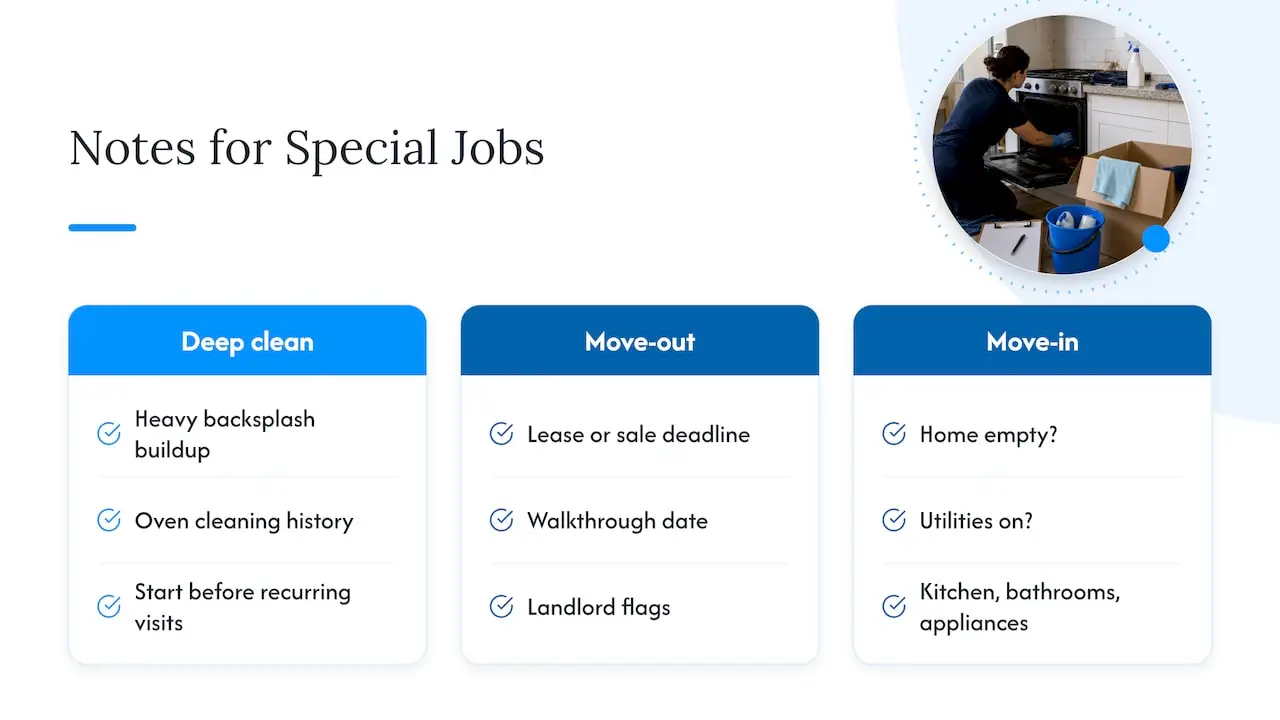
Deep cleaning. If your home has not been professionally cleaned in a while, write what has built up: “Heavy buildup around the kitchen backsplash, the oven has not been cleaned in over a year.” Starting with a deep clean before recurring visits clears years of grime so later standard visits can stay on schedule; we explain the approach in deep clean before recurring visits, and the weekend deep clean checklist covers room by room and appliances.
Move-out cleaning. Note the lease or sale deadline, the walkthrough date, and anything the landlord flagged. If the aim is your deposit, our move-out cleaning checklist and the guidance on security deposit cleaning explain how to schedule. If you are unsure which service fits, compare deep cleaning vs move-out cleaning.
Move-in cleaning. Say whether the home is empty, whether utilities are on, and where you want the focus: kitchen cabinets, bathrooms, inside appliances. The move-in cleaning checklist and apartment move-in cleaning guide help you list priorities.
Book a clean with notes that get read
We offer standard cleaning and deep cleaning for homes and apartments across Washington, DC, Virginia and Maryland, with recurring or one-time scheduling. See our standard and deep cleaning services or, if you are moving, book a move-in or move-out clean. Add your home guide to your booking, and the team that arrives will know your home before they walk in.
Mistakes that make notes fail
- Too long. If it runs past two pages, the important line is buried.
- No labels. A paragraph of text cannot be scanned at the front door.
- Only “don’ts.” Pair each warning with what to do instead.
- Out of date. Review the guide at least once a year and after any renovation, new pet or change of locks.
- Codes in the open. Keep access details out of anywhere a stranger could read them.
- Emotional wording. Describe the result you want, not your frustration. It gets a better response.
FAQ
What should I write in notes for my house cleaner?
Start with access, parking, pets, priority rooms, skip areas, delicate surfaces and product or safety preferences. Keep it labeled and under about two pages. Add a separate short note for anything that applies to only one visit.
How do I give feedback to a cleaner without sounding rude?
Open with something that went well, name one or two specific things to change, and close with thanks. Send it within a day, ideally with a photo. Specific requests are easier to act on than general disappointment.
Should I leave a checklist or a home guide?
Both have a place. A checklist describes the scope of a type of visit, such as standard or deep cleaning. A home guide covers what is unique about your property and does not change from visit to visit. Keep the two separate so permanent details do not get lost in a task list.
Is it okay to tell my cleaner which products to use?
Yes, and it is helpful if you have allergies, pets or sensitive surfaces. Name the product or the label you prefer, and say where it is kept. Do not ask anyone to mix products, and check the label for drying times if animals are in the home.
Sources
- How to Document Cleaning Instructions for Each Property
- How to Record Cleaning Change Decisions Without Confusing the Current Job
- 5 tips for getting the service you want from your house cleaner (Care.com)
- About Cleaning and Disinfecting Pet Supplies (CDC)
- Safer Choice fact sheet (EPA)
- Cleaning Chemicals and Your Health (OSHA)