

To reschedule a cleaning online, open your booking confirmation or the company’s booking page, pick a new date, and confirm, ideally at least 24 to 48 hours before your appointment. Do it inside that window and most companies move you at no cost. Do it later and many treat it as a cancellation. This guide covers how it works, what the notice rules usually look like, what the law says, and how to ask politely when plans change.
TL;DR
- Reschedule as early as you can. Many cleaning companies use a 24 to 48 hour notice window, and moves inside it are often billed like cancellations.
- Use the online link, text or portal first. It leaves a written record and works at any hour.
- Read the policy before you pay. The FTC says material terms such as cancellation deadlines and fees must be disclosed clearly before you complete an online booking.
- Offer two or three alternate dates in your message. It makes the change easy to accept.
- If a late change is unavoidable, ask. Companies often have some flexibility, but never assume it.
Table of Contents
- How to reschedule a cleaning online, step by step
- Notice windows and fees: what is normal
- What the law says about changing or cancelling a booking
- Etiquette: how to reschedule without souring the relationship
- Before you book: make future changes painless
- Special cases that need extra care
- Our perspective on rescheduling
- Ready to book or change a cleaning?
- FAQ
- Sources
How to reschedule a cleaning online, step by step
The exact buttons differ by company, but the process is nearly always the same.
- Find your confirmation. Search your email or texts for the booking confirmation. It usually holds a manage-booking link, a customer portal login, or a reply-by-text option.
- Check the notice window. Before you click anything, look at the time left until your appointment and at the cutoff in the policy. This decides whether the move is free.
- Choose a new slot. Online systems show live availability. Pick the closest date that truly works for you, because every extra change is another chance for a fee.
- Confirm and save the new confirmation. You should receive an email or text with the updated date. If you don’t within a few minutes, assume it did not go through and contact the company.
- Handle access details. If you gave a door code, a key arrangement or pet instructions, confirm they still apply for the new day.
If you booked recurring service, ask whether you are moving one visit or the whole schedule. A one-time shift and a permanent change to your weekly or biweekly slot are different requests.
What if there is no reschedule button?
Some smaller companies still handle changes by phone or by replying to a message. That is fine, but follow up in writing. A short text or email such as “Confirming that my Thursday 10 a.m. cleaning moved to Saturday at 10 a.m.” protects both sides if a mix-up happens.
There is a reason online options matter. Industry commentary notes that letting clients reschedule through text or an online portal at any hour reduces the friction that leads to full cancellations. Tools such as Square Assistant let a business offer exactly that, with clients confirming, cancelling or rescheduling by text around the clock. When a company offers it, use it.
Notice windows and fees: what is normal
There is no national standard, so your booking terms rule. Still, patterns are consistent enough to plan around.
| Situation | What commonly happens |
|---|---|
| Reschedule outside the notice window (often 24 to 48 hours) | Free, sometimes limited to one free move per billing cycle |
| Reschedule inside the window | Often charged as a late cancellation |
| Standard cleaning, late change | Fees commonly run $50 to $75 |
| Deep or move-out cleaning, late change | Can reach up to 50% of the service price |
| No-show or lockout (cleaner arrives, cannot get in) | Frequently the full session cost |
These are industry patterns, not a promise about any one company. Deep cleans and move-outs cost more to hold because they book larger blocks of a team’s day. That is why the fee scales up for them.
Two habits keep you out of fee territory. First, treat the notice window as a hard deadline, not a suggestion. Second, rebook rather than skip. A moved appointment is almost always easier on everyone than a cancelled one.
Lockouts are the costliest mistake
A lockout is not a reschedule. If the crew arrives and cannot enter, labor has already been dispatched, and many companies charge automatically when the window closes. If you realize the morning of that nobody will be home and you cannot leave a key or code, message the company immediately rather than hoping.
What the law says about changing or cancelling a booking
People often assume a cleaning booking can be undone freely for a few days. Usually it cannot.
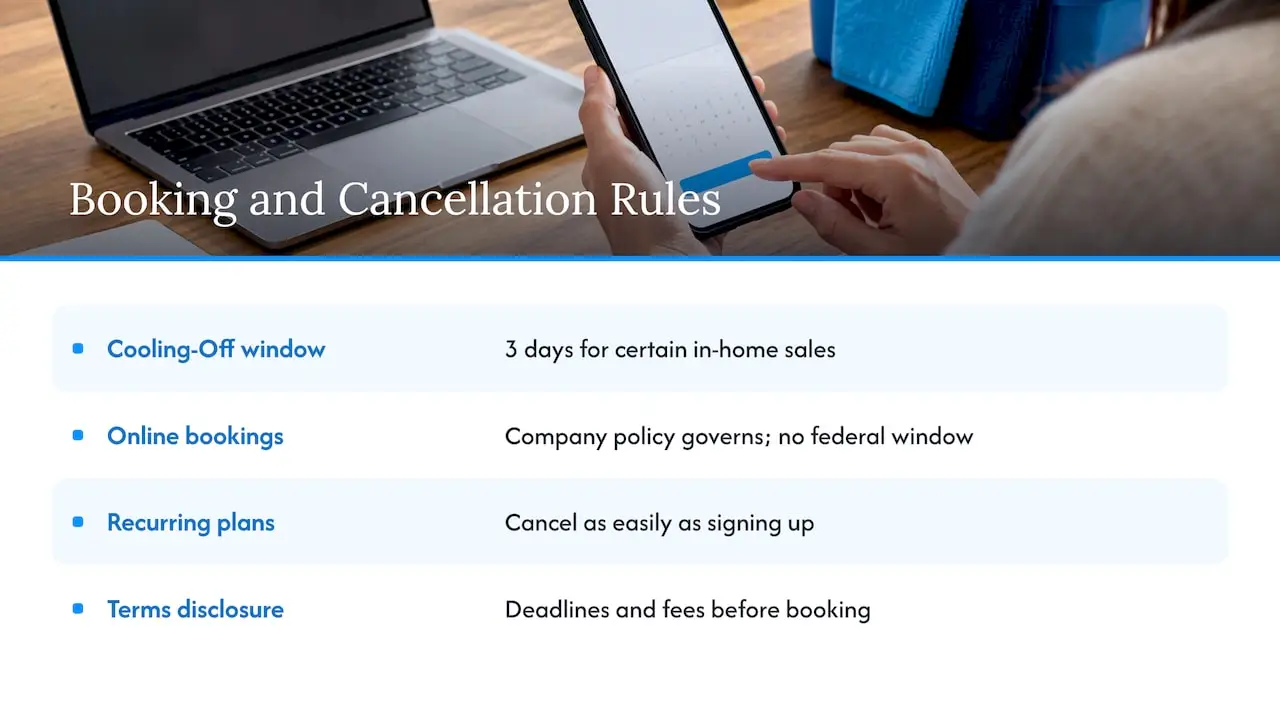
The FTC’s Cooling-Off Rule gives a three-day window to cancel certain sales made at your home or at a seller’s temporary location. It does not cover services booked online or by phone, or at a seller’s permanent place of business. So if you booked a cleaning through a website, the company’s own policy is what governs, not a federal grace period.
What the FTC does address is recurring plans. Its amended Negative Option Rule, described in the agency’s Click to Cancel guidance, says cancelling a recurring service should be as easy as signing up. If you joined online, you should be able to leave online or by phone. The same guidance says businesses must clearly disclose material terms, including cancellation deadlines and fees, before you finish booking. Rules and their effective dates can change, so check the FTC page if a specific dispute depends on it. For a legal question about a contract, a consumer protection office in your state or an attorney is the right person to ask.
The practical takeaway: before you pay, find the cancellation and rescheduling terms. If you cannot find them, ask in writing. A company that is clear up front rarely surprises you later.
Etiquette: how to reschedule without souring the relationship
Rescheduling is normal. Cleaners plan their routes around your slot, though, so how you do it matters.
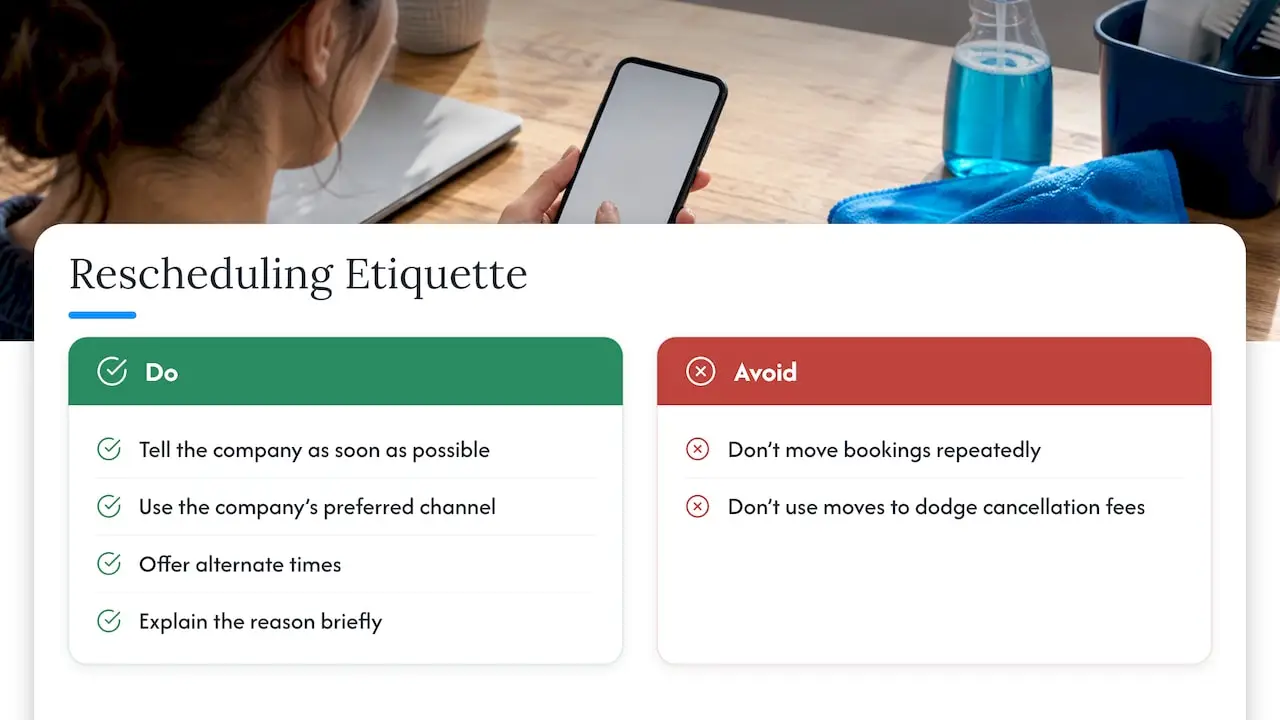
Tell them as soon as you know. A week’s notice and a day’s notice feel very different on the other end. The moment a conflict appears, move the booking.
Use the channel they prefer. If the company has an online portal, use it. If it asks for a call on same-day changes, call.
Offer options. “I can’t do Tuesday. Would Wednesday morning or Friday afternoon work?” gets a faster yes than an open-ended request.
Be honest about the reason, briefly. You do not owe a story. “Travel plans changed” or “I’m sick and don’t want to expose your team” is plenty. The second one is also considerate: a cleaner working in a home with an ill resident takes on risk.
Do not use rescheduling to dodge a fee-heavy cancellation. Moving a booking again and again is the same as cancelling it, and most policies cap free moves.
Say thank you. A short note appreciating flexibility goes a long way, especially with a team you want to keep for months.
A message you can copy
Hi, this is [Name] at [address]. I need to move my cleaning from [date and time]. Could we do [option 1] or [option 2] instead? I’m giving notice more than [X] hours ahead, so please let me know if any fee applies. Thank you for working with me on this.
We also keep a set of cancellation message templates for homeowners if you need wording for a cancellation, not just a move.
Before you book: make future changes painless
The best time to think about rescheduling is before your first appointment. Ask or check for these five things:
- The notice window, in hours, and whether it counts business hours or clock hours.
- How many free reschedules you get per month or billing cycle.
- Whether you can change online, by text, or only by calling.
- What happens with deep cleans and move-outs, which often have stricter terms.
- What counts as a lockout, and how to give access.
If you are choosing between service types, it also helps to know which visit you actually need. Our guide to standard versus deep cleaning explains the difference, and the recurring cleaning plan guide helps you pick a frequency you can keep. A schedule that fits your real week is the best way to avoid needing to reschedule at all.
Special cases that need extra care
Move-out and move-in cleans
These are tied to a lease end, a key handoff or a closing date, so the room to move is small. If your move date shifts, tell the company the moment you know. A move-out clean is usually timed for after your belongings are out and before a landlord inspection or walkthrough. Our guide to move-out cleaning for your security deposit suggests booking 48 to 72 hours ahead in DC, Maryland and Virginia, which also leaves a buffer if something has to slide by a day.
Deep cleans before recurring service
A first deep clean sets the baseline for everything after. Pushing it back pushes back the start of your recurring plan. If you have to move it, rebook promptly and keep the recurring schedule on track. See why a deep clean before recurring visits makes later visits easier.
Recurring visits on holidays or during travel
For a one-off skip, ask to move that single visit to another day that week rather than cancelling. Some companies allow a pause. Others bill the skipped visit. Check before you assume.
Same-day changes
If you are inside the window, call or text rather than relying only on the online form. A person can sometimes find a fix that a portal cannot, and you can ask about the fee politely. Do not count on a waiver.
Our perspective on rescheduling
We serve busy households across Washington, DC, Virginia and Maryland, and we know that a schedule rarely survives a whole month untouched. Kids get sick, work trips appear, a closing date moves. Our approach is built on flexible scheduling for recurring and one-time cleans, so changes are part of the service rather than a problem.
Here is what we believe makes rescheduling work, for any company and any customer:
- Clear terms before you pay. You should not have to hunt for the policy.
- Easy online changes. If booking took two minutes online, changing it should too.
- Early notice as a courtesy. Our teams plan routes around your slot. The earlier we know, the more likely we can offer a new time that suits you.
- A written record. Whatever channel you use, keep the confirmation.
We use eco-friendly products that are safe for families and pets, and our staff are trained and insured. That means a reschedule is never about us cutting corners. It is about finding a time that is right for your home. If your plans shift, tell us as early as you can and we will work with you.
— Local
Ready to book or change a cleaning?
If you are in DC, Virginia or Maryland and want a cleaning you can adjust when life gets busy, you can book house cleaning online in a few minutes. Our cleaning services page covers standard and deep cleaning, and move-in and move-out cleans are available through the booking page. Pricing is not published on our site, so you will see your details when you book.
FAQ
How far ahead should I reschedule a cleaning?
As early as possible, and no later than the company’s notice window. Many companies use 24 to 48 hours. Check your own booking terms, since windows vary and deep cleans may need more notice.
Will I be charged to reschedule?
Outside the notice window, usually not, though some companies cap free moves at one per billing cycle. Inside the window, the change is often treated as a cancellation with a fee. Read the policy before you pay.
Is there a legal right to cancel a cleaning booking within a few days?
Not for most online bookings. The FTC’s Cooling-Off Rule does not apply to services booked online, by phone or at a seller’s permanent place of business. Your agreement with the company sets the terms, so for a specific dispute, contact your state consumer protection office.
What is polite when I have to reschedule at the last minute?
Contact the company right away by the fastest channel, give a short honest reason, and offer two or three new dates. Ask about any fee rather than assuming it is waived. Thank them for the flexibility.
Can I cancel a recurring cleaning plan as easily as I signed up?
The FTC’s Click to Cancel guidance says cancelling recurring services should be as easy as joining, including online or by phone if that is how you signed up. Check your agreement for notice requirements.
Sources
- Cancellation and Rescheduling Policies for Maid Services
- Click to Cancel: The FTC’s amended Negative Option Rule and what it means for your business
- Buyer’s Remorse: The FTC’s Cooling-Off Rule May Help
- Schedule, Cancel & Re-Book Appointments Via Text Message | Square Assistant