
Clean from the top down and from the back of the home to the front. Do the kitchen and bathrooms early, because they take the longest and need the most care. Leave the floors for last, after the movers and every box have gone through the doors. That order works whether you are leaving a home or about to fill an empty one. It stops you cleaning anything twice.
The details change with your situation. An empty home before move-in is easy to clean, because nothing is in the way. A home you are leaving is harder: you clean around boxes and furniture while the movers still need the floors. This guide covers both, with timing, room-by-room order, supplies and a plan for homes with kids and pets.
TL;DR
- Work top to bottom in every room: ceiling fans and vents first, then shelves and surfaces, then floors.
- Start with the kitchen and bathrooms (or the bathroom you will use during the day), then move to the other rooms. Mop and vacuum last.
- For a move-in clean, book it after closing and inspection but before furniture arrives. Avoid cleaning and moving on the same day if you can.
- For a move-out clean, do the rooms you use least first, and leave high-traffic floors until the movers have carried everything out.
- Keep children and pets away from wet floors and cleaning products until the home has aired out.
Table of Contents
- The order in one pass
- Why top to bottom, and why floors last
- Moving out: the order when you still have belongings
- Moving in: the order before furniture arrives
- Timing: where cleaning fits around keys, inspection and movers
- Supplies, and keeping them safe
- Cleaning order when kids and pets are in the picture
- What we recommend
- Let us handle the order for you
- FAQ
- Sources
The order in one pass
If you only want the sequence, here it is. The sections below explain why each step sits where it does.
- Take out trash and clear the space. Remove leftover items, boxes and debris so you can reach every surface.
- Dust high, then work down. Ceiling fans, light fixtures, vents, tops of cabinets, shelves, window sills and baseboards.
- Kitchen. Oven, range, hood, microwave, refrigerator, cabinets, counters, sink, dishwasher.
- Bathrooms. Toilet, tub and shower, fixtures, grout, vanity, mirrors.
- Bedrooms, living areas and closets. Wipe doors, door frames, switches and shelving.
- Windows and glass once the dusty work is done.
- Floors, last. Vacuum carpets, then sweep and mop hard floors, working toward the exit.
- Final walk-through. Check corners, cabinets and closets, and take photos if you are leaving a rental.
The logic is simple. Dust and debris fall as you clean, so anything you do high up makes a mess below it. Floors collect all of that mess, so they come last. Cleaning them earlier means doing them again.
Why top to bottom, and why floors last
A cleaning business owner quoted by Care.com in its move-out checklist advises cleaning from the top down so you do not have to redo areas you have already finished. The Canadian Association of Movers gives the same direction once you have the keys: go room by room, scrub top to bottom, clean the inside and outside of appliances, and save floors for last.
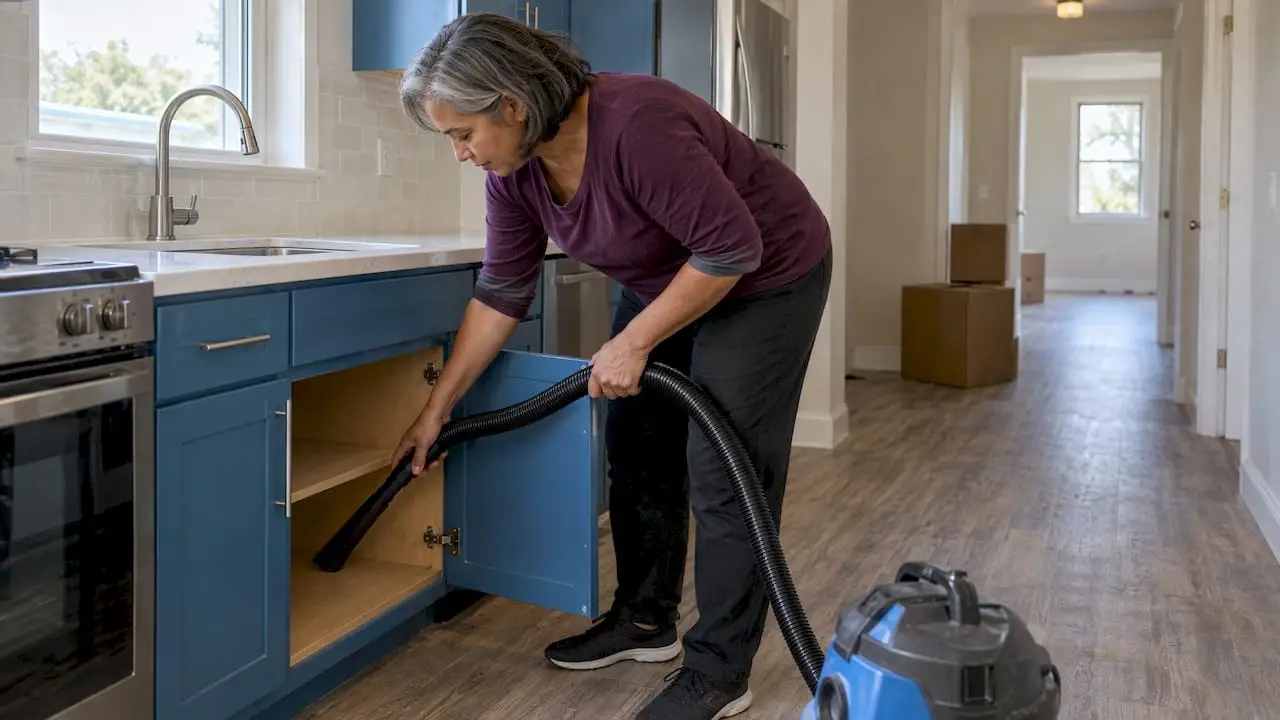
One practical tip from the same Care.com checklist: vacuum drawers, the oven, cabinets and the bathtub first with a hose attachment. That way you are not pushing hair, dirt and dust around while you wipe.
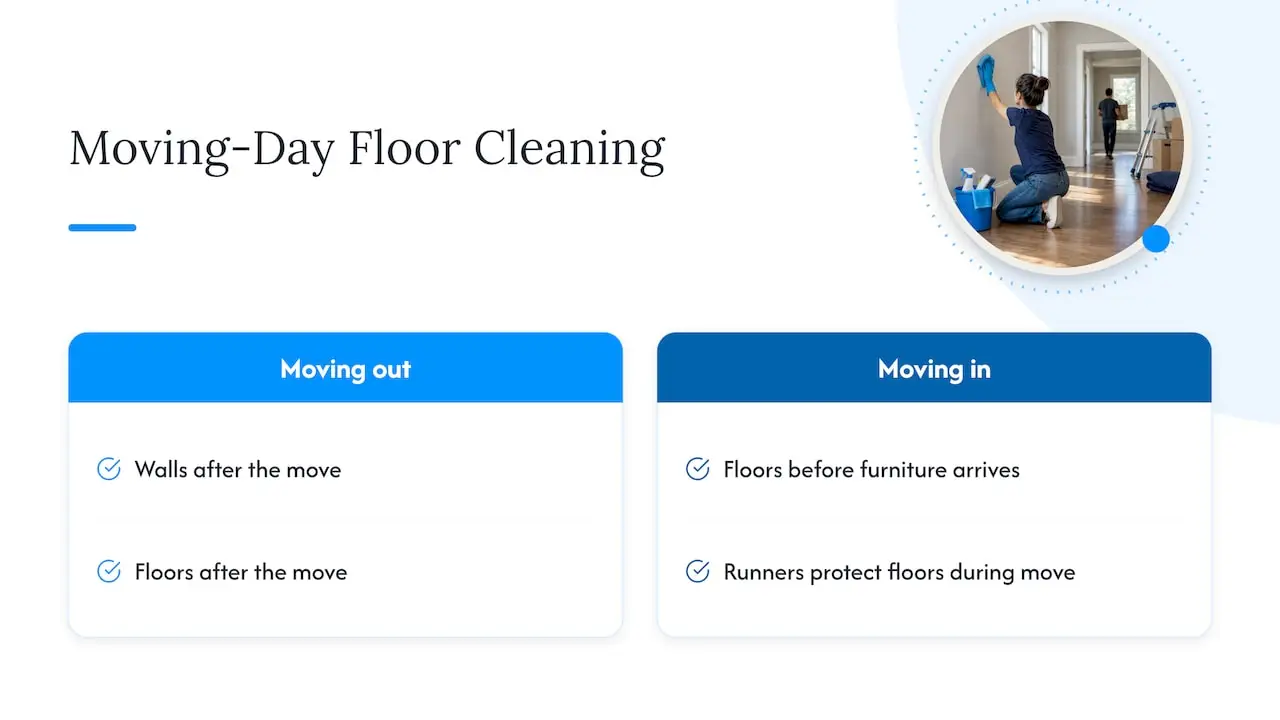
Floors are the one place where moving day changes the rule. The movers will track dirt, drag boxes and scuff edges. If you are leaving a home, the Canadian Association of Movers recommends not cleaning walls and floors until after the move. If you are arriving, clean floors before the furniture comes in, because you will never get easier access to them again. Then protect them with runners or floor coverings on the day.
Moving out: the order when you still have belongings
A move-out clean is mostly a puzzle of timing. You cannot finish a room until everything is out of it, but you also cannot do it all in the last hour.
Before moving day
One moving company’s guide, FastPAC Forwarding, suggests cleaning one room at a time once most of its contents are packed. It starts with the rooms you use least and works toward the kitchen, bathroom and bedroom, which you need until the end. A spare room, a guest bathroom, a hall closet and a storage area are good places to start. The same guide says to leave high-traffic floors until the movers have finished carrying everything out.
That gives you a workable sequence:
- A few days out: clean empty closets, spare rooms, shelves and the inside of cabinets you have already emptied.
- A day or two out: do the oven. Many oven cleaners work best when they have time to sit, which is why Bunklow’s move-out guide recommends doing it early. It also lists the spots people miss most: inside the oven and refrigerator, cabinet interiors, window tracks, baseboards and the base of the toilet.
- The night before: pack the kitchen and bathroom last, keeping a basic cleaning kit out.
On moving day, after the movers leave
- Final dusting of high areas, vents and light fixtures in rooms that are now empty.
- Wipe the refrigerator, counters and sink in the kitchen.
- Clean the toilet, tub, sink and mirror in the bathroom.
- Vacuum carpets, sweep and mop hard floors, ending at the door you will leave through.
- Walk every room with cabinets, closets and appliances open.
If you are renting, this is the clean that decides your deposit. Our move out cleaning checklist walks through what landlords tend to look for, and our page on security deposit cleaning in DC, MD and VA explains how far ahead to book.
Moving in: the order before furniture arrives
Move-in cleaning is the easy version of the same method, because the home is empty. You reach every cabinet, every corner and every floor. Care.com’s new-home checklist says to start in the kitchen, since it is the most labor-intensive room with the highest hygiene standard. Then do the bathroom and other rooms, with floors last.
The Spruce, in its guide How to Clean a New Home, starts with the bathrooms. The reason is practical: you are likely to need one while you work. Both sources agree on the principle that matters most: start at the top of each space and finish at the floor.
So which first, kitchen or bathroom? A professional organizer interviewed by Care.com called them the heartbeat of a home and said you want a clean kitchen for your first meal and a clean bathroom the first time you need it. If you are doing the work yourself, a good compromise is to clean one bathroom first so you have a usable one, then do the kitchen next, then everything else.
Kitchen order
- Pull out and vacuum under and behind appliances where you can.
- Degrease and wipe the oven and range, then the hood and fan.
- Microwave and refrigerator, inside and out.
- Cabinets and drawers, inside and out.
- Counters, then the sink, then the dishwasher.
- Floor, last.
This follows the sequence Care.com gives for kitchens: degrease the oven and range, clean the hood fans, microwave and refrigerator, then cabinets and counters, and finish by sanitizing the sink and cleaning the dishwasher.
Bathroom order
- Soak shower heads. Southern Living, in its list of places to deep clean before moving in, suggests a 50-50 mix of water and white vinegar.
- Toilet, including around the sides of the tank and the base.
- Shower and tub, fixtures and grout.
- Vanity and mirrors.
- Floor, last.
The same list covers door knobs, light switches and air vents, which are easy to forget. Vents belong in the high-first part of your order, so dust and debris do not land on cleaned surfaces. For carpets, it recommends steam cleaning, and mopping for tile and laminate floors.
For a full room-by-room version with safety checks, see our move-in cleaning checklist. Apartment renters can use the shorter apartment move-in cleaning guide.
Timing: where cleaning fits around keys, inspection and movers
The best cleaning order is useless if the clean happens at the wrong time. For move-in, the sequence that works is:
- Closing and key pickup.
- Condition walkthrough and inspection. If the inspection finds problems, you want repairs done before you clean, or you will clean twice.
- Cleaning.
- Furniture and boxes arrive.
BookMyMove, a moving resource, advises scheduling a move-in clean after you have legal access and have done an initial condition walkthrough, and before the movers unload. It suggests reserving one day between closing or key pickup and move-in, or two days for a larger property, heavy buildup or professional carpet work.
A co-owner of a moving company told Care.com not to clean and move in on the same day. The move should be your main focus on that day, and juggling two services on a tight schedule adds stress. If you have no choice, the same BookMyMove page says to schedule the cleaners first and leave a buffer for drying, inspection and corrections. It also says to confirm where the crew can park, who provides keys or codes, whether an elevator must be reserved, and when utilities become active.
For a move-out clean, the usual pattern is to clean once the home is empty, then do your final walk-through before handing back keys. Our moving cleaning timeline lays out what to do in the weeks before, the day before and on the day. If you are not sure which type of clean you need, deep cleaning versus move out cleaning explains the difference. In the DC area, moves cluster around month ends and summer, so book early. Our guide to the best time to book cleaners covers lead times.
Supplies, and keeping them safe
You do not need a cabinet full of products. Care.com’s list covers an all-purpose cleaner, a separate disinfectant, glass cleaner, oven degreaser and toilet bowl cleaner. It adds baking soda and white vinegar, microfiber cloths, sponges and brushes, a broom and dustpan, a mop and bucket, a HEPA vacuum, gloves, trash bags and a new HVAC filter if applicable. The Spruce adds a step ladder, a duster and a toilet brush, which matter for the high-first part of the order.
Some safety basics:
- Use one product at a time and never mix cleaning products, especially anything containing bleach. Bunklow’s guide gives the same warning, along with following the label and keeping air moving.
- Open windows while you work and until surfaces are dry.
- Wear gloves and keep products out of reach of children and pets.
- After a move, many people are also refreshing the home. A guide to non-toxic home decor is a useful companion for choosing safer items once the cleaning is done.
If you want a gentler approach for the household, our page on green cleaning versus regular cleaning explains how we think about it.
Cleaning order when kids and pets are in the picture
Moving day is chaotic for children and animals. The order of cleaning changes slightly, mostly because of where they will be.
- Pets: 4US Moving advises keeping pets out of the main moving zone, in one closed room with a “Do not open” note, or with a friend, relative or sitter. Britannia Cestrian Removals suggests a safe room with water, food, a bed and toys. The room you choose should be the last one you clean and the first one you reopen.
- Children: the best option is to have them stay with relatives, friends or a sitter during the heaviest part of the move. If that is not possible, create a safe corner away from heavy lifting.
- Order: the same Britannia Cestrian guide suggests working back to front: start with rooms you barely use and leave the kitchen and the children’s bedrooms until the very end. Those rooms hold the day together.
- After cleaning: BookMyMove advises keeping children and pets away from open doors, wet floors, equipment cords and cleaning products until the work is complete and the home has aired out. Plan your floor mopping for when they are out of the way, and let floors dry fully.
That last point is another reason floors come last: they are the one thing that keeps everybody out of a room for a while.
What we recommend
We see the same mistake again and again: people start with the floors because they are the most visible part of a room. Then the dust from the vents and shelves lands on them, and the movers walk over them. The result is a second clean.
Our approach is to work from the top of each room down, do the kitchen and bathrooms with the most care, and finish with the floors. That is the order we recommend to our clients in Washington, DC, Virginia and Maryland. For a move-in, we suggest booking the clean after inspection and before furniture arrives. For a move-out, we suggest an empty home and a final pass after the movers leave.
Our staff are trained and insured, and we use eco-friendly products that are designed to be safe for families and pets. That matters most when you have a small child crawling on a new floor, or a dog who will be sniffing every corner on the first night.
When you book, tell us exactly what you want done. A cleaning company will have its own list, but being specific about the oven, the inside of cabinets or the window tracks leaves no gray areas.
Local
Let us handle the order for you
Moving day is already full. If you would rather not spend it on your knees with a toilet brush, we offer Move In and Move Out cleans for homes and apartments across Washington, DC, Virginia and Maryland. You choose the date, and you can tell us what matters most to you. Our staff are trained and insured, and we use eco-friendly products. You can book a Move In or Move Out clean online, or look at our standard and deep cleaning services if you want a fresh start before settling into a routine.

If you prefer to tidy a little before we arrive, our 15-minute prep checklist shows what to clear.
FAQ
Should I clean before or after the movers come?
Both, in different ways. Clean empty rooms, closets and cabinets before the movers arrive, and leave floors and the final pass until after they leave. For a move-in, clean before the furniture and boxes arrive, since the home will never be easier to reach.
What do I clean first in an empty home?
Start high: vents, fans, light fixtures and shelves. Then move to the kitchen and bathrooms, which need the most attention, and finish with floors. If you will be using a bathroom during the work, clean that one first.
Can I clean and move in on the same day?
It is possible, but it is not ideal. A moving company co-owner quoted by Care.com recommends separate days so the move can be your main focus. If you must do both, schedule the cleaners first and leave time for floors and surfaces to dry before anything is carried in.
How should I clean with kids and pets around?
Set up a closed safe room for pets, and arrange for children to be elsewhere during the heaviest work if you can. Keep them away from wet floors and cleaning products until the home has aired out.
Sources
- Care.com: What should I clean before moving into a new home?
- Care.com: The Ultimate Move-Out Cleaning Checklist
- The Spruce: How to Clean a New Home
- Southern Living: 10 Places To Deep Clean Before You Move A Single Box In
- Canadian Association of Movers: Cleaning for the Big Day
- FastPAC Forwarding: Cleaning Tips Before Moving Day
- BookMyMove: Move-In Cleaning Checklist and Costs