A cleaning company’s star rating tells you very little on its own. What helps is who wrote each review, when, what they actually described, and how the company answered when something went wrong. This guide shows you how to read reviews for a home cleaning service in about 20 minutes, so you can pick a company that fits your household, whether that means recurring visits, a move-out clean, pets or a preference for eco-friendly products.
TL;DR
- Read the newest reviews first. Recent feedback reflects the current staff and management, not the company as it was two years ago.
- One bad review is noise. The same complaint repeated (lateness, surprise charges, poor communication, unfinished work) is a pattern.
- Check at least two or three platforms, because a company can look great on one site and draw complaints on another.
- Filter for your situation: a glowing review about a one-time move-out clean says little about a weekly clean with two dogs.
- Reviews narrow your list. A short call and a trial clean make the final decision.
Table of Contents
- Start with who is talking
- What real reviews look like
- Weigh the rating, the count and the dates together
- Read the one-star reviews and the replies
- Compare across platforms
- Match the reviews to your situation
- What reviews can’t tell you
- Our perspective on reviews
- A 20-minute review check you can repeat
- Book a clean with Pure Homes Cleaning
- FAQ
- Sources
Start with who is talking
Before you judge what a review says, ask who is saying it and where. The Federal Trade Commission’s guide to evaluating online reviews tells consumers to consider what they know about the reviewer and the platform, and to look at a variety of sources instead of trusting a single site.
In practice, that means a few quick checks on every platform you use:
- Click the reviewer’s name. A profile with a history of varied reviews (a restaurant, a dentist, a plumber) looks like a real customer. A profile with a single review, posted the day it was created, deserves less weight.
- Look at the dates. The FTC guide points to review timing and sudden bursts as things to check. Twenty five-star reviews in one week, followed by months of silence, is worth a pause.
- Read the reviewer’s other reviews. Someone who gives every business five stars, or every business one star, tells you more about themselves than about the cleaner.
- Don’t trust looks alone. The same guidance cautions that appearances alone can’t reliably identify fake reviews. Perfect grammar doesn’t make a review real, and clumsy writing doesn’t make it fake. Judge the substance.
There is also a legal backdrop worth knowing. The FTC’s rule on consumer reviews and testimonials went into effect on October 21, 2024 and addresses fake or deceptive reviews, with civil penalties available for knowing violations. That is a reason to report reviews that look bought, but it is not a reason to assume every review you read has been screened.
What real reviews look like
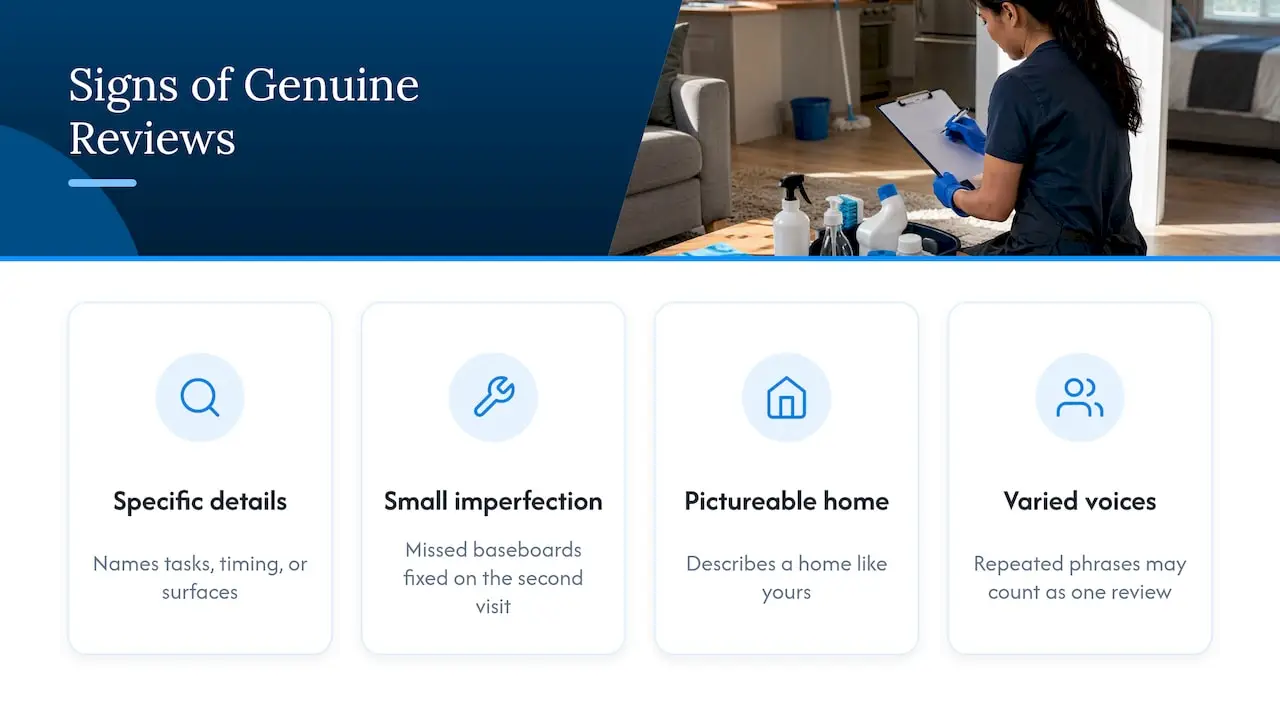
Genuine reviews of a home cleaning service usually share a few traits. They are specific without being a script.
They name details. “The team arrived within the window, did the kitchen and bathrooms first, and found the grease on the range hood without being asked” is more believable than “Amazing service, highly recommend!” Concrete details are harder to fake and more useful to you.
They mention a small imperfection. A reviewer who says the baseboards were missed on the first visit but fixed on the second is showing you how the company handles real life. Honest five-star reviews often include a minor note like this.
They describe a home you can picture. A two-bedroom apartment, a three-story row house, a house with a shedding dog. The closer the description is to your place, the more it tells you.
They vary in length and voice. If a dozen reviews use the same phrases in the same order, treat them as one review.
Weigh the rating, the count and the dates together
A 4.9 from six reviews and a 4.6 from 300 reviews are not comparable. Here is a simple way to think about it.
| What you see | What it can mean | What to do |
|---|---|---|
| High rating, very few reviews | New company, or a small sample | Read every review; ask for references or book a trial |
| High rating, hundreds of reviews, mostly old | Strong past, unknown present | Read only the last six months |
| Slightly lower rating (4.4 to 4.7), many detailed reviews | Normal for a busy company that is honest about feedback | Read the lowest reviews and the replies |
| Perfect 5.0 with generic praise | Possibly curated or incentivized | Look for specifics and check another platform |
| Sharp drop in recent reviews | Staffing or management change | Ask the company directly what changed |
Recency matters most. SafeWise’s July 2026 guide to vetting service workers says recent reviews better reflect current management, staffing and service quality than older ones. Cleaning is a people business, and teams turn over. A review from three years ago describes a team that may no longer exist.
The same guide notes that repeated complaints about lateness, unexpected charges, poor communication or unfinished work carry more weight than one isolated negative review. So sort by lowest rating, read the first ten, and tally the themes. If one problem shows up in four of them, that is your answer. If the complaints are all different and scattered, you are likely looking at ordinary variation.
Read the one-star reviews and the replies
The most useful reviews are often the worst ones, because they show you what happens when something goes wrong. Read them in two passes.
Pass one: what actually happened? Separate facts from feelings. “They never showed up” is a fact. “They were rude” is a feeling that may or may not be fair. Look for complaints about things you can check: missed appointments, charges that differed from the quote, damage, items missing, or a clean that was left unfinished.
Pass two: how did the company respond? A good reply:
- Comes within a few days, not months later.
- Addresses the specific complaint instead of pasting a template.
- Offers a concrete fix, such as a return visit or a refund where warranted.
- Stays calm, even if the reviewer was harsh.
A reply that attacks the customer, claims the reviewer was never a client without checking, or ignores the complaint entirely tells you how a problem in your own home would be handled. No replies at all, across dozens of negative reviews, is a signal too.
Warning signs worth taking seriously
- The same complaint across several reviews and months.
- Price surprises: a quote that grew after the team arrived, or fees nobody explained.
- Frequent cancellations or reschedules by the company, not the customer.
- Different cleaners every visit with no communication about it.
- Complaints about damage or missing items with no real response.
- Reviews that praise the company’s sales call but say little about the actual cleaning.
One caution on that last point: a review that only describes the booking experience is a review of the website, not of the clean.
Compare across platforms
Don’t stop at one site. SafeWise advises comparing feedback across several places, such as Google, Yelp, the Better Business Bureau and local neighborhood groups, because a company may rate well on one site while collecting complaints on another. Each place gives you something different:
- Google reviews are usually the most numerous and recent, and they come with the reviewer’s other activity.
- Yelp tends to filter aggressively, so some legitimate reviews are hidden. Check the “not recommended” section before drawing conclusions.
- BBB shows formal complaints and whether the company resolved them, which is a different lens from star ratings.
- Neighborhood groups and community forums give you candid, local, unpolished opinions. In Washington, DC, Northern Virginia and Maryland, a neighborhood email list or social group can tell you whether a company works well in your kind of housing, such as an older rowhouse, a condo with building access rules, or a large suburban home.
When the platforms agree, you can trust the picture. When they disagree, find out why before you book.
Match the reviews to your situation
A review is only useful if the reviewer’s situation resembles yours. Filter on what matters to you.
Recurring cleaning for a busy household
Look for reviews from customers who have used the service for months. They can tell you whether the same team shows up, whether quality holds after the first visit, and whether scheduling is easy to change. Many companies clean well the first time; consistency across the sixth and twelfth visits is what you are buying. If you are weighing frequencies, our comparison of weekly and biweekly cleaning explains how to trial each.
Deep cleaning
Readers who book a deep clean usually want visible results on the neglected places: inside the oven, behind appliances, grout, baseboards. Look for reviews that name those tasks and the condition of the home before the visit. If you are unsure whether you need a deep clean or a standard visit, see standard versus deep cleaning.
Move-in and move-out cleaning
These reviews should mention empty homes, inside-cabinet and appliance work, and, for renters, whether the clean helped with the security deposit. Be careful here: a review saying “I got my full deposit back” reflects the landlord’s decision as much as the cleaners’ work, so look for descriptions of what was cleaned instead. Timing also matters in tight move windows, so read for whether the team was punctual and finished on schedule. Our move out cleaning checklist shows what a thorough clean should cover, and a make-ready checklist for rentals is a useful way to turn review details into a list of questions about reliability and fit for your unit.
Pets
Search the reviews for “dog,” “cat,” “hair,” and “litter.” You want to see that cleaners handled pet hair on upholstery and floors, respected closed doors and crates, and communicated about anything unusual. Complaints about a team being uncomfortable around animals, or about a pet escaping during a visit, are worth taking seriously.
Eco-friendly products
The phrase “eco-friendly” in a company’s marketing is easy to write. In reviews, look for customers who mention fragrance levels, how the home smelled afterward, and whether a household member with sensitivities had any issues. Then ask the company directly which products it uses and whether it can accommodate your preferences.
What reviews can’t tell you
Reviews are one input. Before you book, verify the things a review rarely shows:
- Insurance and training. Ask whether the company carries insurance and how it trains its staff. Ask what happens if something is damaged.
- Who is coming to your home. Ask whether cleaners are employees of the company and whether they are screened. SafeWise’s vetting guide is a good outline of what to confirm before letting any service worker in.
- What is included. Ask for a written scope of what a standard and a deep clean cover, so you can compare quotes fairly. Our standard cleaning checklist is one example of a scope you can hold a provider to.
- Pricing and cancellation terms. Ask how the price is set, what triggers extra charges and what the cancellation policy is. Unexpected charges are one of the most common complaint themes, so get the answer in writing.
- What happens if you’re unhappy. Ask whether they will return to fix a missed area and how quickly you must report it.
We lay out the questions and what good answers sound like in 6 questions to ask a cleaning service. If you’re also considering hiring someone directly, independent cleaner versus company covers the trade-offs.
Our perspective on reviews
We serve homes in Washington, DC, Virginia and Maryland, and we read reviews the same way we’d advise a neighbor to read them. We care more about the pattern than the average. A company that shows up on time, communicates when something changes and fixes a missed spot quickly will earn trust over a dozen visits, and that pattern appears in reviews long before it appears in a star rating.
We also think reviews should be paired with a low-stakes test. That is why we encourage new customers to book one trial clean first before committing to a schedule. One visit shows you more about punctuality, care and communication than any review can. For many homes, a deep clean before starting recurring visits also makes the recurring clean easier to judge, since you start from a clean baseline. We explain that approach in deep cleaning before recurring visits.
Our approach rests on reliability, trained and insured staff, eco-friendly products that are safe for families and pets, and flexible scheduling for recurring or one-time cleans. Hold any company, including us, to those kinds of specifics.
— Local
A 20-minute review check you can repeat
Use this routine for each company on your shortlist.
- Minutes 1 to 5: Google. Sort by newest. Read the last 15 reviews. Note the dates, the details and whether the company replies.
- Minutes 6 to 10: the low end. Sort by lowest. Tally repeated complaints. Read the replies.
- Minutes 11 to 15: a second platform. Check Yelp or BBB for complaints and how they were resolved. Compare with Google.
- Minutes 16 to 18: your situation. Search the reviews for your keywords: pets, move out, deep clean, eco-friendly, apartment, kids.
- Minutes 19 to 20: write your questions. Turn anything unclear into a question for the company: insurance, scope, pricing, cancellation.
Then call or message the two best candidates. How quickly and clearly they answer is its own review.
Book a clean with Pure Homes Cleaning
If you live in Washington, DC, Virginia or Maryland and want to see how we work, start with our standard and deep cleaning services. Planning a move? You can request a move-in or move-out clean through our booking page. Tell us about your home, your pets and any product preferences, and we will build the plan around them.
FAQ
How many reviews should a cleaning service have?
There is no magic number. A company with 30 detailed, recent reviews can be a better bet than one with 500 old, generic ones. Focus on how many reviews are from the last six to twelve months and whether they describe real visits.
Are five-star reviews always trustworthy?
No. The FTC’s guidance says you can’t spot fake reviews by appearance alone, so look at the reviewer’s history, the timing of reviews and the level of detail. A mix of ratings with specific, believable comments is a better sign than a wall of identical praise.
Should I avoid a company with a few bad reviews?
Not necessarily. Every busy company gets some. What matters is whether the same complaint repeats and how the company responds. A prompt, specific reply that offers a fix is often a better sign than no negative reviews at all.
How do I find reviews relevant to a move-out clean?
Search the review text for “move out,” “move in,” “empty,” “deposit” and “landlord.” Read for descriptions of the tasks completed and the timing, instead of relying on claims about deposits, which depend on the landlord’s judgment.
Do reviews replace a trial clean?
No. Reviews help you build a shortlist and ask better questions. A single trial visit lets you see punctuality, quality and communication in your own home before you commit to a schedule.
Sources
- How To Evaluate Online Reviews, FTC Consumer Advice
- How to Vet a Contractor or Service Worker Before Letting Them In Your Home, SafeWise
- The Consumer Reviews and Testimonials Rule: Questions and Answers, FTC