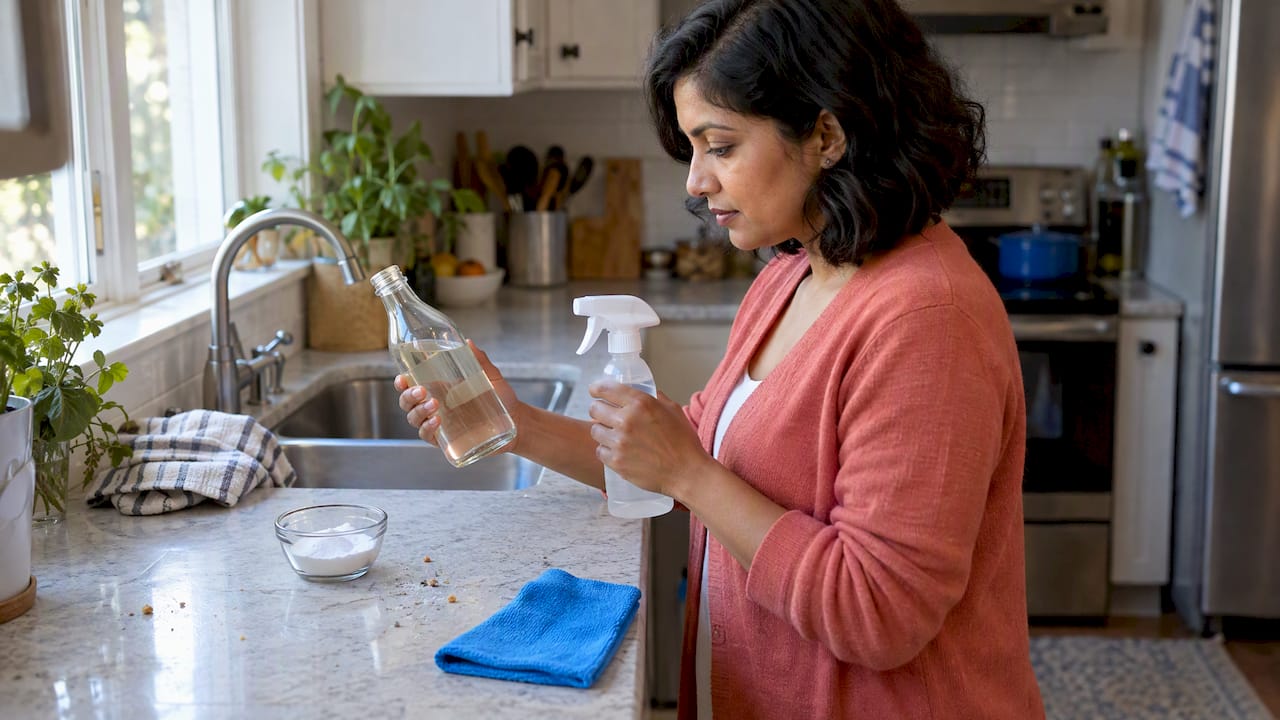
No cleaner is chemical-free. Water, vinegar, baking soda and lemon juice are all chemicals, and so is everything in a plant-based spray. The real questions are whether a product cleans the soil you have, whether it kills germs when that matters, and whether it is safe around your kids and pets. Natural cleaners do some jobs very well and some jobs poorly. Below we sort the common myths from the facts, so you can stock your cabinet with products that fit the job.
TL;DR
- “Chemical-free” is a marketing phrase, not a chemistry fact. Every cleaner, including homemade ones, is made of chemicals.
- Natural cleaners can lift everyday dirt, especially with some elbow grease, but most homemade mixes do not disinfect.
- “Natural” does not guarantee “safe” or “low-emission”. Some fragranced green products release more airborne compounds than regular ones.
- For most surfaces, soap and water plus a little effort is enough. Disinfect only when you need to, and follow the label.
- Never mix cleaning products, and keep all of them out of reach of children and pets.
Table of Contents
- Myth 1: “Chemical-free” cleaning exists
- Myth 2: Natural cleaners don’t work
- Cleaning versus disinfecting: the distinction most myths skip
- Myth 3: Vinegar and baking soda make a super cleaner
- Myth 4: Natural means safer for your air and your family
- Myth 5: If it’s plant-based, organic or has a short ingredient list, it’s safe
- Pets and kids: where the myths cost the most
- A sensible “gentle but effective” kit
- Our perspective: judge a cleaner by the job, not the label
- Let us handle the cleaning, and the product questions
- FAQ
- Sources
Myth 1: “Chemical-free” cleaning exists
It doesn’t. The American Cleaning Institute states plainly that all cleaners, including mix-at-home recipes, are made of chemicals, whether those chemicals were extracted from plants or synthesized in a lab. Vinegar is acetic acid in water. Baking soda is sodium bicarbonate. Even tap water is a chemical compound.
The word “natural” is slippery for the same reason. The same organization notes that surfactant raw materials, whether petrochemical or oleochemical, have to be chemically converted before they become useful cleaning ingredients. A plant-derived ingredient has still been processed. And it advises shoppers not to assume a product is safer or works better because the label says “natural”.
What people usually mean by “chemical-free” is something more reasonable: fewer harsh ingredients, less strong fragrance, and nothing I’d worry about with a toddler on the floor. That is a fair goal. It just needs a better name, such as “gentler” or “lower-hazard”, and it needs to be checked against how well the product works.
Myth 2: Natural cleaners don’t work
This is the opposite myth, and it is just as wrong. Many of the pages that rank for this topic spend their time defending natural products, and many others dismiss them. The evidence sits in between.
What the research shows:
- Soap and water do a lot. The Washington State Department of Health says thorough cleaning with plain soap and water is often all that is needed. Most of what we clean in a home (dust, grease, spills, fingerprints) is soil, not a germ problem. Removing soil is what soap is for.
- Effort matters. A 1994 study of six alternative hard-surface cleaners found that alternative cleaners may remove soil if users are willing to work harder. As a group, though, they were less effective than commercial cleaners at removing soil and reducing microbes. That study is old, and formulas have changed, but the basic trade-off still shows up in practice: gentler products often ask for more scrubbing or more dwell time.
- Freshness matters for DIY. A 2015 study of three home products found an environmentally preferable product was an effective alternative to bleach. It also found that DIY cleaners may be adequate for household cleaning if freshly prepared each day.
So are natural cleaners effective? For everyday soil, often yes. For sanitizing a surface that raw chicken touched, or for a sick room, usually no, at least not on their own.
Cleaning versus disinfecting: the distinction most myths skip
Most arguments about “natural versus chemical” mix up two different jobs.
- Cleaning removes dirt, grease and some germs physically. Soap, water and a cloth do it.
- Disinfecting uses a product proven to kill germs on a surface. It needs the right product, the right surface and the right contact time.
EPA-registered disinfectants are tested for germicidal properties. According to the American Cleaning Institute, most mix-at-home alternatives have no disinfectant properties and are less effective than commercial disinfectant cleaners at reducing microbes and removing soil. If your goal is to disinfect, the CDC advises using an EPA-registered product and following its label for protective equipment, dilution and contact time. The same CDC page says properly diluted bleach solutions are effective against bacteria, viruses and fungi on many hard surfaces.
That last point surprises people who think bleach is a villain and vinegar is a hero. Bleach is hazardous if you misuse it, and it damages some surfaces. But when you need a germ kill, it has real evidence behind it, and vinegar doesn’t.
The good news: you rarely need to disinfect. The Washington State Department of Health advises to disinfect only when needed, and says in most situations cleaning is all you need. We go deeper on the timing in our guide on disinfectant versus cleaner. For the surfaces that do call for it, such as door handles and light switches, see our high touch surface cleaning protocol.
Myth 3: Vinegar and baking soda make a super cleaner
This one comes up in “people also ask” boxes constantly, and it deserves a straight answer. Each ingredient is useful alone. Combined, they mostly put on a show.
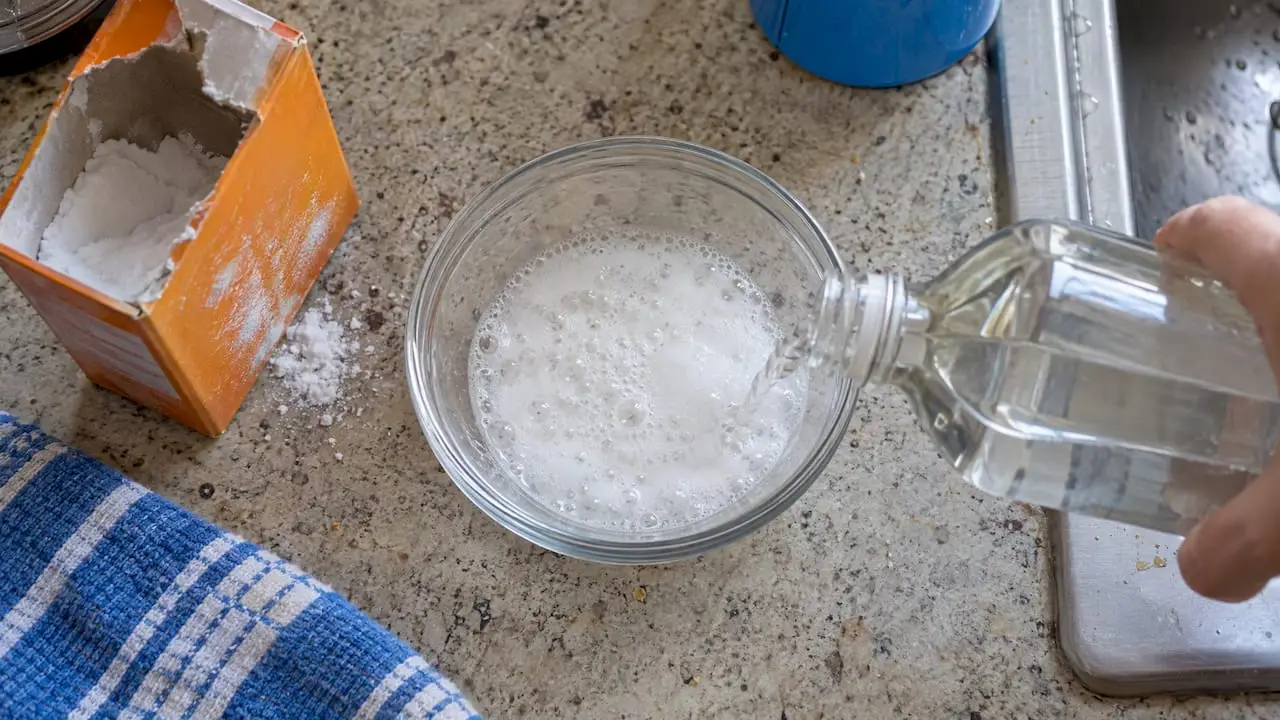
Vinegar is a mild acid. Baking soda is a mild base. Mixed, they fizz and largely cancel each other out, leaving mostly salty water. The foam can help physically push loose gunk out of a drain or lift a bit of grime, but you’ve lost much of what each ingredient could do separately.
What each can do on its own, in practical terms:
| Ingredient | Good for | Not good for |
|---|---|---|
| White vinegar | Cutting mineral film and soap scum on glass and tile, a rinse for coffee makers (check the manufacturer’s manual) | Natural stone like marble and granite, which acid can etch; disinfecting; unsealed grout |
| Baking soda | Gentle scrub paste for sinks and tubs, absorbing odors in a fridge or carpet | Disinfecting; heavy grease on its own; polished or soft surfaces that scratch |
| Dish soap and warm water | Grease, fingerprints, everyday spills, most hard surfaces | Heavy hard-water scale |
The surface list is where homeowners get hurt most often. Vinegar on a stone countertop is a common, avoidable mistake. If you are unsure what your counters are made of, use soap and water.
A safety point matters more than efficiency here. Never combine vinegar with bleach, and never combine any cleaning products without checking. The CDC’s household guidance says to never mix products, because some combinations release dangerous fumes. “Natural” ingredients are not exempt from that rule.
Myth 4: Natural means safer for your air and your family
This is the claim we’d challenge most, because it feels so intuitive. Plant-based, essential-oil-scented products seem gentle. The measurements don’t always agree.
A 2024 study on volatile organic emissions from cleaning products found that green cleaners generally emitted more monoterpenes than regular cleaners, with modeled increases in some harmful secondary pollutants. Monoterpenes are the compounds that give citrus and pine scents their smell. They are natural, and they still react in indoor air. If you want a wider look at the topic, this summary of indoor air quality research is a helpful companion read.
Keep it in proportion. The U.S. EPA says that risks from cleaning product chemicals at typical exposure levels are often uncertain and probably low in many cases, and that reducing a product’s intrinsic hazard is a worthwhile pollution-prevention goal. So the takeaway is not “avoid green products”. It is:
- Choose fragrance-free or lightly scented products if anyone in the home has asthma or sensitivities.
- Ventilate while you clean.
- Use less product, not more.
If asthma is a concern in your household, our guide to cleaning with asthma shows how to cut triggers without sprays, and our comparison of green and regular cleaning covers the respiratory side in more detail.
Myth 5: If it’s plant-based, organic or has a short ingredient list, it’s safe
The opposite instinct causes trouble too: that a long chemical name is a red flag and a plant name is a green light. Names tell you very little. Many long names are ordinary, well-studied ingredients, and some plant extracts (essential oils, for example) can irritate skin and airways or be hazardous to pets.
The most reliable shortcuts are third-party labels, not marketing words:
- Safer Choice. The EPA manages this program, which certifies products with safer ingredients.
- Design for the Environment label. The EPA offers it for antimicrobial products, per the same page.
- EPA registration number. On a disinfectant, this tells you the product was tested to make its germ-kill claims.
Words like “non-toxic”, “eco” and “chemical-free” are not the same as these. When we shop for supplies, we look for a certification and a full ingredient list before we trust a front label.
Pets and kids: where the myths cost the most
Households with children and pets are the people most drawn to “chemical-free” marketing, and the stakes for them are real.
The CDC’s guidance for families is simple. Store chemicals out of reach of children and pets, ventilate well, never mix products, and never use disinfection products on pets. A “natural” label does not change any of it. Concentrated essential oils, for instance, are a poor choice around pets even though they are plant-derived.
The Washington State Department of Health lists bleach, quaternary ammonium compounds, benzene, hexanes and phenols among common chemicals to avoid. Check your labels for these, especially in disinfecting wipes and sprays used daily.
Practical habits that work better than any label:
- Clean floors and pet areas with mild soap and water, and let them dry before pets and toddlers return.
- Keep sprays and wipes in a high cabinet or one with a child lock.
- Open a window or run a fan while you clean.
- Use one product at a time, and rinse a surface before switching.
We’ve put the details in two guides: pet safe cleaning and keeping kids safe during house cleaning, which includes a quick prep routine.
A sensible “gentle but effective” kit
You don’t need a cabinet full of products. Here is what we’d stock to cover most homes:
- Dish soap and warm water for most surfaces, from counters to cabinet fronts.
- Microfiber cloths, so you rely less on product and more on friction.
- Baking soda for gentle scrubbing of sinks and tubs.
- White vinegar, kept for glass, tile and mineral film, and kept away from stone and bleach.
- One EPA-registered disinfectant for the moments that truly need it, used exactly as the label says.
- A fragrance-free option for bedrooms and nurseries.
The point is a short list, each item matched to a job. A room-by-room version is in our eco-friendly house cleaning guide.
Our perspective: judge a cleaner by the job, not the label
We clean homes across DC, Virginia and Maryland, and the families who book us often start with the same worry: “I want something safe for my kids and dog, but I also want the house actually clean.” Those two goals are compatible, but not through a slogan.
We use eco-friendly products, and we say so. We also don’t claim they are “chemical-free”, because nothing is. What we promise is the approach: our trained, insured team matches the product to the soil and the surface, uses the gentlest thing that does the job, and doesn’t reach for a heavy product when soap and water will do. Pets and families are the reason we do it that way, and it is why we’d rather explain a limit, such as natural products not being disinfectants, than hide it.
If someone in your home is sick, or you’re dealing with raw-meat spills, we’d tell you to use a proper disinfectant on those specific surfaces and follow the label. For the rest of the house, plain, careful cleaning wins.
— Local
Let us handle the cleaning, and the product questions
If you’d rather not sort through labels, our team handles it. We offer standard and deep cleaning for homes and apartments, built around eco-friendly products and flexible scheduling, whether you want recurring visits or a one-time clean. Moving soon? You can book a move-in or move-out clean online. Not sure which to choose? Our guide to standard versus deep cleaning lays out the difference.
FAQ
Are natural cleaners effective?
For everyday dirt, grease and spills, often yes, especially with soap, warm water and some scrubbing. Research on alternative cleaners has found they can remove soil if you work harder, but as a group they performed below commercial cleaners at soil removal and microbe reduction. They also generally don’t disinfect.
Is vinegar and baking soda a myth?
The combination is mostly a myth. The fizz is a reaction between an acid and a base that leaves little cleaning power behind. Each ingredient is useful on its own: vinegar for mineral film on glass and tile, baking soda as a gentle scrub. Keep vinegar off natural stone, and never mix it with bleach.
Is “chemical-free” on a label trustworthy?
No. Every cleaner is made of chemicals, including homemade ones, and the American Cleaning Institute calls the term a misnomer. Look instead for a full ingredient list and third-party marks such as the EPA’s Safer Choice label.
Do I need a disinfectant at home?
Usually not. Public health guidance says cleaning is enough in most situations, and you should disinfect only when needed. When you do, choose an EPA-registered product and follow its dilution and contact-time instructions.
Are green cleaners safe for pets?
Not automatically. Plant-derived does not mean pet-safe, and concentrated essential oils can be a problem. Store every product out of reach, ventilate, never mix products, and never use disinfection products on pets.
Sources
- DIY or Homemade Cleaners, American Cleaning Institute
- Natural Cleaning Products, American Cleaning Institute
- Hard Surface Cleaning Performance of Six Alternative Cleaners
- Safe Cleaning Practices in Your Home, Washington State Department of Health
- The effectiveness of three home products in cleaning and disinfection
- When and How to Clean and Disinfect Your Home, CDC
- Does green mean clean? Volatile organic emissions from cleaning products
- Identifying Greener Cleaning Products, US EPA
- Indoor air quality research summary