For predictable, recurring upkeep, flat-rate plans usually give you the best value and peace of mind. For unpredictable one-off jobs or small targeted tasks, hourly billing can save you money. The clearest way to confirm which fits your home is a short trial cycle of two or three cleanings before locking into a schedule.
TL;DR:
- A standard home cleaning averages $176 per visit, with typical flat quotes from $118 to $238; those figures exclude deep cleans and move outs.
- Hourly quotes run $25 to $80 per cleaner, so a two person crew working three hours each at $50 per hour costs $300.
- Deep cleans often cost $200 to $400, while move out jobs can exceed $500; an itemized flat quote defines the work and limits billing surprises.
- For homes whose condition changes week to week, hourly billing may beat a flat quote sized for the messiest visit, but longer visits cost more.
Table of Contents
- Key differences between flat-rate and hourly cleaning
- Typical costs and what drives the price
- How to decide which billing model fits your home
- Real-world scenarios and worked examples
- What to ask, a booking checklist, and how to compare quotes
- How Pure Homes Cleaning prices your home
- A practical recommendation for busy homeowners
- How Pure Homes Cleaning can help you choose with confidence
- FAQ
- Sources
Key differences between flat-rate and hourly cleaning
Flat-rate pricing means you pay one set fee for a defined scope of work, no matter how long it takes the crew to finish. Companies typically use this model for recurring, repeatable jobs like weekly or biweekly standard cleaning, since they can estimate the scope accurately after the first visit. Hourly pricing charges you per cleaner, per hour, and tends to fit one-time jobs, unusual layouts, or small tasks where the scope is hard to predict in advance.
- Flat-rate pros: predictable monthly budget, no incentive for the crew to stretch the job, easy to compare across providers.
- Hourly pros: flexible for small or unusual jobs, you only pay for time actually used.
- Flat-rate con: a one-time surprise, like heavy buildup behind appliances, may require a re-quote.
- Hourly con: bills can balloon if the home takes longer than expected, and a rushed crew may cut corners to stay on budget.
One detail trips up a lot of homeowners: hourly rates are charged per cleaner, so a two-person crew working two hours bills as four labor-hours, not two.
Typical costs and what drives the price
Most cleaning companies charge a flat rate between $118 and $238 per visit, with an average of $176, according to HomeAdvisor’s cost data. That range reflects a standard home cleaning, not a deep clean or move-out job. Hourly rates commonly run $25 to $80 per cleaner, and since most companies send two cleaners to a standard visit, the effective hourly bill for the whole job often doubles.
Angi’s pricing research notes that flat rates are more common for routine, recurring cleanings, while hourly pricing shows up more often for specialized or one-time jobs, with average hourly cost centering around $50 and varying by market.
A few factors push the final number up or down:
- Home size and condition: more square footage or heavier buildup means more labor-hours.
- Crew size: a two-person team finishes faster but the hourly total reflects both cleaners’ time.
- Add-ons: inside-oven cleaning, baseboards, or interior windows add to either pricing model.
- Frequency: weekly service usually costs less per visit than a one-time deep clean.
Ask any provider for an itemized quote that lists exactly what is included, then ask what would trigger an extra charge. That single question avoids most billing surprises.
How to decide which billing model fits your home
Start with a quick self-assessment. Walk through these points before you request quotes:
- Home size and layout: larger or multi-level homes tend to favor flat-rate pricing because the scope is easier to define upfront.
- Clutter and condition: heavily cluttered spaces or inconsistent upkeep make hourly billing safer until a provider can estimate accurately.
- Cleaning frequency: recurring weekly or biweekly service almost always favors flat-rate, since the company learns your home’s scope over time.
- Budget predictability: if you need the same number on your bank statement every month, flat-rate wins.
- Scope variability: one-off jobs like post-party cleanup or a single room favor hourly billing.
As a rule of thumb: recurring standard cleaning should be flat-rate, while small, unpredictable, or rarely needed jobs should be hourly. To translate an hours estimate into a dollar figure, multiply the number of cleaners by the hours quoted, then by the per-cleaner rate. A two-person crew estimated at three hours each, at $50 per hour, comes to $300 total labor-hours cost, which you can then compare against a flat quote for the same scope.
Pro Tip: Always ask whether a quoted “4 hours” means four hours per cleaner or four total labor-hours split between the crew. The difference changes your total cost significantly.
If a flat quote feels too low for the condition of your home, ask for a re-quote after the first visit rather than letting the crew rush through a scope that was underestimated.
Real-world scenarios and worked examples
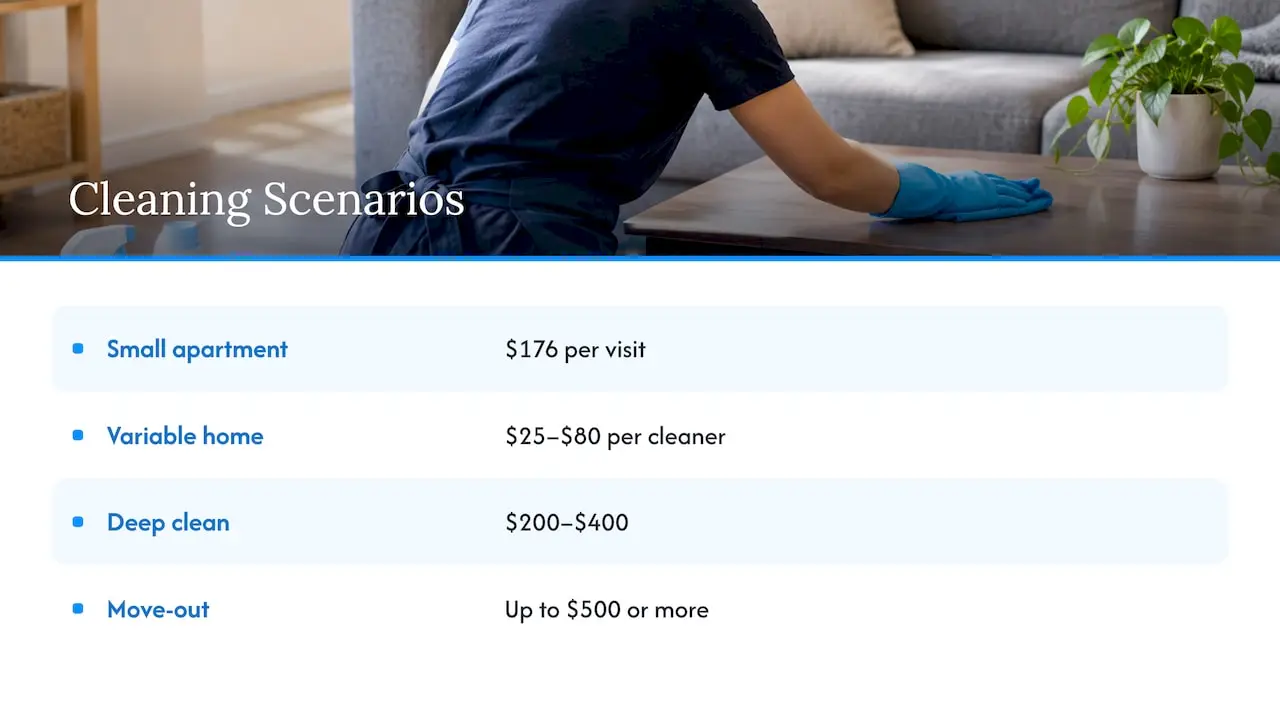
Small apartment, recurring biweekly clean: A studio or one-bedroom typically falls within the flat-rate average of $176 per visit, and since the scope rarely changes, flat-rate pricing keeps the bill predictable over months of service.
Three-bedroom family home with variable needs: If the home’s condition swings week to week, kids’ messes one visit, light tidying the next, hourly billing at $25 to $80 per cleaner can sometimes come in cheaper than a flat quote sized for the worst-case scenario, though it carries the risk of a longer, costlier visit when the home is more disorganized than usual.
Move-out or deep clean: These jobs often run $200 to $400 for a deep clean and up to $500 or more for a move-out, depending on size and condition. Here, an itemized flat quote is usually safer than open-ended hourly billing, since move-out scopes (inside cabinets, appliances, baseboards) are well-defined. Our guide on deep cleaning versus move-out cleaning breaks down which scope applies to your situation.
What to ask, a booking checklist, and how to compare quotes
Before booking, ask every provider the same set of questions so you can compare quotes fairly:
- How many cleaners will be on-site, and is the quote per cleaner or total labor-hours?
- What tasks are included, and what counts as an add-on?
- Are supplies included, and is there a travel fee for your neighborhood?
- What is the cancellation policy, and is there an overtime rate if the job runs long?
| What to check | Flat-rate quote | Hourly quote |
|---|---|---|
| Scope definition | Fixed task list | May vary by time used |
| Budget predictability | High | Lower |
| Risk if home is messier than expected | Possible re-quote | Bill increases |
| Best fit | Recurring standard cleaning | One-off or small jobs |
Before the first appointment, use a printable standard cleaning checklist to confirm scope, and book a trial run of two to three visits before committing to a long-term schedule. For homeowners tackling a broader refresh alongside cleaning, resources like One Day Doors & Closets’ home makeover guide cover small upgrades that pair well with a deep clean.
How Pure Homes Cleaning prices your home
We assess scope on a walkthrough or through photos you send with your booking, then calculate labor-hours based on square footage, room count, and condition before quoting a price. That process is explained in more detail in our guide to how long a house cleaning takes, which converts labor-hours into expected clock time for your home. We recommend a short trial cycle so you can see how a flat-rate plan performs against your actual routine before committing. Every visit uses eco-friendly products, and our staff are trained and insured, which matters when you are handing over keys or scheduling around a family’s routine.

A practical recommendation for busy homeowners
Recurring households do better with flat-rate pricing: the budget stays steady and nobody has an incentive to rush. One-off or unpredictable jobs often cost less billed hourly, but only if you trust the crew not to pad the clock. Run a trial cycle, use the checklist above on every quote you collect, and let the numbers decide.
— Local
How Pure Homes Cleaning can help you choose with confidence
Once you know which billing model fits your home, the next step is booking a provider who prices clearly from the start. We offer Standard Cleaning for recurring flat-rate upkeep, Deep Cleaning for homes that need a reset, and Move In Clean or Move Out Clean for move day scopes that call for an itemized quote rather than open-ended hourly billing.
- Standard Cleaning: fits weekly or biweekly households that want flat-rate predictability.
- Deep Cleaning: fits homes that have not had a thorough clean in months or are prepping for a big event.
- Move In Clean or Move Out Clean: fits lease transitions where a defined, itemized scope protects your deposit or your move-in timeline.
On your first visit, our crew walks the home, confirms scope against your checklist, and flags anything outside the original quote before starting. We recommend scheduling two to three visits as a trial cycle so you can judge consistency before setting a long-term plan. We serve households across Washington, DC, Maryland, and Virginia, and you can book your first cleaning online in a few minutes.
FAQ
What is the difference between flat rate and hourly rate?
Flat-rate pricing charges one set fee for a defined scope of work, regardless of how long the job takes. Hourly pricing charges per cleaner, per hour, so the total depends on both the time spent and the number of cleaners sent.
How much does it cost to hire a cleaner per hour?
House cleaners typically charge $25 to $80 per hour per cleaner, and since most companies send two cleaners to a standard visit, the effective hourly bill for the full job is often double the per-cleaner rate.
What is the 5-5-5 rule for cleaning?
There is no single standardized industry definition of a “5-5-5 rule” for house cleaning. If you have seen the term used for a specific routine, it likely refers to a personal productivity method rather than a recognized pricing or scheduling standard in the cleaning industry.
What should a cleaner do in 3 hours?
A three-hour visit from a single cleaner, or less time if two cleaners are sent, typically covers a standard clean of kitchens, bathrooms, dusting, vacuuming, and mopping in a small to midsize home. The exact scope depends on home size and condition, which is why requesting an itemized quote matters more than a flat hour count.
Is flat-rate or hourly cleaning better value?
For recurring, predictable upkeep, flat-rate pricing usually gives better value because the scope is well defined and the cost does not fluctuate. For one-time or unpredictable jobs, hourly billing can cost less, provided the crew works efficiently and the scope stays within the estimate.
Sources
- How Much Does It Cost to Hire a House Cleaner? 2025 Data | HomeAdvisor
- How Much Does It Cost to Hire a House Cleaner? | Angi