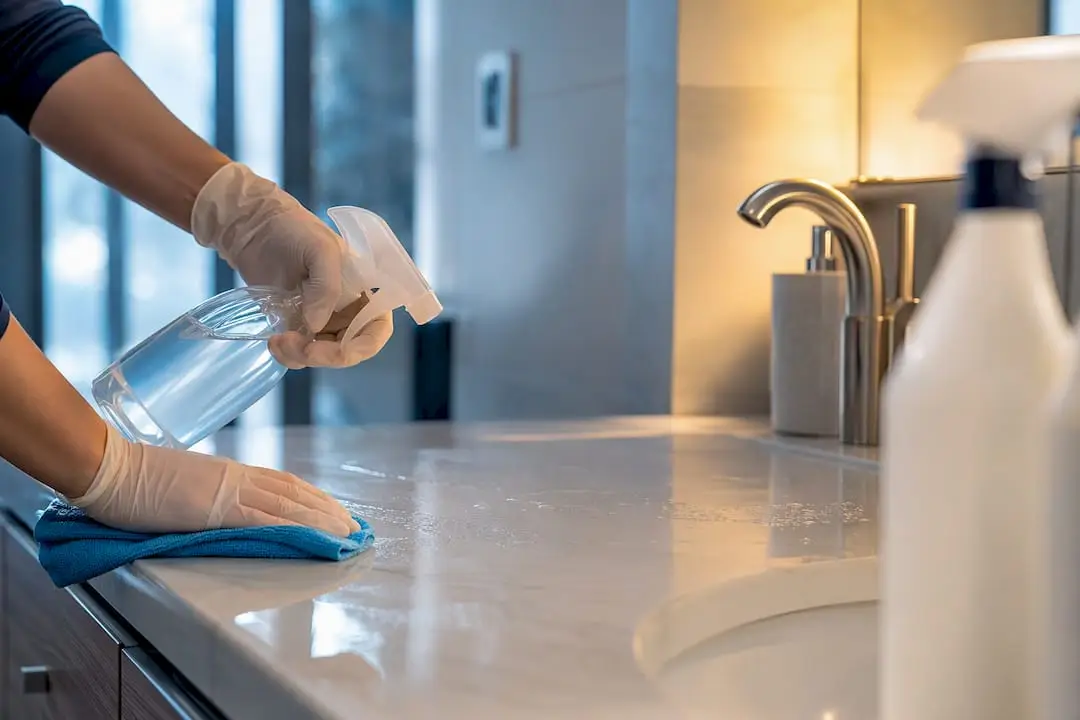
Cleaning and disinfecting are not the same job. Cleaning uses soap and water to lift dirt, grease, and most germs off a surface, while disinfecting uses an EPA-registered chemical to kill the specific germs that survive. Clean first, always. Then disinfect only when it’s actually warranted, like an illness in the house, and give the product the full contact time listed on its label.
TL;DR:
- Disinfectants are EPA-registered products that only kill specific pathogens listed on their labels, requiring proper contact time for effectiveness.
- Cleaning must always precede disinfection, as dirt and grease can shield germs and reduce the disinfectant’s ability to work fully.
- Quats are common disinfectants suitable for most surfaces but can degrade over time if not compatible; bleach is best for nonporous, hard surfaces.
- Using disinfectants with a contact time longer than the applied surface remains wet ensures proper pathogen elimination, especially on high-touch points.
- Overusing disinfectants in a home without active illness offers limited benefits and can harm surfaces, so targeted cleaning and disinfection are more effective.
Table of Contents
- Disinfectant vs Cleaner: Cleaning, Sanitizing, and Disinfecting Defined
- When Should You Clean, Sanitize, or Disinfect?
- How Do You Disinfect a Surface Correctly?
- Bleach, Quats, Alcohol, and Hydrogen Peroxide: Which One Fits Your Surface?
- What Does a Professional Cleaning Protocol Actually Look Like?
- Is More Disinfectant Always Better?
- Book a Professional Clean That Handles Disinfection Right
- Where These Guidelines Come From
- Sources
- FAQ
Disinfectant vs Cleaner: Cleaning, Sanitizing, and Disinfecting Defined
These three words get used interchangeably at the grocery store, but they describe three different jobs, and the difference between disinfectant and cleaner has real consequences if you get it backward.
Cleaning uses soap or detergent plus water to physically remove dirt, grease, and organic soil from a surface. A basic all-purpose cleaner does this well. It picks up a lot of germs along with the grime simply by rinsing them away, but it makes no claim to kill any specific pathogen, and it doesn’t have to. That’s why any dish soap or countertop spray can call itself a cleaner without ever going through federal registration.
Sanitizing sits in the middle. It reduces germs to a level public health standards consider safe, typically referenced for food-contact surfaces like cutting boards, high chairs, and baby bottles. Sanitizing doesn’t promise to eliminate every pathogen. It promises a low enough count that the risk becomes negligible for everyday contact.
Disinfecting is the strongest claim of the three. A true disinfectant is an EPA-registered antimicrobial pesticide that kills the specific viruses, bacteria, or fungi named on its label. That regulatory distinction matters more than most shoppers realize:
- Cleaning products are regulated as general consumer goods unless they make a kill claim.
- Sanitizers and disinfectants must be registered with the EPA and tested against named organisms before they can carry that claim.
- A label that doesn’t list a specific pathogen, like norovirus or influenza A, isn’t validated to kill it, no matter how strong the smell.
- Products vary widely. One disinfectant might kill rhinovirus but not C. diff spores, so the label is the only reliable guide.
This is the regulatory backbone behind CDC’s cleaning and sanitizing guidance, and it’s why cleaning always comes first in the sequence. Dirt and grease shield germs from disinfectant contact, so skipping the cleaning step can leave a disinfectant fighting a losing battle against soil it was never designed to cut through.
When Should You Clean, Sanitize, or Disinfect?
Most of what happens in a healthy home doesn’t need a disinfectant at all. Soap, water, and a little elbow grease handle the vast majority of household grime, and the CDC notes that routine cleaning is enough for most homes most of the time. Here’s how to sort your specific situation into the right category.
- Default to cleaning for everyday surfaces: floors, furniture, light switches, doorknobs, and countertops that see normal daily use. Soap and water, done regularly, keeps germ counts low without any chemical overkill.
- Sanitize anything that touches food or a baby’s mouth. Cutting boards, high chair trays, pacifiers, and bottle nipples fall into this category. A run through the dishwasher’s sanitize cycle or a brief soak in a diluted sanitizing solution is usually sufficient. This is also where “sanitizer vs disinfectant” confusion shows up most, since many kitchen sprays are technically sanitizers, not full disinfectants, even though the bottle sounds tough.
- Disinfect when the stakes go up: someone in the house is sick, you’re cleaning up after vomiting or diarrhea, or a household member is immunocompromised, elderly, or otherwise higher risk. This is the moment to reach for an EPA-registered product and follow its label exactly.
- Increase frequency temporarily during an active illness. Focus on high-touch points, doorknobs, faucet handles, remote controls, phone screens, rather than blanket-spraying every surface in the house.
Concrete examples make this easier to apply. Kitchen counters get a daily wipe with soap and water, and a disinfecting pass after raw meat prep or when someone’s had a stomach bug. Bathroom surfaces, especially toilet handles and faucet knobs, benefit from routine cleaning with disinfection layered in when illness is present. Electronics almost never need liquid disinfectant. Use alcohol wipes formulated for screens instead of soaking a phone or remote in a spray. Soft surfaces like couch cushions and stuffed animals generally aren’t disinfected at all. Laundering is the better route, since washing at the warmest setting the fabric allows and drying completely reduces germs without soaking fabric in chemicals it can’t tolerate.
How Do You Disinfect a Surface Correctly?
Reading the label is the entire job. Skip that step and you’re just spraying a surface and hoping, which is where most home disinfection actually falls short.
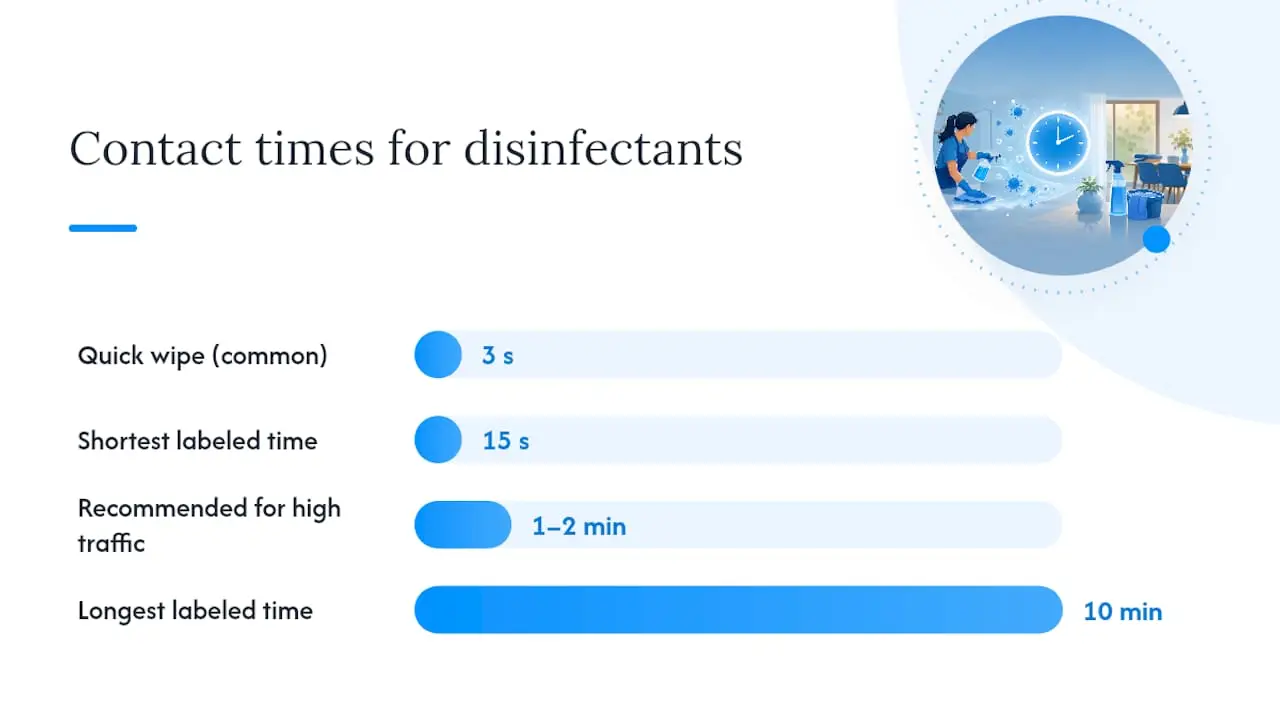
Contact time, sometimes called wet time or dwell time, is the minimum period a surface has to stay visibly wet with the product for it to kill the pathogens named on the label. That window ranges from about 15 seconds to a full 10 minutes, depending on the product and the germ it’s targeting. A quick spray-and-wipe in three seconds might feel thorough, but if the label calls for four minutes of visible wetness, that surface was never actually disinfected. It was just dampened.
Reading a disinfectant label properly means checking five things before you spray anything:
- EPA registration number, usually printed in small type near the ingredients list, confirming the product went through federal review.
- Target organisms, the specific viruses, bacteria, or fungi the product is validated against.
- Approved surfaces, since some products are rated for hard nonporous surfaces only.
- Dilution ratio, if the product is concentrated rather than ready-to-use.
- Contact time and required PPE, like gloves or ventilation, listed in the directions.
The practical sequence looks like this: clean the surface first to remove visible dirt and organic material, apply the disinfectant so the surface is fully wet, leave it alone for the labeled contact time without wiping it away early, and reapply if it dries before that window closes. Ventilate the room, wear gloves if the label calls for them, and never, under any circumstance, mix bleach with ammonia or other cleaning chemicals. That combination produces toxic fumes and sends people to the emergency room every year.
One of the most common real-world failures isn’t a chemistry problem at all. It’s a workflow problem: people wipe a surface dry well before the labeled time has elapsed, often because they’re moving fast through a cleaning routine. Industry guidance on disinfectant selection points out that choosing a product with a contact time you can realistically sustain, rather than the strongest-sounding option on the shelf, often produces better real-world results.
Pro Tip: If you’re cleaning a high-traffic surface like a bathroom counter or a shared doorknob, pick a disinfectant with a short contact time, something in the 1 to 2 minute range, so you’re not tempted to wipe it dry early just to keep moving.
Following label directions isn’t a suggestion. Under the Federal Insecticide, Fungicide, and Rodenticide Act (FIFRA), the “Directions for Use” section on a registered disinfectant’s label is a legal requirement, not marketing copy. Using a product off-label, at the wrong dilution, on an unapproved surface, or for less than the stated contact time, voids the product’s own kill claims. And if anyone in your household experiences a chemical exposure, from fumes, skin contact, or accidental ingestion, call Poison Control immediately at 1-800-222-1222.
Bleach, Quats, Alcohol, and Hydrogen Peroxide: Which One Fits Your Surface?
Not every disinfectant belongs on every surface, and picking the wrong chemistry can damage the very thing you’re trying to protect.
- Bleach (sodium hypochlorite) is a strong, inexpensive disinfectant well suited to hard, nonporous surfaces like tile, sinks, and toilets. It’s harsh on metals, fabrics, and many plastics, and it should never be mixed with ammonia-based cleaners.
- Quaternary ammonium compounds (quats) show up in most spray disinfectants sold for general household and commercial use. They’re gentler on surfaces than bleach but can bind to cloth wipes and lose potency if you’re using cheap, absorbent wipes, an effect sometimes called quat binding.
- Alcohol-based disinfectants, usually isopropyl or ethanol in the 60 to 90 percent range, work fast and evaporate cleanly, which makes them the better choice for small electronics like phone screens and remote controls.
- Hydrogen peroxide formulations offer a lower-toxicity option that breaks down into water and oxygen, appealing for households trying to cut down on harsh fumes, though contact times can run longer than bleach.
- Enzymatic cleaners aren’t disinfectants at all. They break down organic stains and odors, particularly useful for pet accidents on carpet or upholstery, and often work best as a pre-clean step before any disinfecting product.
Material compatibility deserves real attention here. Repeated exposure to bleach or strong quats can degrade rubber gaskets, discolor plastic housings, and pit certain metals over time, which is why checking a product’s compatibility guidance before standardizing on one disinfectant for everything in the house is worth the extra five minutes. Households with animals should also weigh ventilation and residue risk carefully. If you’re not sure which chemistry is safest around pets, our guide on pet-safe cleaning products walks through what to use and what to skip.
For everyday practicality: bleach or a quat-based spray for bathroom hard surfaces, alcohol wipes for electronics, hydrogen peroxide for households sensitive to fumes, and laundering rather than spraying for anything fabric. If you’re refinishing or just protecting wood doors and trim during a deep clean, these tips on cleaning interior doors cover finish-safe methods that won’t strip a painted or stained surface.
What Does a Professional Cleaning Protocol Actually Look Like?
Most homeowners never see the checklist a trained cleaning team follows, but it answers a lot of the “am I doing this right” questions this article has raised.
Pure Homes Cleaning’s high-touch surface protocol follows the same sequence detailed above, just applied consistently across every appointment:
- Surfaces are cleaned first to remove visible soil before any disinfectant touches them.
- The disinfectant applied matches the surface type and is left for its full labeled contact time, not a quick wipe-and-go.
- Rooms are ventilated during and after application, and staff use PPE appropriate to the product.
- Surfaces are checked against material-compatibility guidance before a stronger chemistry gets used on delicate finishes.
The difference between doing this occasionally and doing it every single appointment is consistency, and that’s often the real value of hiring a team rather than doing it yourself. If you’re short on time, have a household member at higher health risk, or just want documented compliance with contact times instead of guessing, that’s the point where booking a professional starts to make sense. You can see the full breakdown on the high touch surface cleaning protocol page, and if you’re trying to decide how deep a clean you actually need, the comparison at standard vs deep cleaning is worth a look before you book.
Is More Disinfectant Always Better?
Here’s where I’ll push back on the instinct a lot of people have picked up since 2020: more disinfectant is not automatically safer. Frequent cleaning paired with targeted disinfection beats constant heavy chemical use, both for your health and for your surfaces. Overusing strong disinfectants in a home with no active illness burns through ventilation, irritates airways, and accelerates wear on plastics and finishes for a benefit that mostly doesn’t exist.
The smarter approach is targeted. Clean daily. Disinfect the handful of high-touch points that matter, and step it up only when someone’s actually sick. Lower-toxicity options like hydrogen peroxide formulations deserve more consideration than they get, especially in households with kids, pets, or anyone with respiratory sensitivity. And the manufacturer’s compatibility guidance isn’t fine print to skip. It’s there because a disinfectant strong enough to kill a virus is also strong enough to degrade a rubber seal or cloud a plastic finish over repeated use. Respecting the label protects your health and your home at the same time.
— Local
Book a Professional Clean That Handles Disinfection Right
Our professional cleaning service is an option for households who’d rather not track contact times and label directions themselves. The advantage is straightforward: trained, insured staff who apply eco-friendly products and follow documented high-touch protocols on every visit, so you’re not guessing whether a surface was disinfected long enough.
Whether you need a routine Standard Cleaning to keep everyday surfaces in check, a Deep Cleaning that resets a home room by room, or a Move In or Move Out Clean before you hand over keys, the same clean-first, disinfect-when-needed approach applies across the board. Scheduling works entirely online, and plans flex around recurring visits or one-time appointments depending on what your household actually needs. If you’re ready to stop wondering whether last weekend’s wipe-down actually did the job, book your appointment now and let a trained team handle the contact times for you.
Where These Guidelines Come From
The distinctions in this article, cleaning versus sanitizing versus disinfecting, contact time requirements, and safe product use, come from federal public health guidance rather than marketing claims. The CDC’s cleaning and disinfecting overview and its detailed PDF breakdown explain when each process applies at home. The EPA’s disinfectant registration page and its consumer guidance on product differences cover label requirements and regulatory status. For any chemical exposure, contact Poison Control at 1-800-222-1222.
This article is general information, not a substitute for advice from a qualified doctor. Consult a qualified healthcare professional about your own circumstances before acting on anything here.
Sources
- Difference Between Cleaning, Sanitizing, and Disinfecting — CDC (PDF)
- What’s the difference between products that disinfect, sanitize, and clean? — U.S. EPA
FAQ
Is Disinfecting the Same as Cleaning?
No. Cleaning removes dirt and many germs with soap and water, while disinfecting uses an EPA-registered product to kill specific pathogens named on its label. Cleaning should always happen first, since leftover soil can block a disinfectant from reaching the surface.
Do I Clean or Disinfect First?
Clean first, every time. CDC guidance is clear that removing dirt and grease before applying a disinfectant lets the product actually reach and kill the germs it’s designed for, rather than fighting through soil.
What Does Disinfectant Not Kill?
A disinfectant only kills the specific organisms listed on its label, so it won’t reliably kill anything outside that list. Some products, for example, aren’t validated against tough pathogens like norovirus or certain bacterial spores, which is exactly why checking the label’s target organisms matters more than trusting a product’s general reputation.
Is Lysol All-Purpose Cleaner a Disinfectant?
It depends entirely on the specific product and label; some Lysol-branded sprays are EPA-registered disinfectants, while certain all-purpose cleaning formulas in the same product line are cleaners without a registered kill claim. Check the label for an EPA registration number and a list of target organisms before assuming any product disinfects.
When Should I Book a Move Out Cleaning Instead of Doing It Myself?
Booking a move out cleaning makes sense when you’re on a lease deadline and need a documented, thorough clean covering high-touch surfaces, appliances, and bathrooms in one pass rather than piecing it together yourself. Pure Homes Cleaning’s move out clean applies the same clean-first, disinfect-when-needed protocol used across its other services.