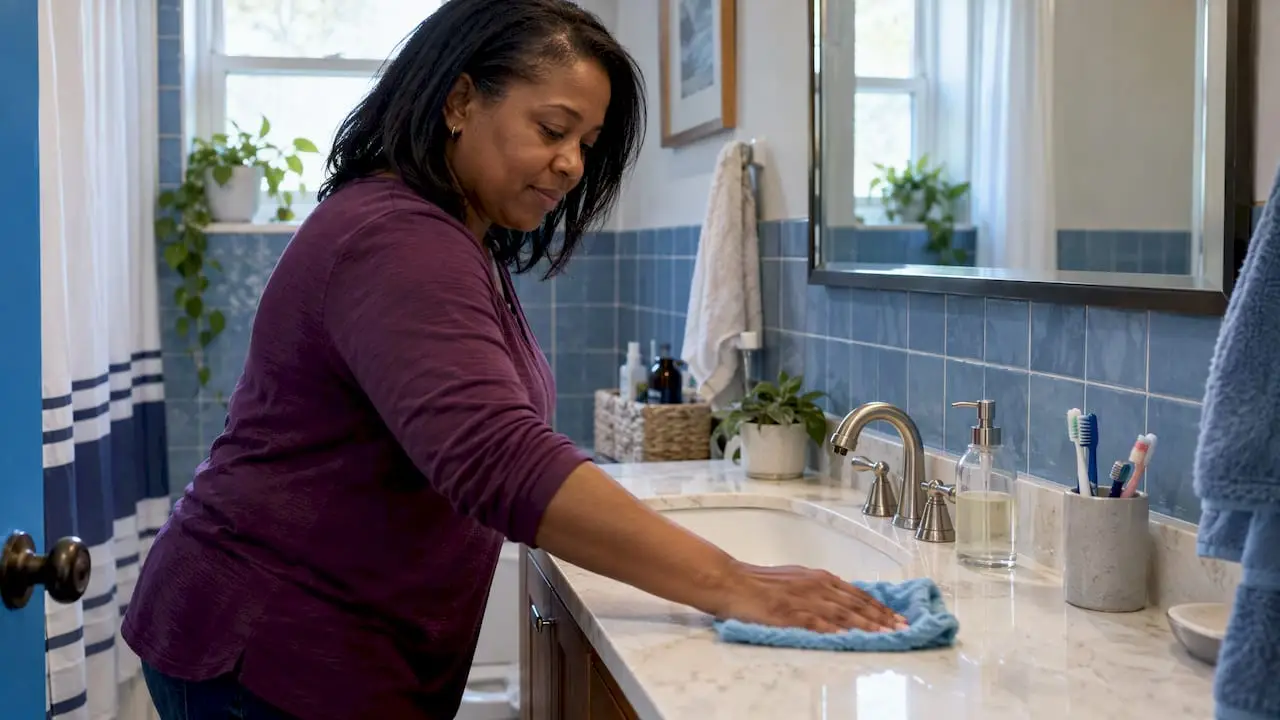
Between-cleanings maintenance is the short, repeatable upkeep you do yourself so a professional visit starts from “lightly lived in” instead of “months behind.” It is not a second deep clean. It is a few small habits: wipe the surfaces you touch most, deal with floors and bathrooms on a weekly rhythm, and save the big jobs for a monthly or seasonal slot. Done well, it takes 10 to 20 minutes on most days, and it makes every professional clean last noticeably longer.
Below you will find the tasks worth doing and how often, a short routine for a home office, the safety habits that matter around kids and pets, and a way to tell when upkeep is no longer enough.
TL;DR
- Think in layers: daily resets, weekly basics, monthly detail jobs and seasonal projects. Each layer stays small because the others carry their share.
- Daily upkeep is about counters, dishes, clutter, high-traffic floors and the surfaces everyone touches.
- A home office needs its own mini routine: dust electronics, wipe the desk, and follow the manufacturer’s cleaning instructions for equipment.
- With pets and children, read labels, never mix products, and keep animals away from surfaces until they are fully dry.
- When baseboards, appliances and bathrooms stay dirty despite your effort, that is the signal to book a deep clean rather than push harder.
Table of Contents
- What maintenance between professional cleanings really means
- The daily layer: 10 to 20 minutes that carry the week
- The weekly layer: the basics a visit would otherwise find
- Monthly and seasonal jobs: where upkeep ends and detail work begins
- A home office routine that takes five minutes
- Safe habits around children and pets
- Our perspective: protect the pro visit, do not replace it
- How to build a routine a busy household will keep
- When routine upkeep is no longer enough
- Let us handle the heavy part
- FAQ
- Sources
What maintenance between professional cleanings really means
A professional cleaning does the work that is slow, physical and easy to skip: scrubbing bathrooms, degreasing, detailed floors and surfaces you rarely reach. Maintenance is everything in the gap. Its job is not to make the house look like a show home. Its job is to stop dirt from building into the kind of layer that needs scrubbing.
The easiest way to picture it is as two different tasks with two different tools. Maintenance is quick and frequent: a damp cloth, a vacuum pass, a dishwasher load. Deep work is slow and occasional: inside the oven, behind appliances, baseboards. When you try to do the second kind of work every week, you burn out. When you ignore the first kind, the second kind piles up. A good routine keeps each in its lane.
If you are deciding what a visit should cover, our guide to standard versus deep cleaning explains how the two differ and which one fits your home’s current condition.
The daily layer: 10 to 20 minutes that carry the week
The American Cleaning Institute lists a short set of daily jobs: cleaning high-touch surfaces, sweeping high-traffic areas, wiping kitchen counters and tables after meals, running the dishwasher, putting away clutter and spot cleaning. None of these is dramatic. Together they stop the most visible mess from compounding.
Here is how that looks in a normal day.
- After breakfast: wipe the counter and table, load the dishwasher, start it when it is full.
- Before leaving or after work: a two-minute clutter sweep. Mail, shoes, and cups go back to their places.
- After dinner: wipe the counters again, sweep the kitchen floor and the entryway, and run the dishwasher if it is full.
- Whenever you notice it: spot clean a spill, a splash on the bathroom mirror, a paw print by the door.
High-touch surfaces deserve a word. Door handles, light switches, faucet handles, remotes and phones collect contact all day. If you want a complete method, including what to use and in what order, see our high-touch surface cleaning protocol.
If you rent a small apartment, the same logic applies in less space. Our apartment cleaning checklist built on short daily sprints breaks the routine down for renters.
The weekly layer: the basics a visit would otherwise find
Weekly tasks, according to the same American Cleaning Institute guidance, include vacuuming or mopping floors, dusting, cleaning bathrooms, cleaning out the fridge, and changing bed linens and towels. This is the layer where most households fall behind, because it is the one with the longest list.
Two ideas make it easier:
- Spread it across the week. The Spruce suggests that a realistic plan can use daily, weekly and monthly task lists, with chores assigned to days that fit the household. Bathrooms on Tuesday, floors on Thursday, bedding on Saturday works better for many families than one Saturday marathon.
- Give the fridge a fixed day. Pick the evening before trash pickup or grocery shopping and clear it then. It becomes automatic.
The same source notes that following a schedule faithfully for a few months can help it become a routine. That is useful guidance: do not judge the plan in week one. Give it a trial period, adjust what is unrealistic, and keep what works.
If you are also weighing how often professionals should visit, our piece on trialing weekly or biweekly cleaning for 2 to 3 cycles shows a low-risk way to test it. And our daily, weekly and monthly plan for DC-area homes puts the full rhythm on one page.
Monthly and seasonal jobs: where upkeep ends and detail work begins
The jobs most people skip are the ones that make a home feel truly clean. One guide recommends monthly work such as cleaning inside the microwave and oven and wiping baseboards, with seasonal work such as cleaning behind and under appliances. A second source lists monthly tasks as cleaning baseboards, washing pillows and heavy bedding, cleaning appliances and washing windows.
Seasonal work, per the American Cleaning Institute, can include washing curtains, windows and screens, washing shower curtains and laundering pillows.
Here is a simple way to place these on a calendar:
| Frequency | Examples | Rough time |
|---|---|---|
| Daily | Counters, dishes, clutter, entry floor, high-touch surfaces | 10 to 20 minutes |
| Weekly | Floors, dusting, bathrooms, fridge, bed linens and towels | 1 to 2 hours, spread out |
| Monthly | Microwave, oven, baseboards, pillows, windows | One focused hour or two |
| Seasonal | Curtains, screens, shower curtains, behind and under appliances | A weekend morning |
The time estimates are our own working guidance, not a published standard, and they vary with the size of the home. The point is the shape: small and frequent at the bottom of the list, bigger and rarer at the top.
When the monthly and seasonal list feels like too much, that is the right moment to hand it off. Our weekend deep cleaning checklist shows every room and appliance, so you can do the pieces you like and book out the rest.
A home office routine that takes five minutes
A desk is a high-touch zone and a dust trap. If you work from home, add a few steps to your daily and weekly rhythm.
Daily, at the end of the workday:
- Clear cups, plates and paper. A clear desk is easier to wipe.
- Wipe the desk surface, the mouse, the keyboard edges and the phone.
- Put cables and papers back where they live.
Weekly:
- Dust shelves, monitor stands and the tops of devices.
- Clean equipment according to the manufacturer’s instructions. CDC guidance on cleaning and disinfecting says you can dust electronics and clean equipment per the maker’s directions.
- Vacuum under the desk, where crumbs and pet hair gather.
The same CDC guidance suggests wipeable covers on electronics so cleaning and disinfecting are easier, and it notes that many electronics products contain alcohol because it dries quickly. Do not spray liquid straight onto a keyboard or screen. Apply the product to a cloth first, and check what your device’s manual allows.
Safe habits around children and pets
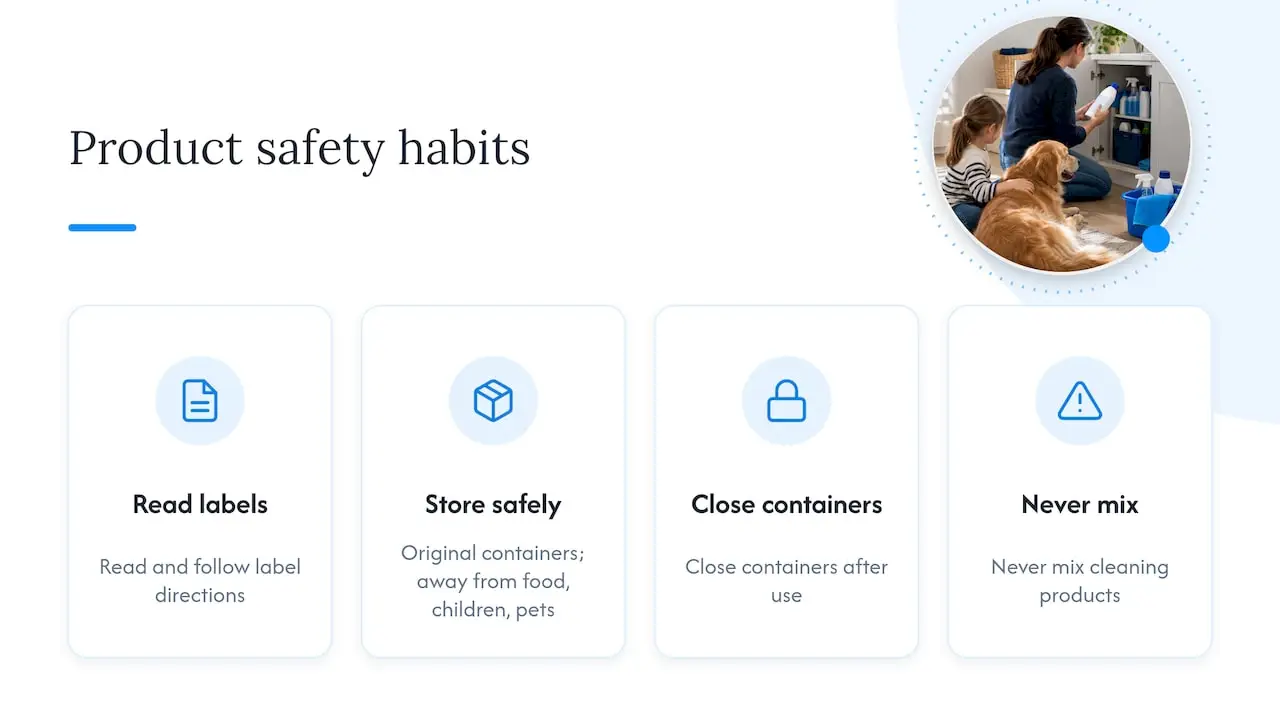
The more often you clean, the more the safety habits matter, because you are handling products every day. The American Cleaning Institute’s room guide lists the basics: read and follow label directions, keep products in their original containers away from food and out of reach of children and pets, close containers after use, and never mix cleaning products. The institute explains that products which are safe alone can create dangerous fumes when mixed.
Cleaning versus disinfecting
Most days you only need to clean. The CDC explains that cleaning physically removes dirt and germs with soap or detergent, while disinfecting kills germs with chemicals, and that some disinfectants need a cleaning step first so they can reach the surface. That means wiping with soap and water is a perfectly good default for a kitchen counter, and disinfectant is a deliberate extra for specific moments, such as after raw meat or illness. Our article on when to use a disinfectant versus a cleaner walks through the order.
Pet-friendly choices
If you have animals, the EPA says that products carrying its Safer Choice label have ingredients evaluated against safety criteria for people, pets and the environment. The EPA also points out that fumes from some cleaning products can linger and aggravate respiratory conditions, so lower-fume products help indoor air quality. If you are thinking about what else affects how a room smells and feels, this look at sustainable home fragrance and cleaner indoor air is a good companion read.
Cat owners should know one specific warning. The CDC says to avoid disinfectants containing phenol, such as 2-phenylphenol, which is toxic to cats, and to keep pets away from cleaned areas until surfaces are completely dry. If you are unsure about a product your pet has been exposed to, call your veterinarian.
For a fuller list of what to buy and what to skip, see our guide to pet-safe cleaning.
Our perspective: protect the pro visit, do not replace it
We clean homes across Washington, DC, Virginia and Maryland, and the pattern is consistent. Households that keep a small daily routine get more from every visit. Our team spends its time on bathrooms, kitchens, floors and detail work, not on clearing a month of clutter first.
That is why we do not push the idea that you must do everything yourself. We lean toward a hybrid approach: you handle the quick, daily resets, and professionals handle the heavier work. One guide describes the same split, DIY maintenance for daily and weekly chores and professional cleaners for deep cleaning, as a way for busy households to make the most of both budget and effort. We agree with that logic.
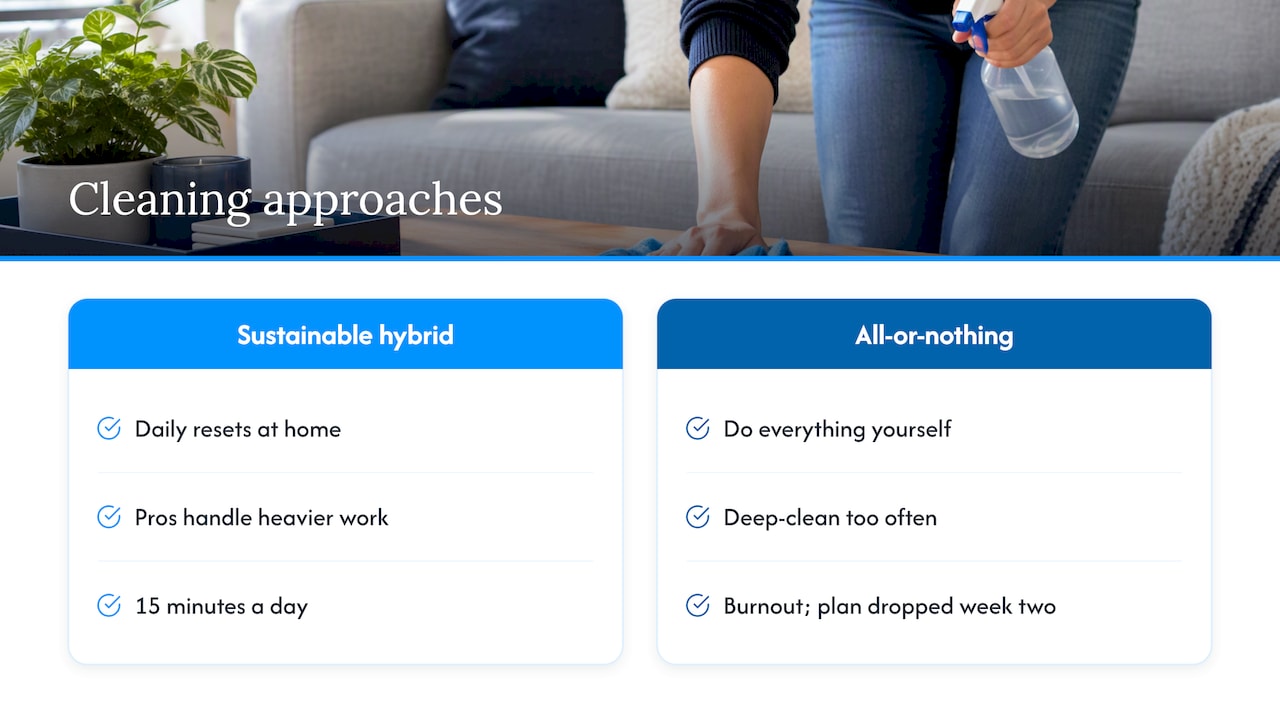
We also think the biggest mistake is the all-or-nothing plan. The same guide argues that sorting tasks by frequency, daily, weekly, monthly and seasonal, keeps people from attempting deep-cleaning jobs too often, which leads to burnout. A plan you can keep at 15 minutes a day beats a perfect one you drop in week two.
Finally, we use eco-friendly products and train and insure our staff, because the people and pets living in the house are the reason the house is being cleaned in the first place. Whatever you use between visits, choose products you are comfortable breathing and having near your family.
— Local
How to build a routine a busy household will keep
Start small and make it visible.
- Pick three daily anchors. Counters after meals, a clutter sweep, and the dishwasher. Do nothing else for the first two weeks.
- Assign weekly tasks to days. Put one bathroom, one floor job, and one laundry job on separate days. Share them if more than one adult lives in the house.
- Put monthly jobs on the calendar. Give each one a date, such as the first Sunday, so it does not float.
- Review after a few months. The Spruce notes that sticking with a schedule for a few months can help it become routine. If a task keeps getting skipped, move it or hand it off.
- Decide what to outsource. Bathrooms, floors and kitchens are common choices. Our busy families cleaning plan shows how to divide jobs between household and cleaners.
If you want a one-page reminder for the fridge, our printable six-item house cleaning checklist is a quick reset.
When routine upkeep is no longer enough
Maintenance has limits. Watch for these signs:
- Grime comes back right after you clean. Grease on cabinet fronts or soap scum that does not wipe off usually needs stronger, slower work.
- Baseboards, vents, and appliance interiors are visibly dirty. These are monthly and seasonal jobs. If they have not happened in a long time, upkeep cannot catch up on its own.
- You dread the list. If the tasks feel unmanageable, you are likely to skip them, and the backlog grows.
- A life change is coming. Moving in, moving out or starting recurring service is a reset point.
In those cases, a deep clean is a better move than trying harder. If you are about to start regular service, our guide on deep cleaning before recurring visits explains why one thorough first visit makes later ones easier. If you are leaving a rental, compare deep cleaning with move-out cleaning, and see the move-out checklist for getting your deposit back. Moving in? The room-by-room move-in checklist covers it.
Let us handle the heavy part
Pure Homes Cleaning offers standard cleaning and deep cleaning for homes and apartments in Washington, DC, Virginia and Maryland, with eco-friendly products and flexible scheduling for recurring or one-time visits. See the options on our services page, or go straight to booking a move-in or move-out clean. If you are not sure which visit fits your home, start with the one that matches your daily routine and adjust after a few cycles.
FAQ
What is the difference between cleaning and maintenance?
Cleaning is the thorough work: scrubbing bathrooms, degreasing kitchens, detailed floors and surfaces. Maintenance is the light, frequent upkeep that keeps a clean home from sliding back, such as wiping counters, sweeping and putting things away. You need both, and maintenance makes each cleaning faster and more effective.
How often should I do maintenance cleaning at home?
Some tasks are daily, such as wiping counters and spot cleaning. Others are weekly, such as vacuuming, dusting and bathrooms, according to the American Cleaning Institute. Detail work like baseboards and the oven can be monthly or seasonal.
What should a home office cleaning routine include?
Clear and wipe the desk daily, dust electronics weekly, and clean equipment following the maker’s instructions. Wipeable covers on electronics make cleaning simpler. Apply products to a cloth, not directly to a device.
Is it safe to clean with pets at home?
Yes, with care. Read labels, store products out of reach, never mix products, and keep animals off surfaces until dry. Cat owners should avoid phenol-based disinfectants, and anyone worried about an exposure should call a veterinarian.
Sources
- Home Cleaning Routine, American Cleaning Institute
- Room by Room Cleaning Guide, American Cleaning Institute
- A Realistic Cleaning Plan For Your Entire Home, The Spruce
- The Complete House Cleaning Guide: Room-by-Room Tips
- CDC’s Cleaning and Disinfecting Guidance
- About Cleaning and Disinfecting Pet Supplies, CDC
- Safer Choice fact sheet, EPA