
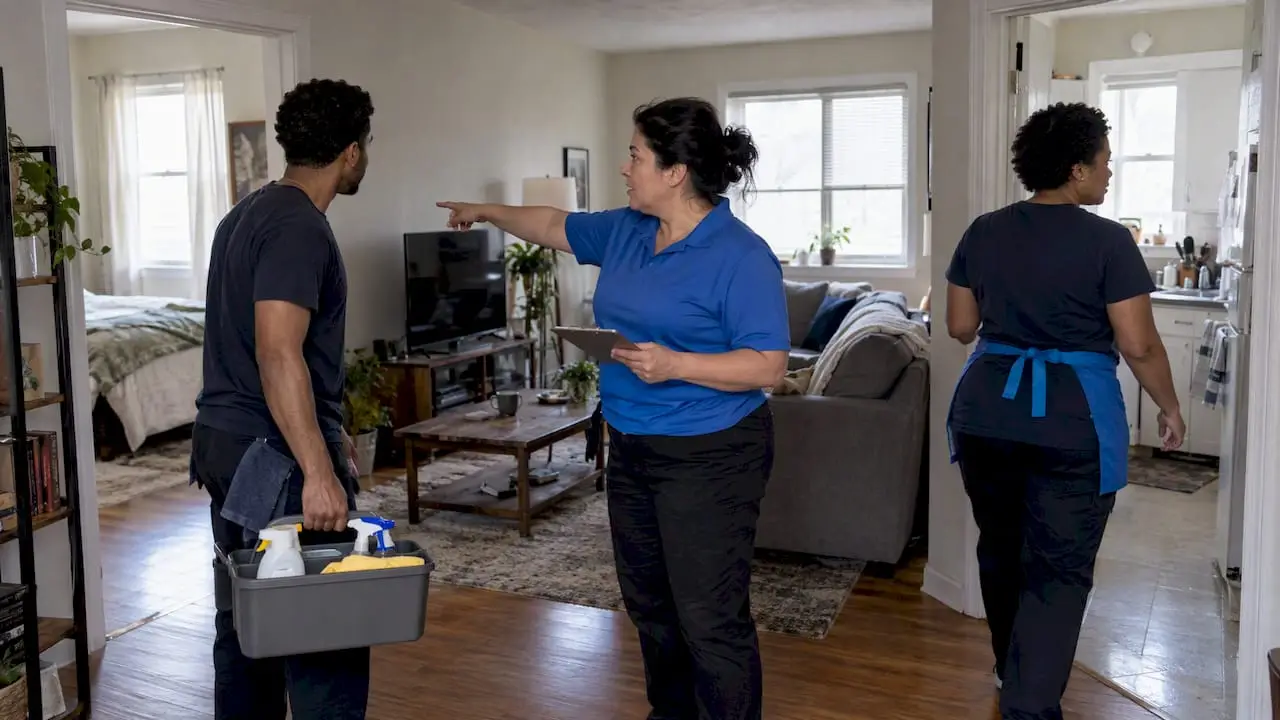
For a typical one to three bedroom home, one cleaner handles a routine clean and two cleaners handle most deep cleans within a normal service window. The right number shifts with job type, bedroom and bathroom count, how lived in the home is, and how tight the appointment window needs to be. The sections below show how we turn those variables into labor hours and a reliable headcount.
TL;DR:
- Use two cleaners for three bedroom homes, deep cleans, or tight windows; detailed move out jobs and large homes with short deadlines may need three.
- ISSA benchmarks put routine biweekly cleaning at 650 to 750 square feet per labor hour, while initial or deep cleans average about 500.
- Define rooms and tasks, estimate labor hours, divide by the service window, then round the headcount up and add a 10% to 20% buffer.
- Pets, visible clutter, and appliance add ons can increase labor estimates by 20% to 40%, so account for them before assigning the crew.
Table of Contents
- Quick crew-size guide by home size and job type
- How to estimate staffing: convert scope into labor hours
- Production rates and timing: what realistic speeds look like
- Scheduling, training, and safety when assigning multiple cleaners
- Sample staffing scenarios (concrete examples supervisors can copy)
- Applying this at Pure Homes Cleaning
- Practical priorities when deciding crew size
- How Pure Homes Cleaning can help
- FAQ
- Sources
Quick crew-size guide by home size and job type
A one-bedroom or two-bedroom apartment with a routine maintenance clean is a one-person job in most cases. Add a second cleaner once you cross into a three-bedroom, two-bath home, or any time the job type changes from routine to deep or move-out. These jumps are not about square footage alone: a two-bathroom condo often takes longer than a three-bedroom home with a single bath, because bathrooms and kitchens carry a disproportionate share of the labor.
As a scanning reference for booking sheets:
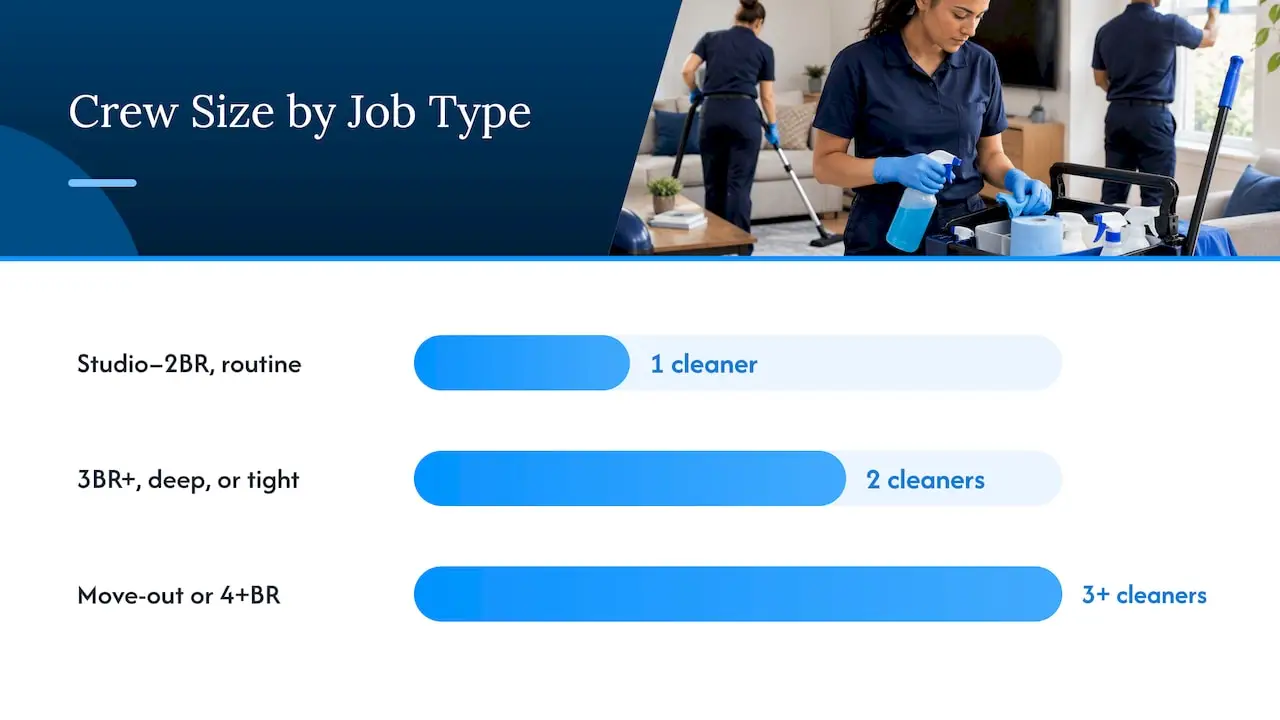
- One cleaner: studio to two-bedroom, one-bath, routine or light maintenance clean.
- Two cleaners: three-bedroom or larger, any deep clean, or a tight same-day service window.
- Three or more cleaners: move-out or move-in cleans with appliance and cabinet interiors, four-plus bedrooms, or a short window under three hours for a large home.
Short service windows change the math even when the home itself is modest. A customer who needs a two-bedroom unit turned around in ninety minutes for a same-day showing often needs two cleaners working in parallel rather than one cleaner working fast, because speed has a ceiling that headcount does not.
A few cues on the booking sheet tell a supervisor more than square footage does: visible clutter in photos or notes, pets in the home, and add-ons like inside-oven or inside-fridge cleaning. Each of these can add 20 to 40 percent to the labor estimate before you even touch a production-rate chart, and each is a reason to bump the crew size rather than stretch a single cleaner’s shift.
How to estimate staffing: convert scope into labor hours
Before any math happens, scope has to be nailed down. That means the specific rooms being cleaned, which tasks are included (inside appliances, baseboards, window tracks), and what the customer actually expects to see when they walk in. A vague scope produces a vague labor estimate, and a vague labor estimate produces a crew that is either sitting idle or racing the clock.
Once scope is clear, the conversion from scope to headcount follows a repeatable sequence:
- Pick a production-rate source: either a bedroom and bathroom proxy for routine quoting, or task-based workloading for anything non-standard. Care that many cleaning companies anchor quotes to bedroom and bathroom counts rather than square footage alone, because square footage does not capture how work is distributed through a home.
- Calculate total labor hours for the job using that rate, whether it comes from a published benchmark or your own team’s measured time per task.
- Divide total labor hours by the length of the service window the customer needs.
- Round up and add a buffer, typically 10 to 20 percent, to absorb the variability every real job carries. ISSA’s workloading guidance outlines this same sequence: decompose the job into tasks, assign production rates, calculate labor hours, and use the result to validate staffing rather than guess at it.
A task-based breakdown also exposes something important: two cleaners are not automatically twice as fast as one. Splitting a three-hour job between two people might cut elapsed time to ninety minutes, but it does not cut total labor hours, and some tasks like inside-cabinet detailing do not parallelize well in a cramped kitchen.
Pro Tip: Build a simple spreadsheet with task, average minutes, and room count, then let it auto-total labor hours whenever you plug in a new job’s scope.
Billing model matters here too. Care.com’s guidance on rate setting notes that hourly billing protects against underestimated scope since the clock simply runs longer, while flat-fee pricing gives the customer a predictable total but puts more pressure on your estimate being right the first time. Flat-fee jobs are where a documented buffer matters most, because a crew that runs short on time with a fixed price already quoted has no room to negotiate extra hours.
Production rates and timing: what realistic speeds look like
ISSA benchmarks put routine biweekly residential cleaning at roughly 650 to 750 square feet per labor-hour, while an initial or first-time clean drops to around 500 square feet per labor-hour. That gap exists because a first clean usually uncovers buildup, clutter, and areas that have not been touched in a while, all of which slow the work down regardless of how experienced the cleaner is.
These numbers are starting points, not guarantees. A few things pull the effective rate down:
- Extra bathrooms, since tile, grout, and fixtures take disproportionate time relative to their square footage.
- Kitchens with heavy appliance use, since stovetops, microwaves, and inside-fridge requests add minutes that a square-footage number does not account for.
- Homes with pets, since pet hair and tracked-in debris add vacuuming and mopping passes.
- Cluttered homes, since cleaners spend time moving items before they can clean the surface underneath.
Two quick examples show the conversion in practice. A 1,500 square foot home getting a routine clean at 700 square feet per hour needs about 2.1 labor-hours, which one cleaner comfortably covers in a two to three hour window. The same 1,500 square foot home getting an initial deep clean at 500 square feet per hour needs 3 labor-hours, which pushes a solo cleaner past a typical three-hour appointment and makes a two-person crew the safer call for a two-hour window.
ISSA’s Cleaning Times resource is a reasonable place to start if you want more granular task times, but published rates should always get checked against your own team’s actual pace before they drive a schedule.
Scheduling, training, and safety when assigning multiple cleaners
Staffing a crew is not just about hitting a labor-hour target. The Bureau of Labor Statistics reports that most maids and housekeeping cleaners receive on-the-job training rather than formal classroom instruction, which means a new hire’s first several jobs need a built-in training margin, not a full production-rate assignment on day one.
A few operational habits keep quality from slipping once more than one cleaner is on a job:
- Pair new hires with an experienced cleaner for at least the first few jobs rather than sending them out solo.
- Cap per-cleaner workload at a level that leaves room for a short break on jobs over three hours, since fatigue shows up as missed detail work before it shows up as missed time.
- Build a five to ten minute inspection slot into every job’s schedule rather than assuming the last task finishes exactly on time.
- For short windows, assign tasks by zone (kitchen, bathrooms, bedrooms) rather than by room-by-room sequence, so a handoff between cleaners does not create downtime.
Pro Tip: Keep a running log of which jobs ran over their estimated window and by how much; after a few weeks, that log tells you more about your real production rate than any published benchmark.
Sample staffing scenarios (concrete examples supervisors can copy)
These scenarios use the production rates above as a starting point, and each assumes a standard square footage home unless noted otherwise.
- One-bedroom, one-bath routine clean, 700 square feet. At 700 square feet per hour, that is 1 labor-hour, comfortably handled by one cleaner in a 90-minute window.
- Two-bedroom, two-bath routine clean, 1,200 square feet. At 700 square feet per hour, that is about 1.7 labor-hours. One cleaner fits a two-hour window; add a second cleaner only if the window drops to 60 minutes or the home has pets.
- Three-bedroom, two-bath deep clean, 1,800 square feet. At 500 square feet per hour for a deep or initial clean, that is 3.6 labor-hours. Two cleaners split that to roughly 1.8 hours each, fitting a two-hour window with a small buffer.
- Three-bedroom move-out clean with appliances and cabinets, 1,800 square feet. Move-out work runs closer to the initial-clean rate or slower once appliance interiors and cabinet detailing are added, often pushing total labor past 5 hours. Three cleaners bring that down to under two hours each, which fits the tight turnaround most move-out customers need before a final walkthrough.
- Two-bedroom routine clean with two bathrooms and a dog in the house. Treat the extra bathroom and pet hair as a 20 to 30 percent add to the base 1.7 labor-hour estimate, landing closer to 2.2 hours, which still fits one cleaner in a two-and-a-half hour window but leaves little room for a short window request.
Clutter, extra bathrooms beyond the base count, and add-on requests like inside-window cleaning should each nudge these numbers up before you finalize a crew assignment, not after a cleaner calls in from the job running behind.
Applying this at Pure Homes Cleaning
We size crews using the same logic laid out above across our Standard Cleaning, Deep Cleaning, and Move In Clean and Move Out Clean services. A routine Standard Cleaning on a typical apartment usually runs with one cleaner, while Deep Cleaning and most Move In Clean and Move Out Clean jobs get a two or three-person crew depending on bedroom count and condition. We use eco-friendly products across every service tier, and we build buffer time into every booking window so a crew is not racing a clock that was set without a real scope review. Supervisors who want to see the underlying math can request a sample staffing worksheet through our booking page.
Practical priorities when deciding crew size
The biggest mistake supervisors make is trusting a published production rate more than their own team’s track record. Measure actual completed-job times, feed inspection feedback back into your estimates, and treat any unfamiliar job type with a conservative buffer rather than an optimistic one. Flexible staffing beats a rigid headcount rule every time a job turns out to be bigger than the booking sheet suggested.
— Local
How Pure Homes Cleaning can help
If you are weighing crew sizes against a service window and want a second opinion, we can walk through the scope with you before you commit a staffing plan. We offer Standard Cleaning for routine maintenance, Deep Cleaning for first-time or seasonal resets, and Move In Clean and Move Out Clean for move-day deadlines with appliance and cabinet detailing included.
A few ways to put this guidance to work right away:
- Compare your own scope against our standard versus deep cleaning breakdown to confirm which service tier matches the job.
- Use our cleaning service walkthrough checklist to document scope before you estimate labor hours.
- Reference our deep clean checklist when a job includes appliance interiors or cabinet detailing.
Request a sample staffing worksheet or get a quote for your home through our online booking page and we will help you figure out the right crew size before the appointment is set.
FAQ
Do homeowners need to stay home when cleaners arrive?
Staying home is a personal preference, not a requirement. Many customers provide entry instructions and leave for the appointment, while others prefer to be present, especially for a first visit; either approach works as long as access and expectations are clear ahead of time.
Who typically needs professional cleaning services the most?
Busy households juggling work and family schedules, renters facing move-out deposit deadlines, and anyone managing a home with pets or limited time for deep cleaning tend to rely on professional cleaning the most. First-time or infrequent cleans also tend to take longer, which is a common reason households bring in a crew rather than tackle buildup alone.
How long does it take to clean a 1,500 square foot house?
At a routine production rate of roughly 650 to 750 square feet per labor-hour, a 1,500 square foot home takes about 2.1 labor-hours for a standard clean. A first-time or deep clean at closer to 500 square feet per hour takes about 3 labor-hours, which often calls for two cleaners to finish within a typical appointment window. You can see how labor hours translate to actual clock time in our guide to cleaning duration.
How can someone clean a house in two hours?
A two-hour window works best for a routine maintenance clean on a smaller home, or for a larger home when two cleaners split the work by zone instead of working room by room in sequence. Focusing on high-traffic areas, kitchens, and bathrooms first, and saving lower-priority tasks for a longer appointment, helps a crew hit a tight deadline without cutting corners on the areas customers notice most; our prep checklist for cleaners also helps shorten the time needed on-site.
What is the difference in staffing between a deep clean and a move-out clean?
A deep clean typically adds detailed tasks like baseboards and inside-appliance cleaning to a routine scope, while a move-out clean adds cabinet interiors, full appliance detailing, and often a stricter deadline tied to a lease or closing date. Move-out jobs generally need one more cleaner than an equivalent deep clean to meet that deadline reliably, as outlined in our move-out cleaning checklist.
Sources
- Workloading: Finding the right balance — ISSA
- Care
- Maids and housekeeping cleaners — U.S. Bureau of Labor Statistics