

The realistic fix is a rhythm, not a marathon: 10 to 20 minutes of daily resets, one deeper task assigned to each weekday, and a monthly rotation for the jobs that build up quietly. That structure keeps a home functional without eating your Saturday. If a week falls apart anyway, protecting three tasks (beds, kitchen, one load of laundry) is enough to restart Monday, and hiring a service like Purehomescleaning for the deep-clean layer is a legitimate part of the plan, not a failure of it.
TL;DR:
- Short, daily routines focused on quick reset tasks can keep a home functional with only 30 to 45 minutes spread across the day.
- Assigning one deeper cleaning task to each weekday makes maintenance manageable without overwhelming weekend efforts.
- Monthly deep-cleaning jobs should be spread across weeks to avoid overwhelming weekends, with specific tasks like oven cleaning or vent dusting scheduled in rotation.
- Sharing chores through task, day, or zone methods, and involving kids early, helps distribute workload and teach responsibility effectively.
- Hiring professional cleaning services for deep or seasonal tasks provides essential support when families face unpredictable schedules or need a reset.
Table of Contents
- Building a Daily Cleaning Schedule for Busy Families
- What’s the Best Weekly Cleaning Routine for a Family?
- How Often Should You Deep Clean Beyond the Weekly Tasks?
- How Do You Split Chores Between a Partner and Kids?
- Adjusting the Plan for Real Life: Single Parents, Shift Work, and Pets
- How Professional Cleaners Fit Into a Family’s Routine
- Meal Prep and Kitchen Cleaning Inside the Weekly Plan
- Managing Clutter So Cleaning Actually Sticks
- Keeping Cleaning Supplies Organized and Within Reach
- Seasonal Cleaning Tasks Beyond the Monthly Rotation
- The Overlooked Truth About Cleaning Schedules
- When It Makes Sense to Book Professional Help
- Sources
- FAQ
Building a Daily Cleaning Schedule for Busy Families
Three short windows a day beat one long session on Saturday. A 10-minute morning routine, a 15-minute after work reset, and a 15-minute evening wind down adds up to roughly 30 to 45 minutes total, spread across a day that already has structure built into it. That’s the whole trick: you’re not adding a new task to your day, you’re attaching a five-minute chore to something you already do, like brushing your teeth or starting the coffee maker.
Here’s what each window actually looks like in a real house with real kids in it.
- Morning (10 minutes). Make the beds while the shower runs. Start a load of laundry before anyone leaves for school or work. Wipe bathroom counters and the sink while brushing teeth. Load stray dishes from the night before into the dishwasher.
- After work (10 to 15 minutes). Reset the kitchen first: dishes into the dishwasher, counters wiped, table cleared. Do a 5 minute living-area pickup, shoes to the closet, backpacks off the floor, remotes back on the side table.
- Evening wind-down (10 to 15 minutes). Run the dishwasher. Set out tomorrow’s clothes or lunch items. Do a final sweep of common areas so you wake up to a clean kitchen instead of last night’s mess.
None of this requires a special product or a color-coded binder. It requires three or four small habits attached to things you’re already doing. A combined daily rhythm of 10 to 15 minutes plus one deeper weekday job is what keeps the house “good enough” between the bigger weekly and monthly efforts covered further down.
A few small mechanics make this easier to sustain than it sounds. Keep a clutter basket by the stairs or the front door. Anything out of place gets tossed in, and whoever’s heading that direction on their next trip carries it back to where it belongs. That one basket eliminates a dozen tiny “where does this go” decisions a day.
Adopt a dishwasher-first rule: nothing sits in the sink. If it’s dirty, it goes straight into the dishwasher or gets hand-washed on the spot. A sink full of dishes is the single biggest visual signal that a kitchen, and by extension a house, feels out of control. Fixing that one habit changes how the whole room feels.
And give laundry a landing zone. A hamper in every bedroom, plus one shared bin for towels, means clothes have a home the second they come off, instead of piling on a chair for three days before anyone deals with them.
Pro Tip: Run your evening dishwasher load right before bed instead of after breakfast. You wake up to an empty, ready-to-load dishwasher, which makes the morning 10 minutes noticeably faster.
This daily layer is the floor, not the ceiling. It won’t catch bathroom grime or dusty blinds. That’s what the weekly and monthly layers are for, and building those on top of a solid daily habit is far easier than trying to catch up from zero every weekend.
What’s the Best Weekly Cleaning Routine for a Family?
Assign one deeper cleaning task to each weekday instead of stacking them all into a Saturday marathon. This is the model behind most working-parent cleaning schedules, and it works because a single 30 to 45 minute task on a Tuesday feels manageable in a way that four hours on a Saturday never does.
Here’s a sample layout you can copy straight into a family calendar or a kitchen whiteboard:
- Monday: Bathrooms (30 to 40 minutes). Toilets, tubs, showers, mirrors. Tackle it right after the weekend, before grime sets for a full week.
- Tuesday: Dusting and surfaces (20 to 30 minutes). Shelves, TV stands, window sills, baseboards you can reach without moving furniture.
- Wednesday: Floors (30 to 45 minutes). Vacuum carpets and rugs, sweep and mop hard floors. Midweek keeps buildup from turning into a bigger job later.
- Thursday: Kitchen deep wipe (20 to 30 minutes). Beyond the daily reset: appliance fronts, backsplash, inside the microwave, cabinet handles.
- Friday: Laundry catch-up (30 to 45 minutes). Fold and put away anything that piled up during the week so the weekend starts clear.
- Saturday: 20 minute mini reset. A quick walk-through to straighten what the week missed, plus any outdoor or garage tidying. Sunday stays open.
Each task sits in its own day, which means no single day eats more than 45 minutes, and most weekends stay genuinely free. That’s the entire point of spreading deeper tasks across weekdays instead of hoarding them for Saturday morning.
Some households do better with the opposite approach: one longer weekly block instead of five small ones. If your weekdays are packed with school pickups, practices, and overtime shifts, carving out a single 90 minute to two-hour Saturday or Sunday session for everything, bathrooms, floors, dusting, at once can actually be less mentally taxing than trying to remember five different daily assignments. Both models are legitimate; the day-by-day rotation suits families with predictable evening windows, while the single-block approach suits families whose weekdays are too unpredictable to promise a Tuesday task will happen on Tuesday.
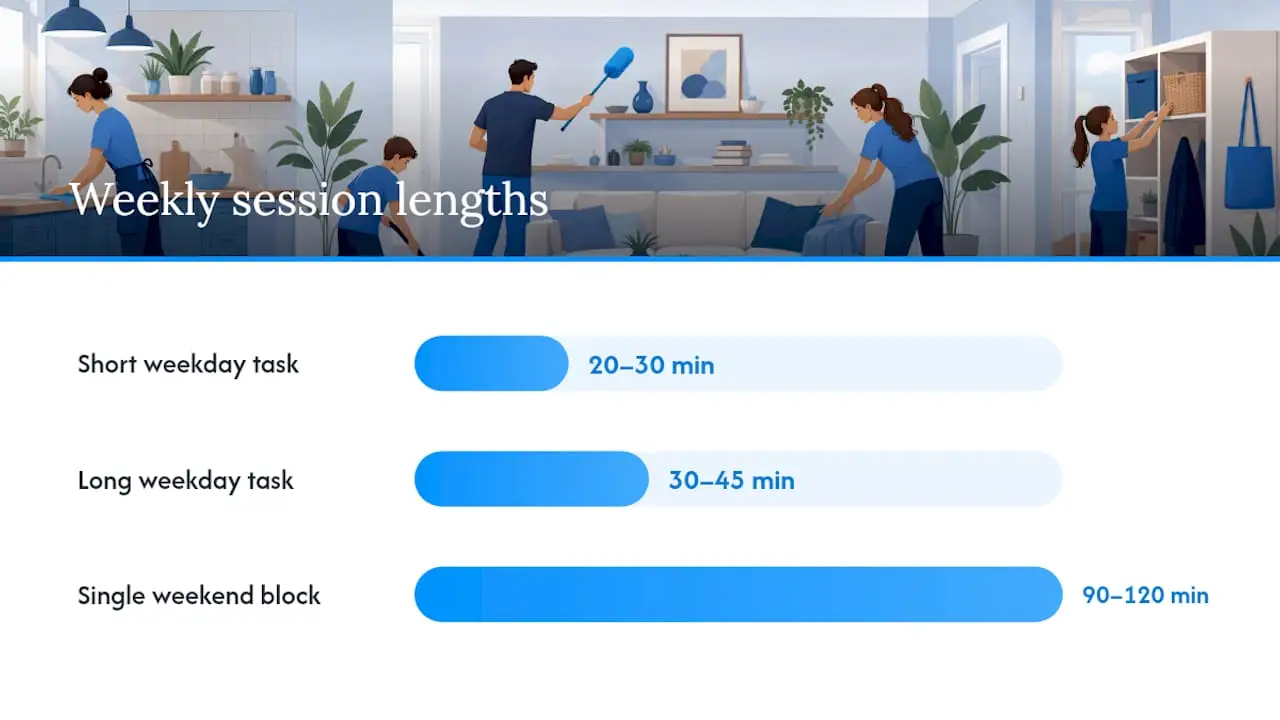
The choice comes down to your household’s actual rhythm, not what looks best on a printable chart. A two-income family with rigid 9-to-5 schedules and a defined evening routine tends to thrive on the daily rotation. A family with rotating shift work, toddlers who blow up nap schedules, or unpredictable overtime often does better protecting one solid weekend block and keeping weekdays to the bare daily reset.
Whichever model you pick, write it somewhere visible. A shared digital calendar, a magnet on the fridge, or a dry-erase chore board all work. The schedule only holds up if everyone in the house can glance at it and know today’s job without asking.
How Often Should You Deep Clean Beyond the Weekly Tasks?
Once a month covers the jobs that don’t need weekly attention but will absolutely make themselves known if ignored for a season. Rotating monthly deep-clean tasks prevents hidden buildup in places your weekly routine simply doesn’t reach.
Here’s a realistic monthly list, spread across the month so no single weekend absorbs all of it:
- Oven interior, degreased and wiped down, roughly 30 to 45 minutes.
- Refrigerator, emptied, wiped, and expired items cleared, about 30 minutes.
- Baseboards throughout the house, wiped or vacuumed, 20 to 30 minutes.
- Air vents and ceiling fans, dusted or vacuumed, 15 to 20 minutes per room.
- Blinds and curtains, dusted or laundered depending on material, 20 to 40 minutes.
- Under furniture and behind appliances, vacuumed, 20 minutes.
Instead of doing all six in one weekend, pair one task with each weekly cycle. Tackle the oven during week one’s kitchen day, the fridge during week two, baseboards during week three, and vents, blinds, and under-furniture spots during week four. That spreads roughly 30 minutes of extra work into a week that already has a rhythm, rather than creating a second, dreaded “deep clean day.”
Put these on a recurring digital calendar reminder or a physical chore board with a rotating magnet so nobody has to remember which month covers the oven. If your kitchen needs a more detailed walk-through, Purehomescleaning’s kitchen deep cleaning checklist breaks the oven, fridge, and cabinet tasks into a step-by-step order that’s easy to follow even at 8 p.m. on a Thursday.
If you’ve fallen behind, triage before you panic. Pick the task with the most visible impact, usually the kitchen or the bathroom, and do that one first. Skip the rest of the list this month and pick it back up next month. A missed rotation isn’t a failed system; it’s just a delayed task.
How Do You Split Chores Between a Partner and Kids?
Splitting tasks works three different ways, and most families end up blending them rather than picking one purely.
By task. One partner always handles kitchen and laundry, the other always handles bathrooms and floors. This works well when one person has a stronger routine or preference for certain jobs, but it can feel unbalanced if the tasks aren’t equally time-consuming.
By day. Partners alternate full responsibility for the daily reset, one person owns Monday, Wednesday, Friday, the other owns Tuesday, Thursday, Saturday. This spreads the mental load evenly but requires both people to know the full routine, not just their half.
By zone. One partner owns the kitchen and living areas, the other owns bedrooms and bathrooms. This tends to work best in larger households because each person becomes the default expert in their zone, which speeds things up over time.
Kids belong in this system as soon as they can hold a toy. Age-appropriate assignments make the chore load lighter while teaching real responsibility, not just busywork:
- Ages 3 to 5: Toy pickup, putting books on a low shelf, helping carry laundry to the hamper.
- Ages 6 to 10: Making their own bed, setting or clearing the table, vacuuming a single room, feeding pets.
- Ages 11 and up: Full ownership of their bedroom and bathroom, loading and running the dishwasher, taking out trash and recycling, basic laundry from wash to fold.
A fridge chart with names and checkboxes, a shared digital calendar everyone can see, and a kitchen timer for races against the clock all help chores stick. Small reward systems, extra screen time, a later bedtime on Fridays, work better than cash for younger kids, who respond more to immediate, visible payoff.
Pro Tip: Demo the task once, out loud, narrating what you’re doing. Kids copy behavior far faster than they follow instructions, and a five-minute demo saves you weeks of re-explaining.
Praise the effort, not just the result. A ten-year-old’s version of “clean” won’t match yours, and pointing that out every time kills motivation fast.
Adjusting the Plan for Real Life: Single Parents, Shift Work, and Pets
Every schedule breaks eventually, usually the week a kid gets sick or a work deadline eats your evenings. The fix isn’t a better schedule; it’s a smaller one you can hold onto no matter what.
- In a crisis week, protect three things only: beds made, kitchen and dishes reset, and at least one load of laundry moving. Everything else can slide without guilt, because those three tasks keep a house livable even when nothing else gets touched.
- Single parents should lean harder on the daily micro-habits since there’s no partner to split weekly zones with. Doubling down on the clutter basket and dishwasher-first rules matters more here, since there’s less backup labor available on a bad day.
- Pet owners need extra focus on lint, fur, and litter, not a whole new system. A robot vacuum running a short daily pass on high-traffic floors handles fur buildup that would otherwise wait for the weekly vacuum day. If pets are part of your daily chaos, Purehomescleaning’s guide on cleaning with pets covers a realistic daily routine built around shedding, tracked-in dirt, and litter box maintenance.
- Shift workers should anchor tasks to wake and sleep, not clock time. If your “morning” starts at 3 p.m., that’s still your morning routine slot, run it right after you wake up rather than trying to force it into a 7 a.m. window that doesn’t exist for you.
- Know which tasks to hand off first if you’re going to outsource. Deep cleaning (ovens, baseboards, grout) is the highest-value task to hand to a professional, since it demands the most time for the least frequent payoff. Daily resets are the cheapest to keep doing yourself since they take minutes, not hours.
How Professional Cleaners Fit Into a Family’s Routine
A cleaning schedule doesn’t have to mean doing every task yourself forever. Hiring outside help can meaningfully cut household stress, and for some families it becomes less of a luxury and more of a necessary support once work and parenting hours stop leaving room for deep cleaning.
Professional cleaning services can support households juggling full schedules by offering routine, deep, and move-in or move-out cleaning options. A few things worth knowing:
- Some cleaning services offer customizable plans, allowing recurring standard cleanings for maintenance with seasonal deep cleans, rather than rigid packages.
- Many cleaning providers use eco-friendly products, which matters for households with kids or pets touching surfaces soon after cleaning.
- Online booking, current promotions, and customer reviews are all available directly on the Purehomescleaning site, so you can compare options before committing.
- The company’s own resources, including a kitchen deep cleaning checklist, double as practical guides even for families not ready to book yet.
Framed this way, professional help isn’t an all-or-nothing decision. Pairing an occasional deep clean with your own daily resets tends to give a schedule far more resilience than trying to do everything solo, every week, indefinitely.
Meal Prep and Kitchen Cleaning Inside the Weekly Plan
Kitchens get dirty faster than any other room because they’re used constantly, which means meal prep habits and cleaning habits need to work together, not separately. Prep on a clear counter, not a cluttered one. Spend two minutes clearing counters before you start cooking so cleanup afterward doesn’t require untangling mail and mugs from actual food mess.
Wash as you go. Rinse mixing bowls and utensils between steps instead of letting everything pile up for one big session after dinner. This alone can cut post-meal cleanup time in half, since the sink never fills past a couple of items.
Designate one cutting board and one set of utensils for raw meat prep, and wipe that zone down immediately after use rather than waiting for the full kitchen reset. Cross-contamination risk drops, and you’re not scrubbing dried-on residue an hour later.
If your family does batch cooking on weekends, treat that session as its own contained cleanup: wipe counters and stovetop immediately after the last dish comes off the burner, not after the food’s been portioned into containers and put away. A five-minute wipe-down while things are still warm beats a fifteen-minute scrub once sauce has dried onto the stovetop.
Tie this into the weekly rotation from earlier: Thursday’s kitchen deep wipe day is the natural spot to also clean out the fridge shelf where meal-prep containers live, so leftovers don’t quietly expire behind Tuesday’s takeout box.
Managing Clutter So Cleaning Actually Sticks
Clutter and dirt are different problems, and treating them the same is why so many cleaning schedules fail. You can vacuum a floor covered in toys, shoes, and mail, but it won’t look clean, because the clutter is doing the visual damage, not the dust.
Run a five minute nightly “surface sweep” separate from your cleaning tasks: clear counters, tables, and floors of anything that doesn’t belong, using that clutter basket mentioned earlier as the default catch-all. This step alone makes a home look dramatically tidier without touching a mop or a rag.
Apply a one-in-one-out rule for toys, clothes, and kitchen gadgets. When something new comes into the house, something equivalent leaves. This keeps clutter from slowly expanding to fill every shelf and drawer you own, which is the real reason closets get harder to close every year.
Give categories of clutter, mail, school papers, shoes, a single designated landing spot near the door or entry table. Clutter accumulates fastest in transition zones, where things get set down “for a second” and never picked back up. A labeled basket or tray in that exact spot solves most of it. For a broader system, the home-organization tips from One Day Doors & Closets walk through setting up entry and storage zones that make seasonal transitions, like back-to-school chaos, much easier to manage.
Keeping Cleaning Supplies Organized and Within Reach
A schedule only works if the supplies it depends on are easy to grab, which is why disorganized cleaning closets quietly sabotage more routines than lack of motivation ever does.
Keep a small caddy of daily-use products, glass cleaner, all-purpose spray, a microfiber cloth or two, on the main floor near the kitchen or a central closet. If grabbing a cleaner requires a trip to the basement, that 10 minute after-work reset turns into 15 minutes of searching first.
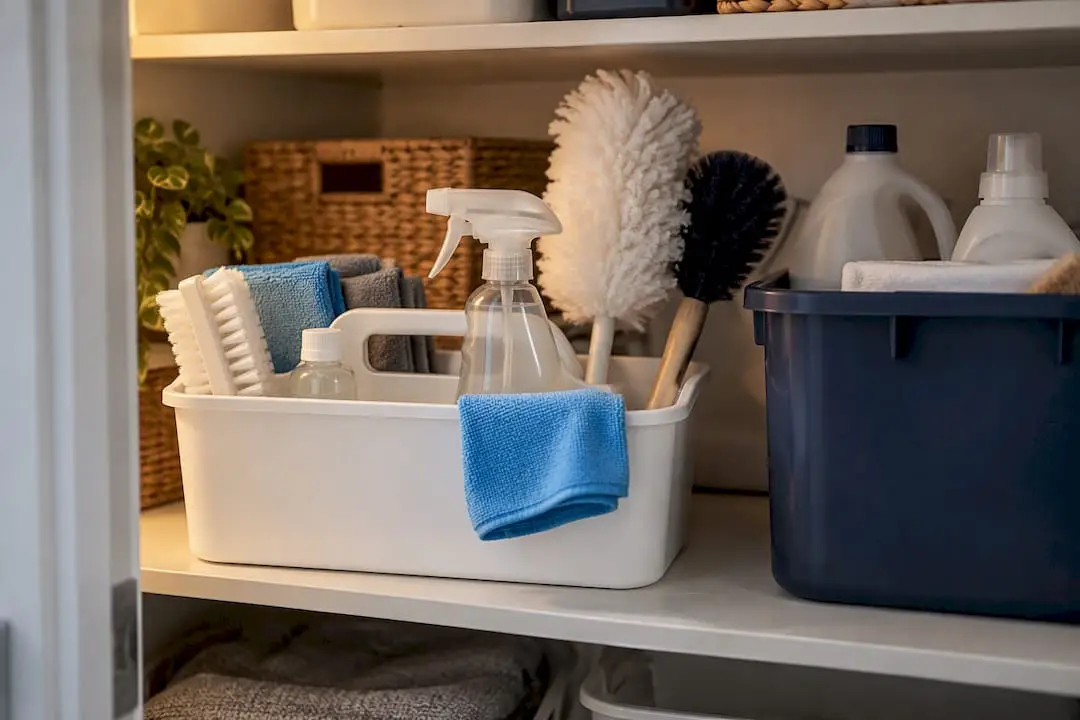
Store heavier-duty or less frequent products, oven cleaner, grout scrub, dusting tools for blinds, together in one bin labeled for monthly tasks. When oven week rolls around, everything you need is already grouped, instead of scattered across three cabinets.
Do a quick supply check on the same day each month, ideally right before your monthly deep-clean rotation starts. Toss anything expired, restock what’s running low, and you’ll never hit “oven day” only to discover the degreaser is empty.
Assign kids their own small, clearly labeled supply set, a spray bottle of diluted vinegar solution, a soft cloth, so they’re not waiting on shared adult supplies to do their assigned chores.
Seasonal Cleaning Tasks Beyond the Monthly Rotation
Some jobs only need attention two to four times a year, which means they don’t belong in a monthly rotation at all. Trying to force seasonal tasks into a monthly schedule is a common reason families feel like the list never ends.
Spring and fall are the natural windows for switching out closet items by season, washing windows inside and out, and deep-cleaning carpets or rugs professionally or with a rented machine.
Early summer is the right time to clean outdoor furniture, patio surfaces, and grills before peak-use months, plus checking gutters and exterior fixtures if that falls within your household’s responsibility.
Late fall, before heating season starts, is when HVAC filters, dryer vents, and chimney or fireplace checks matter most, since these directly affect both air quality and fire safety once heating systems run daily.
Back-to-school season is a natural clutter checkpoint: sorting outgrown clothes, clearing last year’s school papers, and resetting entryway storage for a new routine of backpacks and shoes.
Mark these on the same calendar you use for weekly and monthly tasks, but flag them as seasonal so they don’t compete for attention with this week’s bathroom day. A task that only happens twice a year deserves its own reminder, not a spot squeezed into an already full month.
The Overlooked Truth About Cleaning Schedules
Most cleaning advice treats consistency as a willpower problem. It isn’t. It’s a design problem. Families who “fail” at cleaning schedules usually built a schedule that assumed a version of their week that doesn’t exist, one with no sick kids, no overtime, no broken dishwasher.
The families who make this work aren’t the ones with the most detailed chart. They’re the ones who built in slack: a three-task minimum for bad weeks, a rotation instead of a single deadline, permission to skip a monthly task without restarting the whole system. That’s the piece conventional advice skips. It hands you a perfect weekly grid and no plan for the week that grid falls apart.
Prioritize the daily habits first, not the monthly ones. A house with a clean kitchen and made beds feels calmer than a house with a spotless oven and a sink full of dishes. Get the daily rhythm boring and automatic before you worry about baseboards.
— Local
When It Makes Sense to Book Professional Help
Some weeks, the schedule just needs backup, not a better spreadsheet. Purehomescleaning gives busy households in Washington, DC, Virginia, and Maryland a way to keep the deep-clean layer running without sacrificing a weekend to it, using eco-friendly products and flexible plans built around families juggling work and everything else.

Hiring help tends to pay off most in three situations: recurring maintenance when your weeks are simply too full for the weekly rotation above, a reset before or after a big event when guests are coming and there’s no time to spare, and stretches where illness, injury, or exhaustion make even the daily 10 minute resets feel impossible. None of those are failures. They’re just the moments a schedule is designed to hand off.
Matching the service to the moment matters. Standard cleaning covers routine maintenance, the kind of upkeep your weekly rotation handles most weeks. Deep cleaning fits seasonal resets or the monthly rotation described earlier, especially when you’ve fallen behind on a few cycles. Move-in and move-out cleaning covers transitions, and readers weighing which one fits can compare both directly through the booking page to see current availability and pricing.
Sources
- Best Cleaning Schedule for Working Parents: 15 Minutes a Day — Homsy Blog
- Cleaning Schedule for Working Moms: Daily to Monthly · SelfLoveMom
- Home cleaning routine daily, weekly & monthly – My Homes Life
- I Judged People With House Cleaners. Hiring One Changed My Life. – Business Insider
FAQ
How Many Hours a Week Should Cleaning Take?
Most working parents can maintain a home with short daily upkeep plus one deeper task per weekday, which totals a few hours spread across the week. That’s spread across small windows rather than one long block, based on the daily and weekly structure most working-parent routines follow.
What’s the Minimum Cleaning Schedule for a Bad Week?
Protect three tasks only: beds made, kitchen and dishes reset, and one load of laundry moving. This minimal core keeps a home livable during sickness, deadlines, or travel without requiring the full weekly rotation.
What Age Should Kids Start Doing Chores?
Kids as young as 3 to 5 can handle toy pickup and carrying laundry to a hamper, while chores scale up to full bedroom ownership and dishwasher duty by age 11 and up. Starting early builds the habit before resistance sets in during the tween years.
How Much Does It Cost to Hire a House Cleaner?
Pricing depends on home size, service type, and how often you book, so current rates for Standard, Deep, Move In, and Move Out cleaning are listed directly on the Purehomescleaning services page. Booking a recurring plan generally costs less per visit than one-off cleanings.
Should I Clean Daily or Just Once a Week?
A blend works better than either extreme: short daily resets keep the kitchen and common areas functional, while one deeper weekday task rotates through bathrooms, floors, and dusting. Both the daily and weekly layers are designed to work together, not as competing systems.