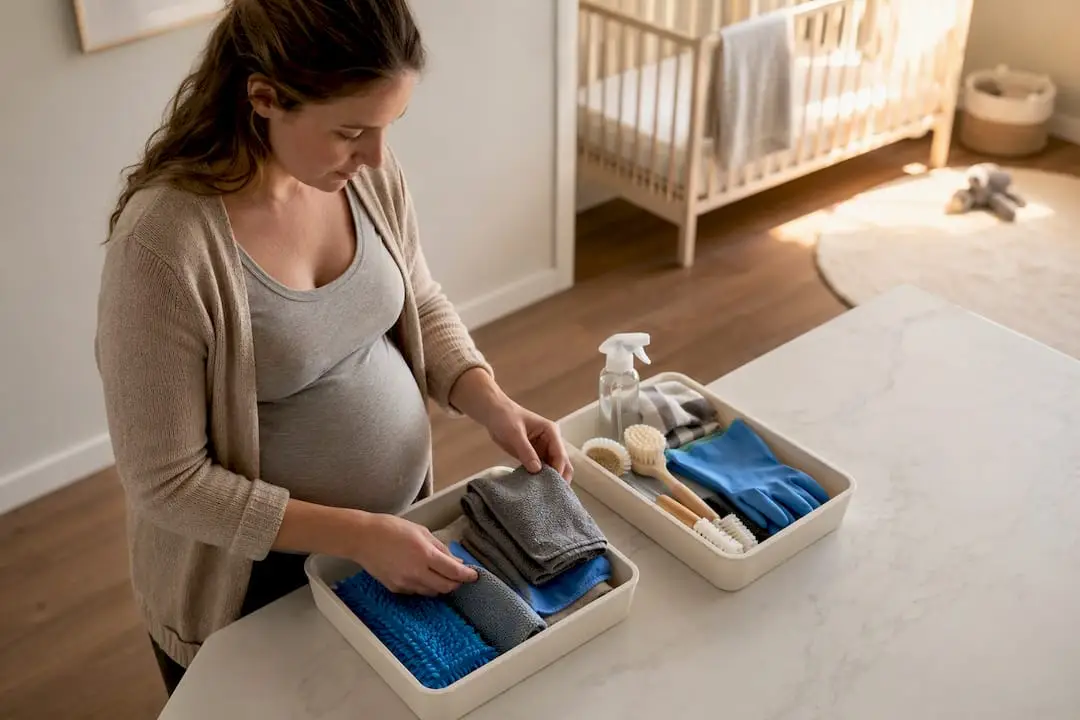
A nesting cleaning checklist works best when it prioritizes three things right away: clear and sanitize the sleeping and feeding zones, deep clean the surfaces baby will actually touch, and stock the essentials you’ll need in the first two weeks. Everything else, including deep decluttering and heavy scrubbing, can wait or get delegated. Skip harsh chemicals and heavy lifting; both carry real risk in late pregnancy.
TL;DR:
- Prioritize cleaning and sanitizing the baby’s sleep and feeding zones, including assembling the crib, stockpiling diapers, wipes, and feeding supplies, and cleaning the car seat early.
- Deep clean surfaces that the baby will frequently touch, such as high-to-low dusting, carpet shampooing, window washing, and replacing HVAC filters, ideally one to two weeks before delivery.
- Remove household hazards like loose cords, old chemicals, and dust in the nursery and common areas, ventilate thoroughly after cleaning, and avoid waiting until the last minute for safety checks.
- Delegate tasks like deep cleaning carpets and cleaning supplies disposal to professionals or family to reduce exhaustion and ensure safety, especially in the third trimester.
- Maintain a simple, realistic postpartum cleaning routine focusing on high-touch, high-germ areas, using quick daily tasks and clear responsibilities to prevent burnout.
Table of Contents
- Your Room-by-Room Nesting Cleaning Checklist
- Deep-Clean Checklist: Surfaces, Floors, Textiles, and Air
- Non-Obvious Safety Checks Most Nesting Lists Skip
- Stocking Up: Groceries, Freezer Meals, and Postpartum Supplies
- Laundry and Sterilizing: Bottles, Pump Parts, and Baby Clothes
- When to Tackle Nesting Tasks Without Overdoing It
- Disposing of Old Cleaning Chemicals Safely
- Airing Out Your Home After a Deep Clean
- Setting Up a Cleaning Routine After Baby Arrives
- Getting Family and Professionals Involved Without the Guesswork
- Bringing in Professional Help: What to Ask For
- Why the Checklist Matters More Than the Instinct
- Sources
- FAQ
Your Room-by-Room Nesting Cleaning Checklist
Nesting hits most people hard in the third trimester, which starts at week 28, though the urge can show up earlier or not at all. It’s not a signal that labor is close, so don’t panic if you feel it at 24 weeks or never feel it. What matters is having a plan that turns the impulse into something useful instead of an exhausting free-for-all.
Start with the spaces that touch your baby’s daily routine, not the ones that just bother you visually.
Closets and drawers
- Sort baby clothes by size, not by outfit “cuteness,” so you’re not digging through newborn gowns when your baby has already outgrown them.
- Purge anything with broken zippers, missing snaps, or stains you can’t lift; donate or toss rather than storing “just in case.”
- Build a baby-basics zone within arm’s reach of the changing area: diapers, wipes, a few onesies, and swaddles.
Nursery
- Assemble the crib or bassinet early and check it against current safety standards, not hand-me-down instructions from a decade ago.
- Clear cords, rugs, and anything with a tripping risk from the path between the bed and the crib.
- Set up the diaper station with everything grouped in one bin so 3 a.m. changes don’t require a search party.
Kitchen and pantry
- Clear counters of anything that isn’t food prep or bottle washing related.
- Dedicate one shelf to formula, bottles, and feeding supplies so you’re not hunting through cabinets one-handed.
- Label freezer meals with contents and date; future exhausted you will thank present you.
Bathroom and master bedroom
- Build a postpartum recovery basket: pads, peri bottle, pain reliever, and comfortable clothing, staged where you’ll actually rest.
- Clear the nightstand of clutter and stock it with water, snacks, and your phone charger.
Living spaces and car
- Create a landing zone near the front door for diaper bags, going-home outfits, and car seat access.
- Secure loose cords, blind pulls, and small breakable decor at floor and low-shelf level.
Organizing before a cleaning crew arrives also makes any deep clean faster and cheaper, since a technician’s time goes toward sanitizing, not sorting your mail pile.
Deep-Clean Checklist: Surfaces, Floors, Textiles, and Air
Decluttering clears the runway; deep cleaning is the actual work of reducing dust, allergens, and germs before a newborn immune system has to deal with them. Work top to bottom in every room so you’re not re-dusting a shelf after you’ve already vacuumed the floor beneath it.
- Dust high to low. Start with ceiling fans and light fixtures, then move to shelves, window sills, and baseboards. Door frames collect more dust than most people expect.
- Vacuum with a HEPA filter if your machine has one. It traps particles that a standard filter recirculates right back into the air.
- Shampoo carpets or book a professional carpet clean, especially in the nursery and any room with heavy foot traffic. Carpet holds dust, pet hair, and residue that regular vacuuming never fully lifts.
- Clean windows and blinds, and steam clean upholstery on couches or gliders where you’ll be nursing or rocking a baby to sleep.
- Replace HVAC filters before baby arrives. A fresh filter directly affects the air quality in every room, not just where you clean by hand.
- Test smoke and carbon monoxide detectors, and replace batteries even if they seem fine. This is one of the most commonly overlooked pre-baby safety tasks, and it takes five minutes.
High-touch surfaces deserve their own pass: doorknobs, light switches, remote controls, and cabinet handles. A dedicated high-touch surface protocol keeps this from becoming guesswork.
Pro Tip: Do the nursery deep clean at least a week before other rooms. Fresh paint fumes, new carpet smell, and cleaning residue all need time to dissipate before a newborn spends eight hours a day breathing that air.
If shampooing carpets or scrubbing grout sounds like more than your body can handle right now, that’s a reasonable place to hand off the job rather than push through it; make sure to choose safe materials as detailed in Nursery Wallpaper Safety Explained for Parents.
Non-Obvious Safety Checks Most Nesting Lists Skip
Cleaning gets all the attention, but a few safety tasks matter just as much and get forgotten because they don’t look like chores.
- Install the car seat and practice using it before your due date, not the morning you’re discharged from the hospital. Fit varies by vehicle, so check it against your specific car’s manual, not just the seat’s instructions.
- Test smoke and carbon monoxide detectors and swap batteries even if the indicator light looks fine.
- Update emergency contacts in your phone and map your fastest hospital route, including a backup if there’s traffic or road construction.
- Check your car’s basics, oil, tire pressure, gas, so a 2 a.m. drive isn’t complicated by a dashboard warning light.
- Assemble a simple first-aid kit and know your pediatrician’s after-hours line before you need it.
Car seat installation errors are common enough that many fire departments and hospitals offer free inspection stations, worth using even if you’re confident you did it right.
Quick fact: Nesting can happen anytime during pregnancy, but it’s most frequently reported in the third trimester, which is exactly when these safety tasks tend to get squeezed out by exhaustion. Front-loading them earlier avoids that crunch.
Stocking Up: Groceries, Freezer Meals, and Postpartum Supplies
You don’t need a stockpile. You need enough that a grocery run isn’t required during the first week home.
Starter stock
- Diapers in newborn and size 1 (babies often skip newborn size fast, so don’t overbuy it).
- Wipes, at least a case, plus a few travel packs for the diaper bag.
- Bottles and formula backup even if you’re planning to breastfeed; flexibility matters more than plans in week one.
Freezer meals
- Casseroles, soups, and anything that reheats in one pot are worth batch cooking and labeling with contents and date before your due date.
- Portion meals for two people, not a family of four, unless you’re also feeding visitors.
Postpartum recovery
- Pads, a peri bottle, stool softener, and pain reliever staged in the bathroom, not buried in a bag.
- Loose, comfortable clothing kept where you’ll actually get dressed, not in a closet across the house.
Pro Tip: Pack your hospital bag by category, toiletries, chargers, going-home outfit, documents, in separate small pouches instead of loose in one bag. You’ll dig through it exhausted and one-handed; organization there saves real frustration.
Laundry and Sterilizing: Bottles, Pump Parts, and Baby Clothes
Newborn skin and lungs are more sensitive than an adult’s, so the detergent and cleaning products you’ve used for years might not be the right call anymore.
- Choose fragrance-free, dye-free detergent. Experts recommend avoiding bleach, phthalates, formaldehyde, synthetic fragrances, and dyes in anything that touches a newborn.
- Wash new baby clothes, crib sheets, and blankets before first use, and keep sheets on a weekly wash cycle once baby’s home, more often if there’s spit-up or a diaper blowout.
- When sanitizing bottles and pump parts, follow the manufacturer’s guidance on which pieces are dishwasher-safe versus hand-wash only, and air-dry everything on a clean rack rather than toweling dry.
- Look for products carrying EPA Safer Choice or EWG verification; both offer third-party screening most drugstore brands don’t disclose.
Products labeled “green” without one of those certifications aren’t automatically safer. Read the ingredient list, not just the front label. Pure Homes Cleaning’s guide to eco-friendly, low-VOC cleaning walks through which swaps actually reduce chemical exposure versus which are marketing.
When to Tackle Nesting Tasks Without Overdoing It
Timing and pacing matter more than most checklists admit. Here’s a rough sequence that works for most third-trimester schedules:
- Weeks 28 to 32: Handle anything requiring physical exertion, deep cleaning carpets, moving furniture, painting the nursery. Your energy and mobility are better now than they will be later.
- Weeks 32 to 36: Finish stocking, laundry, and sterilizing. Assemble the car seat and practice installing it.
- Weeks 36 and beyond: Focus on light maintenance and final touches. Big projects should already be done.
Pace yourself with actual breaks, not just good intentions: stop every 20 to 30 minutes, avoid ladders entirely, and skip anything that requires heavy lifting. Mild alternatives like baking soda, vinegar, and gentle soap handle most light cleaning without the fumes of stronger products.
Worth knowing: Nesting isn’t a reliable predictor of labor timing, and it’s not correlated with imminent delivery no matter what you’ve heard. If cleaning tasks are leaving you dizzy, short of breath, or in pain, stop and call your provider. That’s not nesting anymore; that’s your body asking for rest.
Disposing of Old Cleaning Chemicals Safely
Nesting often surfaces cleaning products that have been sitting under the sink for years, and half-empty bottles of bleach or ammonia-based cleaners aren’t something to keep around a newborn’s home.
Check the label first. Many household chemicals, oven cleaners, drain openers, and anything marked “corrosive” or “flammable” count as household hazardous waste and can’t go in regular trash or down the drain. Most counties and cities run household hazardous waste drop-off events or permanent collection sites; a quick search for your local public works or sanitation department will point you to the nearest one.
Never combine leftover chemicals into one container to save space. Mixing bleach with ammonia-based cleaners produces toxic fumes, and mixing unknown products is how kitchen-sink chemistry experiments turn into ER visits.
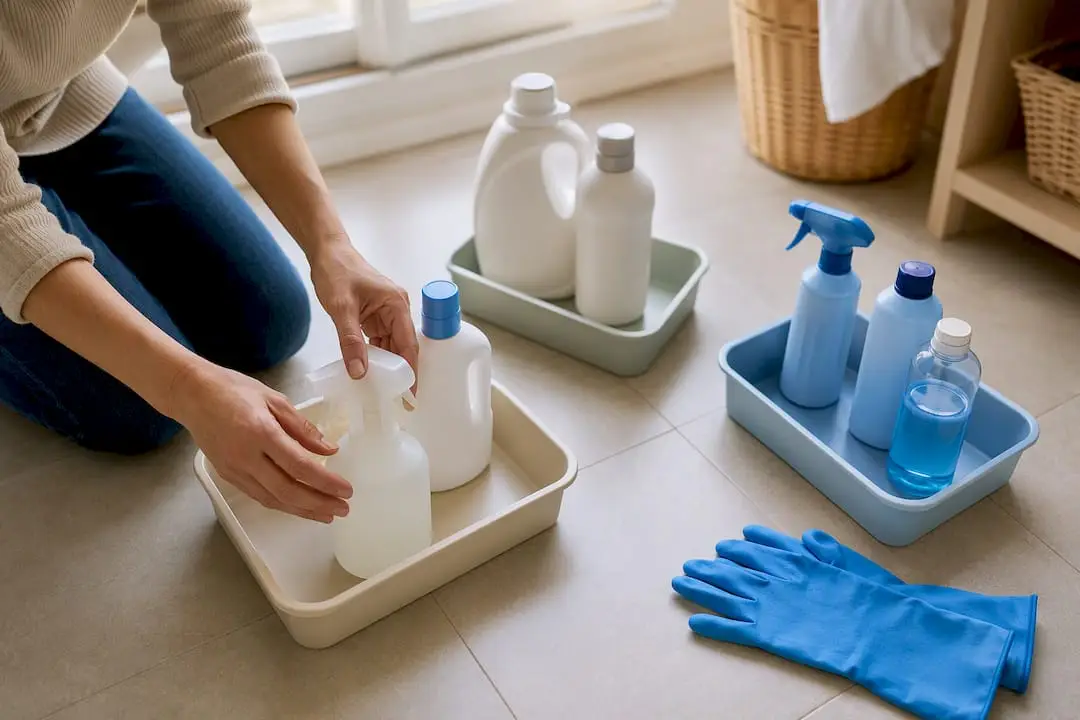
For products you’re simply replacing with safer alternatives, not disposing of as hazardous waste, consider donating unopened items to a local shelter or community group rather than tossing them. If a product doesn’t have clear disposal instructions on the label, your local waste authority’s website almost always has a lookup tool.
Do this cleanup early, ideally in the second trimester when you have more energy and aren’t rushing. It also clears cabinet space for the baby-specific products you’re about to bring in.
Airing Out Your Home After a Deep Clean
Cleaning products, fresh paint, and new furniture all release compounds into the air that take time to settle, and a newborn’s respiratory system handles airborne irritants far less efficiently than an adult’s does.
After any deep clean, open windows for at least a few hours if weather allows, even in cooler months. Cross-ventilation, windows open on opposite sides of the home, moves air through faster than a single window ever will. Run bathroom and kitchen exhaust fans during and after cleaning to pull moisture and fumes out rather than letting them linger.

If you painted the nursery or brought in new carpet, give the room several days minimum before baby spends real time in it. New carpet and fresh paint both off-gas volatile organic compounds, and a closed nursery door traps that air right where baby will be sleeping. The same logic applies to new furniture, especially pieces with foam padding or laminate finishes; if it’s wrapped in plastic packaging, let it breathe in a ventilated space before it’s part of the nursery.
Air purifiers with HEPA filters help between deep cleans, but they’re not a substitute for actual ventilation right after using cleaning products. Open the windows first; run the purifier as ongoing maintenance after that.
Setting Up a Cleaning Routine After Baby Arrives
The nesting checklist gets you ready for day one. What happens on day thirty is a different problem, and it’s the one most new parents underestimate.
Forget your pre-baby cleaning standards. A realistic postpartum routine focuses on high-touch, high-germ zones: the changing table, bottle prep area, and any surface hands touch before touching baby. Wipe those daily; everything else can shift to weekly or even biweekly without real consequence.
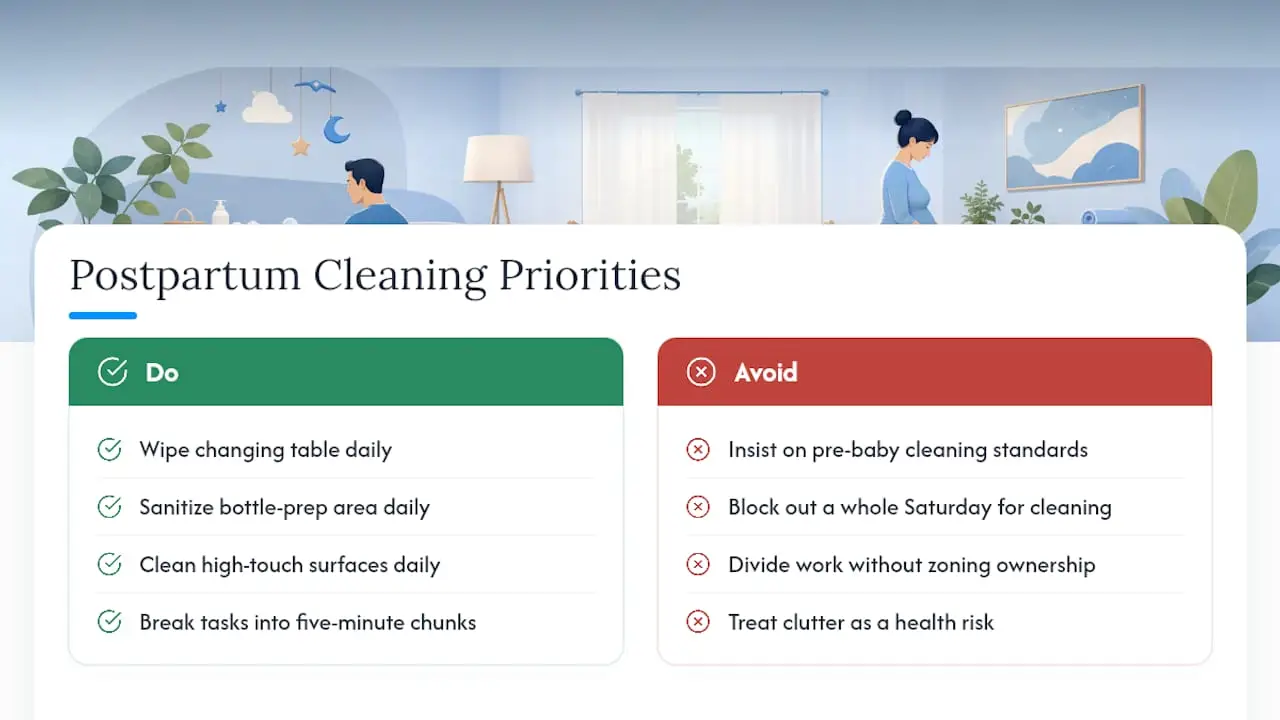
Break tasks into five-minute chunks instead of blocking out a Saturday morning you probably won’t get. Wipe the kitchen counter while formula heats. Run a load of laundry during a nap instead of waiting for a “free” hour that never arrives.
Split responsibilities with your partner or household by zone rather than by task list, one person owns the kitchen and living room, the other owns the nursery and bathroom, so nothing falls through the cracks from ambiguity about whose job it was.
And build in permission to let things slide. A cluttered coffee table isn’t a health risk. An unsanitized bottle nipple is a different category entirely. Knowing which is which keeps a new parent from burning out trying to maintain a standard that made sense before there was a newborn in the house.
Getting Family and Professionals Involved Without the Guesswork
Nesting doesn’t have to be a solo project, and trying to make it one is usually where the exhaustion comes from.
Family members who want to help genuinely want a task, not a vague offer to “let me know what you need.” Hand someone a specific job: “Can you run the vacuum through the living room and hallway?” works far better than “feel free to clean anything.” Give visiting relatives a short list rather than open access to reorganize your kitchen their way.
Where family isn’t an option, or the job is bigger than a weekend favor, that’s where professional cleaners fill the gap. Carpet shampooing, window washing, and full-scale deep cleans are physically demanding and easy to outsource without guilt, especially in the third trimester when heavy lifting and ladder work should be off the table entirely.
Before anyone, family or professional, starts cleaning, walk through which products are safe to use in the nursery and which rooms need extra care around any pets. A quick heads-up avoids someone reaching for a bleach-based cleaner out of habit.
Bringing in Professional Help: What to Ask For
Standard cleaning covers routine upkeep, wiping counters, vacuuming, bathrooms. Deep cleaning goes further: baseboards, inside appliances, grout, and buildup that accumulates over months. If your home hasn’t had a real deep clean in a while, that’s the service to book, not a standard visit. Purehomescleaning’s breakdown of standard versus deep cleaning makes the distinction concrete if you’re unsure which one your home needs.
When you book, ask specifically for pet-safe, low-VOC products and request extra attention on the nursery and high-touch surfaces like doorknobs and light switches. Any reputable cleaning service should be able to confirm what’s in their products without hesitation.
Timing matters here too. Scheduling a deep clean one to two weeks before your due date gives your home time to air out fully before baby’s homecoming, without the fumes-and-fresh-paint problem of cleaning too close to delivery.
Professional cleaning companies handle standard, deep, and move-in cleanings across Washington, DC, Virginia, and Maryland, with eco-friendly product options available on request. If checking “deep clean the whole house” off your list sounds better delegated than done solo at eight months pregnant, you can book a cleaning online and pick a date that fits your timeline.
Why the Checklist Matters More Than the Instinct
Nesting gets treated like a cute pregnancy quirk, folding onesies at midnight, alphabetizing a bookshelf that was fine as it was. That framing undersells what’s actually happening. The urge to prepare gives many expectant parents a genuine sense of control during a stretch of pregnancy that otherwise feels wildly out of their hands, and that psychological payoff is worth taking seriously, not just indulging.
Where I’d push back on how most nesting advice gets written: it treats every task as equally urgent, when the truth is a handful of items carry real weight (car seat installation, working smoke detectors, sanitized feeding gear) and the rest is preference dressed up as necessity. Reorganizing a linen closet for the third time feels productive. It isn’t the same as testing a carbon monoxide detector or confirming your car seat is installed correctly, and treating them as equivalent line items on a checklist is how the important five percent gets lost in the noise of the other ninety-five.
The instinct itself is worth trusting. What it’s not equipped to do is prioritize for you. That’s a job for judgment, pacing, and knowing when to hand something off rather than push through it at 34 weeks pregnant with a rented carpet shampooer.
— Local
Sources
- Nesting During Pregnancy | What is Nesting in Pregnancy?
- Best Baby-Safe Cleaning Products of 2026: Non-Toxic Picks | Babylist
- Nesting Instinct in Pregnancy
FAQ
What should I include on my nesting checklist?
Prioritize sleep and feeding areas first: assemble the crib, sanitize bottles and pump parts, stock diapers and wipes, and install the car seat. Deep cleaning, decluttering, and freezer meal prep round out the rest once those essentials are covered.
What is the daily 6 cleaning list?
There’s no single official “daily six” standard, but a practical version most new parents land on covers wiping the changing table, sanitizing bottle prep surfaces, running one load of laundry, tidying the main living area, taking out trash, and quick-wiping bathroom high-touch spots. Definitions vary by household, so treat this as a starting template rather than a fixed rule.
What to buy first during nesting?
Diapers in newborn and size 1, wipes, bottles and formula as backup even if breastfeeding, and postpartum recovery supplies like pads and a peri bottle top the list. These cover the first week without requiring an emergency store run.
What to deep clean before a baby comes?
Focus on the nursery, sleeping areas, and anywhere with carpet or upholstery, since dust and allergens concentrate there. Add HVAC filter replacement, HEPA vacuuming, and testing smoke and carbon monoxide detectors before moving on to lower-priority rooms.