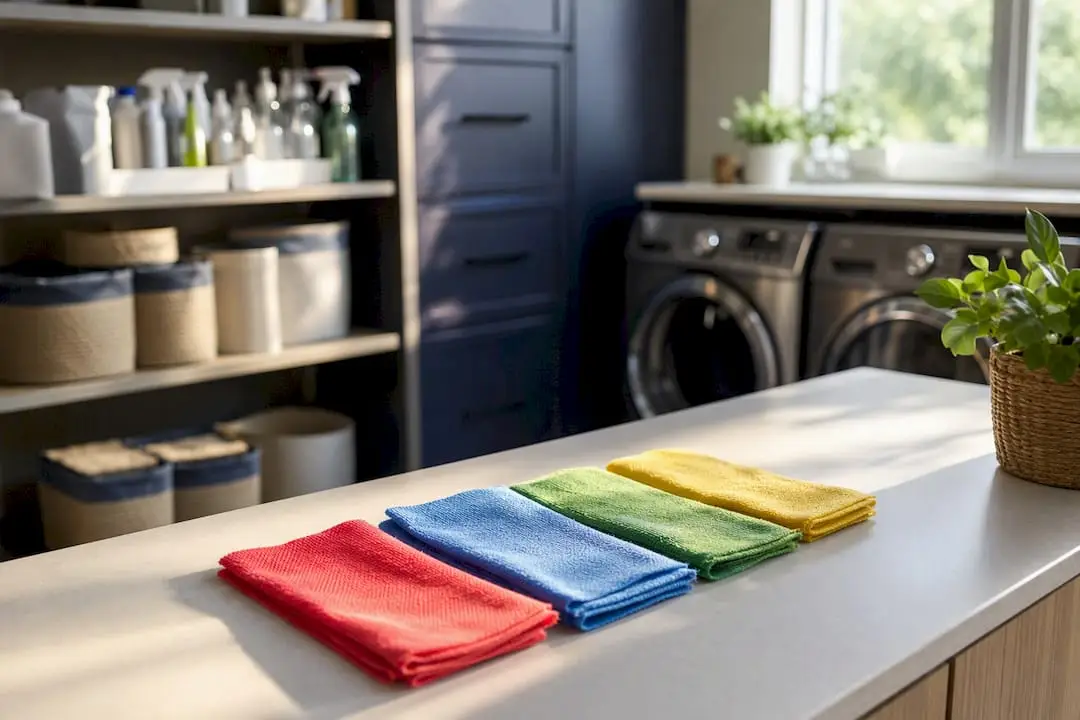
A widely used system assigns four colors to cleaning cloths, each tied to one zone, so no cloth ever crosses from a dirty surface to a clean one. This is the core of what the Weston Manufacturing industry guide calls the standard 4-color system:
- Red: toilets, urinals, and other high-risk, high-contamination surfaces
- Yellow: sinks, washbasins, and sanitary-contact areas
- Green: kitchens and food-prep zones
- Blue: general areas like desks, glass, and hallways
Some facilities add a fifth or sixth color for isolation rooms or glass-only tasks. The four-color base is the widely adopted starting point, not a fixed rule everyone follows identically.
Key Takeaways
Color-coded cleaning cloths prevent cross-contamination by assigning one dedicated color per risk zone, and the system only works long-term with consistent materials, laundering, and audits.
| Point | Details |
|---|---|
| Four core colors | Red for toilets, yellow for sinks, green for kitchens, and blue for general areas cover most standard zoning needs. |
| Microfiber is the default material | Microfiber removes more microorganisms than cotton and tolerates hotter wash cycles, per CDC guidance. |
| Match materials across colors | Buying the same weight and weave for every color prevents staff from identifying zones by feel instead of color. |
| Audits keep the system alive | Regular cart, shelf, and staff-quiz checks catch failures before they become compliance problems. |
| Professional help is an option | Purehomescleaning applies consistent zone-based cleaning protocols on every visit, without requiring homeowners to manage the system themselves. |
Table of Contents
- What Do the Different Colors of Cleaning Cloths Mean?
- Why Color-Coded Cloths Cut Cross-Contamination
- Microfiber vs. Cotton vs. Nonwoven: Which Cloth to Buy
- How to Set Up a Color-Coded Cleaning System
- How Often Should You Wash and Replace Cleaning Cloths?
- Why Color-Coded Systems Break Down (and How to Fix It)
- Color-Coded Cleaning Cloth Quick Reference
- Standards That Shape Color-Coded Cleaning Programs
- How Different Industries Apply Color-Coded Cleaning
- Sustainable Practices for Cleaning Cloths
- What a Color-Coded Cloth Program Actually Costs
- A Household Take on the Color-Coded System
- How Purehomescleaning Applies Color-Coded Hygiene at Home
- Sources
- FAQ
What Do the Different Colors of Cleaning Cloths Mean?
Each color maps to a risk level, not just a room. Getting this wrong is how a toilet cloth ends up wiping a kitchen counter.
- Red goes on toilets, urinals, and any surface with heavy fecal or bodily contamination. It’s the highest-risk category because pathogen loads there are consistently the worst in any building.
- Yellow covers sinks, washbasins, and other sanitary-contact surfaces that aren’t toilets but still carry meaningful bacterial load. Bathroom mirrors and countertops usually fall here too.
- Green is reserved for kitchens and food-prep surfaces, cutting boards, countertops, and appliance exteriors where cross-contamination risk ties directly to food safety.
- Blue handles general, low-risk areas: office desks, windows, glass, door handles, and corridors.
Some operations add purple for isolation rooms or biohazard zones, and a dedicated white cloth for glass and mirrors when streak-free finish matters more than disinfection. Add a color only when a genuinely distinct risk or task justifies it. Adding colors without a clear reason just confuses staff and multiplies laundry sorting.
Why Color-Coded Cloths Cut Cross-Contamination
Color removes the need for staff to read a label or remember a rule under pressure. A color-coded microfiber program works as a visual, non-verbal system that holds up even with staffing turnover or language barriers, since a cleaner from any background can match red to red without translation.
The operational payoff shows up in three places:
- Faster onboarding, since new hires learn “red equals toilet” in minutes instead of memorizing a written protocol.
- Simpler inventory tracking, because color, not description, is what gets counted and reordered.
- Cleaner audit trails, since a supervisor can spot a misused cloth from across the room.
Statistic Callout: Microfiber cloths remove more microorganisms than cotton and tolerate the higher wash temperatures a color-coded rotation depends on, according to CDC guidance on cleaning supplies and equipment. That single material difference is why most modern color-coding programs are built around microfiber rather than cotton rags.
Microfiber vs. Cotton vs. Nonwoven: Which Cloth to Buy
Material choice matters almost as much as color. The CDC’s guidance on cleaning supplies and equipment points to microfiber as the practical default for most facility and residential use, since it pulls more microbes off a surface than cotton and holds up to hotter wash cycles without breaking down.

Cotton still has a place for one-time disposal jobs or where budget is tight and laundering discipline is weak. Nonwoven spunlace cloths work well as a use-once, throw-away option in isolation zones where laundering a fabric cloth adds infection risk rather than reducing it.
The detail people miss: buy the same material across every color. If your red cloths are a heavier terry weave and your blue cloths are thin and floppy, staff start identifying zones by feel instead of color, and that’s exactly the confusion a color system is supposed to eliminate.
- Glass and mirrors: lightweight, low-lint microfiber (300 to 400 GSM)
- Counters and general surfaces: mid-weight microfiber (400 GSM)
- Heavy-duty scrubbing (grout, baseboards): thicker terry-weave microfiber (600 GSM or higher)
How to Set Up a Color-Coded Cleaning System
Rolling out a color coded cleaning cloth system takes a week if you follow a sequence instead of improvising room by room.
- Map your zones first. Walk the space and assign every room or surface type to one of your four colors before ordering a single cloth.
- Match color across the whole kit, not just cloths. A practical setup guide recommends coordinating mop heads, buckets, and trigger-spray bottles to the same colors as your cloths, so a mismatched bucket flags an error before the cloth even touches a surface.
- Order rotation sets, not just enough for one shift. Buy at least two full sets per color so one set launders while the other works.
- Post laminated zone charts on the inside of supply closet doors and on every cart. This single fix does more for compliance than any verbal reminder, according to Opora Supply’s implementation playbook.
- Train with a short script, not a manual. “Red is toilets only. Yellow is sinks. Green is kitchen. Blue is everything else” takes thirty seconds to teach.
- Run supervised checks during week one, then shift to monthly audits once the habit sets in.
If a cloth gets used in the wrong zone, don’t just rinse it and move on. Quarantine it immediately and either deep-clean or dispose of it. Treat the mistake as a real breach, not a shrug-worthy slip.
Pro Tip: Keep one extra “emergency” cloth in each color sealed in a bag near the entrance of high-turnover areas like public restrooms, so a spill doesn’t force someone to grab whatever’s closest.
How Often Should You Wash and Replace Cleaning Cloths?
Wash temperature and detergent choice affect both hygiene and how long the color itself lasts before it fades into ambiguity. Microfiber tolerates hotter cycles than cotton, which is one more reason it’s the CDC’s preferred material for this kind of rotation.
- Wash microfiber at 140 to 160°F with a standard detergent; skip fabric softener, since it coats fibers and kills microfiber’s pickup ability.
- Bleach is fine occasionally on white or light-colored microfiber but can dull colored cloths over repeated cycles, weakening the visual code you rely on.
- Replace red (toilet) zone cloths on the tightest cadence, since they see the heaviest contamination and the fastest wear.
- Blue (general area) cloths can run a longer replacement cycle since exposure and wear are both lower.
- Dry fully before storage. Damp cloths stored in bins breed odor and bacteria fast, and a musty cloth gets skipped by staff who’d rather grab a fresh one from the wrong pile.
Why Color-Coded Systems Break Down (and How to Fix It)
Most color-coding programs don’t fail because the concept is flawed. They fail because nobody keeps checking that it’s still being followed.
The usual culprits: no visual chart at the point of use, mismatched materials that blur the color cue by feel, faded cloths that make yellow look a lot like a washed-out green, and laundering logs nobody actually maintains. Auditability, not the color choice itself, is what determines whether a system survives past the first month.
A simple audit checklist catches most of this early:
- Check carts for correct color matching across cloth, bucket, and mop head.
- Check supply shelves for cloths sorted by color, not thrown in one bin.
- Ask a staff member on the floor what each color means, on the spot.
- Spot check the laundering log for gaps or missing entries.
Pro Tip: Score each audit item on a simple pass/fail basis and track it month over month. A single missed cart check means nothing; three months of the same cart failing means your training script isn’t sticking.
Corrective action should scale with the failure: retrain on a first miss, quarantine and replace on contaminated cloths, and fix procurement if mismatched materials keep showing up.
Color-Coded Cleaning Cloth Quick Reference
| Color | Recommended Use | Best Material | Wash & Replacement |
|---|---|---|---|
| Red | Toilets, urinals, high-contamination surfaces | Heavy-weight microfiber | Hot wash cycle; replace most frequently |
| Yellow | Sinks, washbasins, sanitary-contact surfaces | Mid-weight microfiber | Hot wash cycle; replace on a moderate schedule |
| Green | Kitchen and food-prep surfaces | Mid-weight microfiber | Hot wash cycle; replace on a moderate schedule |
| Blue | Desks, glass, general low-risk areas | Lightweight microfiber | Standard wash cycle; longer replacement interval |
| Purple/White (variants) | Isolation zones or glass-only tasks | Nonwoven (isolation) or low-lint microfiber (glass) | Follow the base color’s zone risk level |
Standards That Shape Color-Coded Cleaning Programs
No single federal law mandates a specific cloth color scheme for every business, but several standards shape how facilities build compliant programs. OSHA’s bloodborne pathogen and hazard communication rules require clear labeling and separation of tools used around contamination risks, which is exactly what a red/yellow/green/blue system delivers in practice even without OSHA naming colors directly.
Food service operations answer to HACCP principles, which require documented control points to prevent cross-contamination between raw and ready-to-eat food surfaces. A green cloth reserved strictly for food-contact surfaces is a direct, low-cost way to satisfy that documentation requirement during a health inspection.
Internationally, ISO 22000 (food safety management) and general facility hygiene standards reference the same core logic: separate tools for separate risk zones, with a verifiable system for keeping them separate. Healthcare facilities layer in guidance like the CDC’s environmental cleaning recommendations, which specifically call out supply and equipment choices, including color-coded cloths, as part of infection control.
None of these standards require the exact red/yellow/green/blue scheme. What they require is a documented, consistent, auditable method for preventing cross-contamination, and color-coding happens to be the simplest way most facilities satisfy that requirement. If you’re setting up a program for compliance purposes, keep a written record of your color assignments and train materials. Auditors want to see the system exists on paper, not just in habit.
How Different Industries Apply Color-Coded Cleaning
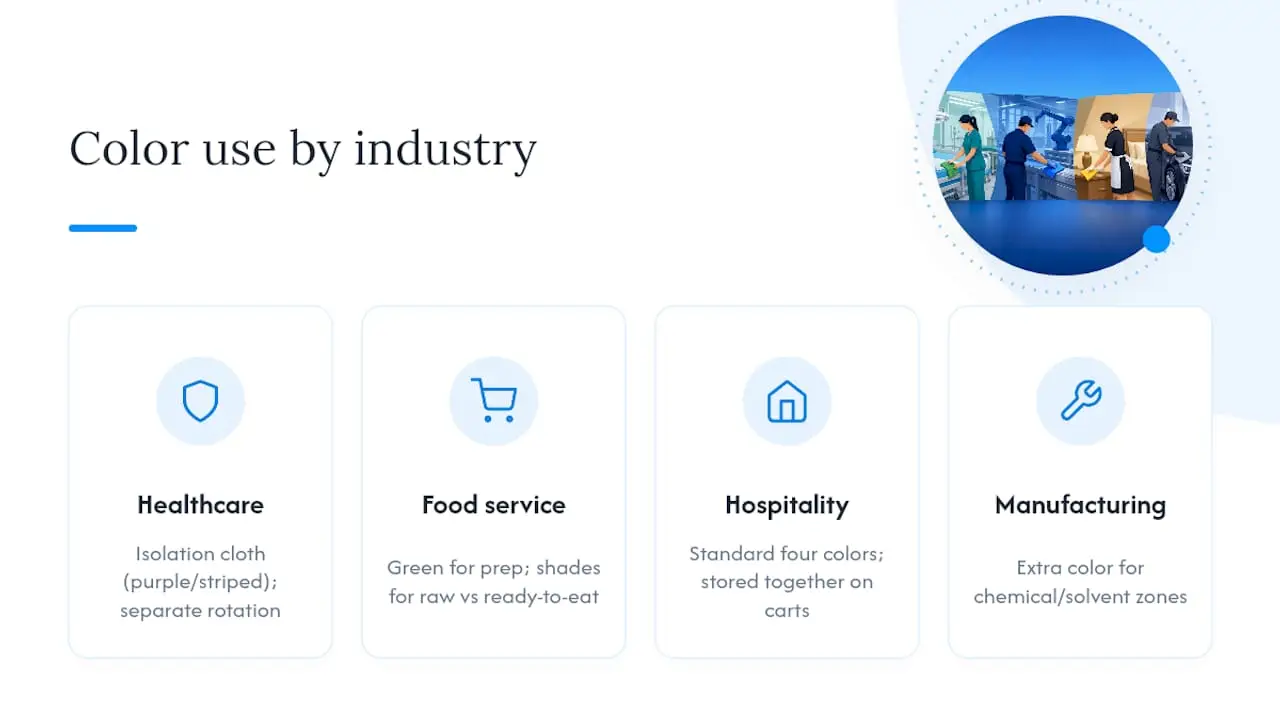
The four-color base gets adapted differently depending on what a facility is actually protecting against.
Healthcare facilities often add a dedicated color for isolation rooms, sometimes purple or a striped variant, kept entirely separate from the general rotation to prevent any chance of a contaminated cloth reentering circulation. Handwashing sinks and patient room surfaces get their own strict color separation, since infection control here has the highest stakes of any setting on this list.
Food service leans hardest on green for prep surfaces and often splits it further, one shade for raw meat prep, another for produce and ready-to-eat surfaces, mirroring the same raw-versus-cooked separation used for cutting boards.
Hospitality operations, hotels especially, tend to run closer to the standard four-color system with less variation, since guest rooms and public areas carry moderate rather than extreme contamination risk. Housekeeping carts here usually store all four colors together, since one room attendant handles every zone type in a single unit.
Manufacturing environments sometimes add colors tied to chemical exposure zones rather than biological risk. A cloth used near solvents or industrial cleaners might get its own color entirely separate from the standard hygiene scheme, since the concern is chemical cross-contact, not bacteria.
The common thread across every industry: the base logic (separate tools, separate risk, one color per zone) stays constant even when the specific palette shifts.
Sustainable Practices for Cleaning Cloths
Cleaning cloths generate real waste over time, especially in programs that lean on disposable nonwoven materials for every task. Reusable microfiber cuts that waste stream substantially since one cloth can survive hundreds of wash cycles before it needs replacing, compared to a spunlace cloth that’s used once and thrown away.
The environmental tradeoff shows up in laundering instead. Washing colored cloth sets daily at high heat uses water and energy, so the sustainability case for microfiber depends on running full loads rather than washing a handful of cloths at a time. Batch your laundering by color set once you have enough dirty cloths to fill a machine, rather than running partial loads out of habit.
Skip fabric softener and heavy bleach use where you can. Both shorten a microfiber cloth’s working life, which means more frequent replacement and more manufacturing demand over time. A cloth that lasts through 300 wash cycles instead of 150 effectively cuts your replacement footprint in half.
For nonwoven disposables, reserve them for situations that genuinely require single-use hygiene, like isolation rooms or biohazard cleanup, rather than defaulting to disposable cloths for routine tasks a reusable microfiber cloth handles just as well. That targeted use keeps the convenience of disposables where they matter without generating unnecessary waste everywhere else.
What a Color-Coded Cloth Program Actually Costs
Startup cost for a small facility running a four-color system usually comes down to cloth count, kit-matching (buckets, mop heads, trigger bottles), and the laminated signage that keeps the whole thing honest. Microfiber cloths cost more per unit than cotton rags upfront, but their longer lifespan and better cleaning performance offset that difference within the first few replacement cycles.
Budget in three buckets: initial procurement (cloths, matched buckets and mop heads, laminated zone charts), ongoing laundering (detergent, water, energy, plus a laundering log system), and rotation-based replacement (higher-risk red and yellow cloths wear out faster than blue).
The biggest hidden cost isn’t the cloths themselves. It’s the labor spent retraining staff after a compliance failure, or the reputational cost of a health inspection flag tied to visible cross-contamination. A modest upfront investment in matched kits and clear signage almost always costs less than the cleanup, retraining, or corrective action that follows a breakdown in the system.
For a household adopting a scaled-down version, expect to spend on four to eight cloths total plus a couple of matched buckets. That’s a modest one-time cost that pays for itself the first time it prevents a stomach bug from spreading kitchen to bathroom.
A Household Take on the Color-Coded System
At home, you don’t need six colors and a laminated chart. Pick red for the toilet, green for the kitchen, and blue for everything else. Skip yellow unless you have a shared bathroom sink that sees heavy daily use. Wash weekly instead of daily, and hire a professional team when your schedule stops leaving room for either.
— Local
How Purehomescleaning Applies Color-Coded Hygiene at Home
You’ve seen what a real color-coded system takes to run well: matched materials, consistent laundering, and someone actually checking that it’s being followed. That last part is where most households fall short, not because the system is complicated, but because life gets busy and the checklist slides.

Purehomescleaning’s teams train on consistent, zone-based cleaning protocols on every visit, the same core logic behind red-for-bathroom and green-for-kitchen separation, so cross-contamination risk in your home gets handled the way a well-run facility handles it, without you having to manage laundering schedules or track which cloth went where. You get a trained team applying that discipline automatically, whether it’s a routine clean or a full deep cleaning service. If you’d rather hand off the whole hygiene protocol than manage cloths and buckets yourself, book a cleaning online in a few minutes and get a team that already runs this system correctly.
Sources
CDC cleaning supply guidance, Weston Manufacturing’s color-code overview, and Opora Supply’s implementation playbook cover the standards and audit practices referenced above.
- CDC — Supplies and equipment for environmental cleaning
- What Do The Colors Of Cleaning Cloths Mean? – Weston Manufacturing
- Color-coded cleaning system implementation — Opora Supply
FAQ
What are the color codes for cleaning cloths?
The most common system uses red for toilets and high-risk surfaces, yellow for sinks and sanitary-contact areas, green for kitchens and food prep, and blue for general low-risk areas like desks and glass.
What do the different colors of microfiber towels mean?
Each color signals a risk zone rather than a specific room, so the same red microfiber cloth works in any toilet or urinal area across a building, and staff never need to check a label to know where it belongs.
What color washcloth is best?
Color choice should match your zone map exactly. There isn’t one universally “best” color. What matters is picking a consistent material, typically microfiber, and never letting one color’s cloth cross into another zone.
What are the different color codes used in cleaning?
Beyond the standard four (red, yellow, green, blue), some facilities add purple for isolation rooms or white for glass and mirrors. Definitions vary slightly by industry, but the core red/yellow/green/blue base is the most widely adopted starting point.
Can Purehomescleaning set up a color-coded system in my home?
Purehomescleaning’s teams already apply consistent, zone-based cleaning protocols on every visit, so you get the benefit of a color-coded hygiene approach without having to buy, launder, or track the cloths yourself.