
Most house cleaners will not do your laundry, organize your closets, wash exterior windows, clean ductwork or chimneys, or handle mold, pest droppings and hoarding conditions. Everything else you’d expect from a clean home, such as surfaces, bathrooms, kitchens and floors, is usually part of the visit. The details change from company to company, so the real skill is knowing where the line sits before you book. This guide shows you where it usually falls, why, and how to get the excluded work done another way.
TL;DR
- A standard clean covers surfaces, bathrooms, kitchens and floors. Laundry, ironing, shopping, organizing and child care are normally outside it.
- Exteriors, high reach areas, chimneys, ducts, mold and pest cleanup are specialist jobs, not routine cleaning.
- Walls, baseboards, cabinet fronts and blinds are usually spot-cleaned in a regular visit. Thorough scrubbing belongs in a deep clean.
- Some extras, like the inside of the oven or fridge, can often be added for a fee. Ask for the task list before you say yes to a quote.
Table of Contents
- What a standard cleaning does cover
- The tasks cleaners usually leave out
- Why these jobs are excluded
- Spot-cleaned, not scrubbed: the gray area
- Jobs that need a specialist
- What cleaners will refuse for safety reasons
- Extras that can be added
- How to prep so nothing gets missed
- Get the right clean for your home
- FAQ
- Sources
What a standard cleaning does cover
It helps to start with what is included, because “what cleaners don’t do” only makes sense against that baseline. According to ISSA, the cleaning industry association, basic residential cleaning generally covers surfaces in kitchens, bathrooms, living areas and bedrooms, plus floors, including vacuuming and wet mopping.
In practice that means:
- Dusting reachable surfaces and wiping counters
- Cleaning sinks, toilets, tubs and showers
- Wiping the outside of kitchen appliances
- Vacuuming carpets and rugs
- Sweeping and mopping hard floors
- Emptying trash cans you have set out
That is a full visit, and it is what most households need every week or two. The gaps show up in the tasks people assume are bundled in but aren’t. If you want a line-by-line view of a typical visit, our printable standard cleaning checklist lays it out.
The tasks cleaners usually leave out
The table below pulls together the exclusions that come up most often, based on industry guidance and published reporting.
| Task | Usually included? | What to do instead |
|---|---|---|
| Laundry and ironing | No | Ask about it separately, or run loads yourself before the visit |
| Shopping, organizing, child care | No | Treat as separate services |
| Porches, patios, garages | Often no | Hire an exterior or outdoor service |
| Exterior window washing | Often no | Hire a window specialist |
| High vents and deep reach areas | Often no | Request in a deep clean, or hire a specialist |
| Chimneys and ductwork | No | Chimney sweep or duct cleaning company |
| Mold, pest droppings, hoarding | No | Remediation specialist |
| Medical equipment | Not normally | Clean per manufacturer or care instructions |
| Items soiled with bodily fluids | Often no | Handle yourself or use a specialist service |
The first group is simple. ISSA says laundry, ironing, shopping, organizing and child care are generally outside basic cleaning and should be discussed separately. Some companies will agree to fold in a small extra, but you should not assume it.
The second group is outdoors and out of reach. Better Homes & Gardens reports that porches, patios, garages and exterior window washing fall outside the usual scope of many residential cleaners. The same article notes that cleaners generally work within reasonable reach, using an extendable duster and a two-step ladder. If a ceiling fan is sitting on a vaulted ceiling or a light fixture needs a tall ladder, expect it to be skipped.
Medical items are a quieter exclusion. AARP’s guide for caregivers says equipment such as hospital beds, oxygen tanks and portable commodes is not normally within a professional cleaner’s scope. If someone in your home uses this equipment, plan to keep it clean yourself or with a caregiver.
Why these jobs are excluded
Cleaners aren’t being difficult. Each exclusion has a practical reason, and understanding it makes it easier to find a workaround.
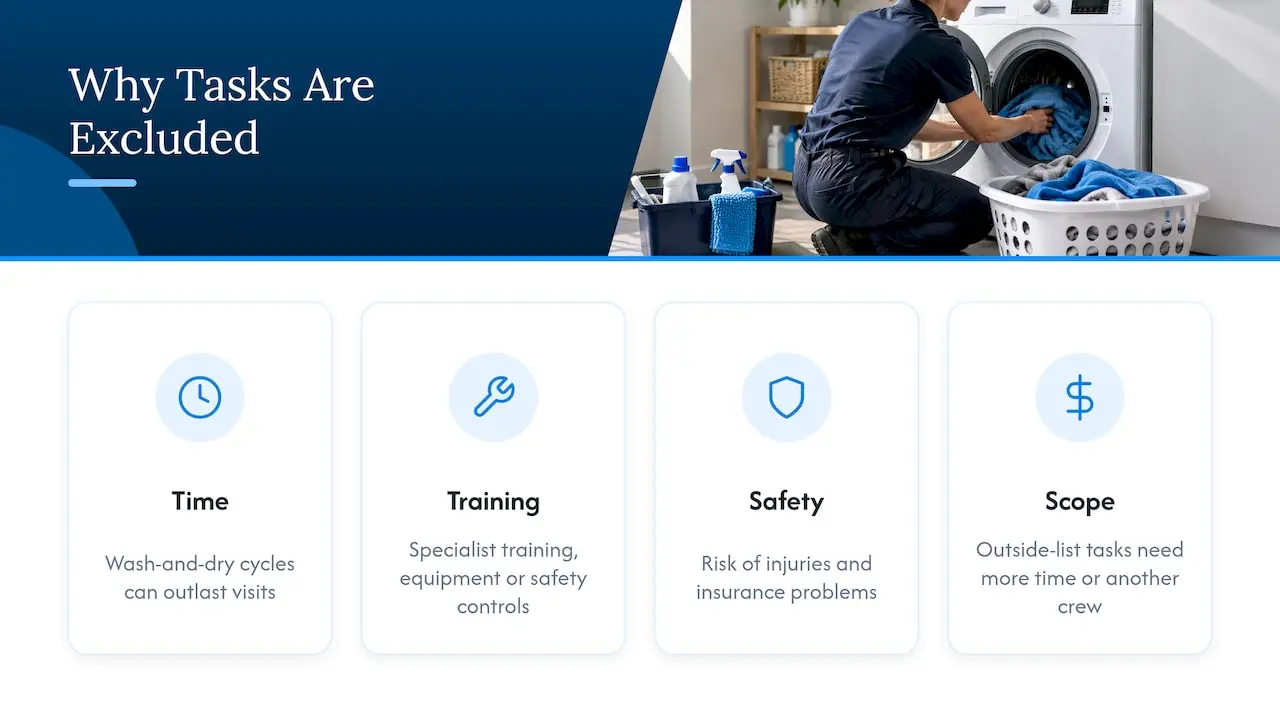
Time. Laundry is the classic case. AARP explains that laundry is normally excluded because wash-and-dry cycles can take far longer than a standard cleaning visit. A cleaner who stays to finish your laundry is either billing for the hours or leaving the rest of your home half done.
Training and equipment. The Spruce’s experts explain that chimneys, ducts, gutters, mold infestations, carpet restoration and floor refinishing require specialist training, equipment or safety controls beyond routine cleaning. A vacuum and microfiber cloths are not the right tools for any of them.
Safety and liability. Reaching too high, handling hazardous materials and touching biohazards are where injuries and insurance problems start. This is the reason for most of the firm “no” answers, and it is covered in its own section below.
Scope and price. A recurring visit is priced around a set list of tasks and a set number of hours. Anything outside that list either needs more time or a different crew. Our guide to what sets your cleaning price explains how scope feeds into an estimate.
Spot-cleaned, not scrubbed: the gray area
The most common source of disappointment is not a flat refusal. It is a task that gets a light touch in a regular visit and a full treatment only in a deep clean.
Better Homes & Gardens says walls, baseboards, cabinet fronts and blinds are typically spot-cleaned during regular service, and that more thorough scrubbing usually requires a requested deep clean. That matches what many homeowners see: a cleaner wipes a visible scuff or dusts the top of a baseboard, but does not wash every wall.
Here is how to think about each:
- Walls. Spot removal of fingerprints and marks is common. Washing whole walls is a bigger job. See when professionals wash walls and what it costs.
- Baseboards. Dusting is routine, detailed scrubbing is not. Our page on what is and isn’t included for baseboards spells it out.
- Cabinet fronts. Wiped where there are visible smudges, with the insides left alone unless you ask.
- Blinds. Often dusted lightly. Detailed slat-by-slat cleaning takes real time.
- Vents. The Spruce notes that ordinary cleaners may vacuum HVAC vents and fireplace ashes but generally do not enter chimneys or clean ductwork.
The pattern is the same each time. Surface work is routine. Detail work is a deep-clean task. If your home has gone several months without a thorough clean, read standard vs deep cleaning before you pick a service, because booking the wrong one is the main reason people feel something was “skipped.”
Jobs that need a specialist
Some problems are not cleaning problems at all. A cleaner who walks past them is protecting you and the crew.
- Mold. Better Homes & Gardens says mold generally requires separate remediation or specialist handling. Green Seal’s residential cleaning standard also lists mold remediation among specialized services outside routine cleaning. If you see mold covering more than a small patch, or it keeps returning, call a remediation company and find the moisture source.
- Pests and droppings. The same source puts pests and pest droppings in the specialist category. Deal with the infestation first, then book a clean.
- Hoarding conditions. Heavy clutter blocks access to surfaces and floors, so a routine visit can’t do much. If a home has reached that point, a hoarder house cleanout is a separate project with its own planning, and the cleaning comes after.
- Chimneys, ducts and gutters. Specialist trades with their own equipment.
- Carpet restoration, upholstery and floor refinishing. Green Seal’s standard lists restorative or deep carpet cleaning and upholstery cleaning as specialized services outside the base scope.
None of this means a cleaner can’t help afterward. Once a specialist has cleared the problem, a deep or move-in clean can bring the home back to a fresh baseline.
What cleaners will refuse for safety reasons
This is the part people rarely hear until a cleaner declines a task at the door. Green Seal’s standard says safety-sensitive issues include chemical handling, hazardous materials, accidents and cleaning where vulnerable people may be affected, and it requires procedures for these.
Two concrete examples from AARP’s caregiver guide:
- Needles. AARP says exposed needles should be capped and placed in a sharps container, and that cleaners may refuse trash containing protruding needles because of puncture risk. If anyone in the home injects medication, use an approved sharps container and keep loose needles out of regular trash.
- Bodily fluids. AARP reports that sheets contaminated with bodily fluids can be outside the scope cleaning professionals describe, because insurance policies may prohibit handling them. Wash or dispose of these items yourself, or ask a care provider for guidance.
If you have a specific medical situation at home, such as home dialysis or hospice care, ask the care team how to handle waste and equipment, and tell your cleaning company in advance what to expect on arrival.
Extras that can be added
A “no” in a standard clean is often a “yes, for an additional charge” somewhere else. AARP’s guide names dishwashing or dishwasher loading and deep cleaning of the refrigerator or oven as possible extras at extra cost.
Here is a practical way to sort your list:
- Add to a standard visit. Inside the oven, inside the fridge, a small load of dishes.
- Move into a deep clean. Baseboards, wall spots, detailed blinds, cabinet interiors, built-up grime in bathrooms. Our weekend deep clean checklist shows what that covers room by room.
- Book a move-in or move-out clean. Empty-home cleaning reaches places a lived-in clean can’t. See deep cleaning vs move-out cleaning and our move-out checklist for getting your deposit back.
- Hire a specialist. Ducts, chimneys, exterior windows, mold, pests.
- Handle yourself. Laundry, organizing, shopping, medical equipment.
Our perspective
We hear the same sentence from new clients: “I thought that was included.” It almost never means anyone cut corners. It means nobody wrote the scope down. A good cleaning relationship begins with a clear task list, and we build ours around how each household lives, whether that is a busy family, a pet owner or someone getting ready to move.
That is why we offer different services for different jobs. Standard cleaning keeps a home that is already in good shape. Deep cleaning does the detail work that routine visits only touch lightly. Move in and move out cleans handle empty homes, where baseboards, cabinets and appliances can get full attention. When you match the service to the condition of the home, the “what don’t cleaners do” list gets much shorter.
We also work with eco-friendly products that are meant to be safe around families and pets, and our staff are trained and insured. If you are not sure whether something is in scope, ask us before the visit, not after.
Local
How to prep so nothing gets missed
A little preparation decides whether you get the clean you pictured.
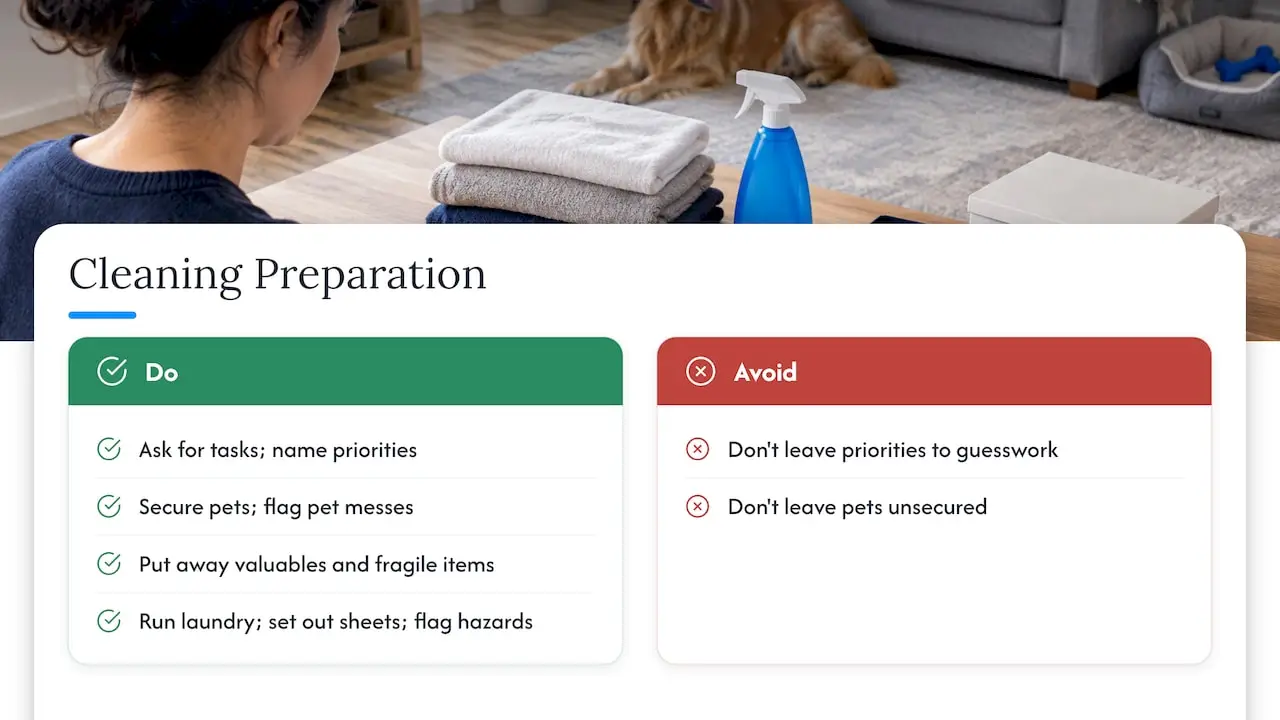
Ask for the task list. ISSA notes that residential services vary widely and advises asking for a list of the tasks a cleaner will perform when you get a quote. Our six questions to ask a cleaning service give you the exact wording, and the walkthrough checklist for comparable bids helps you compare quotes on equal terms.
Secure pets and flag pet messes. ISSA advises securing pets that may get in the way, discussing special pet messes and preferred products, and clarifying expectations up front. If your dog sheds heavily or your cat has had accidents, say so.
Put away what you don’t want touched. Personal papers, valuables, clutter and anything fragile. Cleaners clean surfaces they can see and reach. As one cleaner told a national outlet, people tend not to clean what they or guests can’t readily see, so hidden spots such as under beds and behind doors are worth pointing out.
Run laundry beforehand. If you want bed linens changed, have fresh sheets ready and the old ones set aside.
Separate hazards. Cap and contain sharps, set aside soiled items you want handled differently and tell the cleaner about anything unusual.
Name your priorities. If the oven or the shower grout matters most to you, say so. Do not leave it to guesswork.
Get the right clean for your home
If you live in Washington, DC, Virginia or Maryland and want a clear scope from the start, we can match you with the right service. Choose standard or deep cleaning for your current home, or schedule a move-in or move-out clean when you are changing addresses.

Tell us what you expect to see done when you book, and we will confirm what fits in the visit and what is better handled another way. For a move, our moving cleaning timeline shows what to clean and when.
FAQ
Do cleaners wash dishes and do laundry?
Laundry is normally excluded, because wash-and-dry cycles take longer than a standard visit. Dishes are usually a possible extra, not a default, so ask whether loading the dishwasher is available and what it adds to the visit.
Do I need to leave the house when cleaners are there?
No rule requires it. Many people work from home or run errands, and either way works. What matters is agreeing on access, how to handle pets and which rooms are off limits before the team arrives.
Will a cleaner clean inside the oven and fridge?
Not as part of a basic clean in most cases. These are commonly offered as add-ons for an extra charge, or included in a deep or move-out clean. Ask for them by name when you request a quote.
What should I do if I find mold or pests?
Call a specialist before booking a regular clean. Mold and pest problems need remediation, and a cleaner can’t fix the cause. After the specialist is done, a deep clean can restore the home’s surfaces.
Sources
- ISSA Residential Commonly Asked Questions
- What Caregivers Should Know When Hiring a House Cleaner (AARP)
- 5 Surprising Things Your House Cleaner Won’t Touch (Better Homes & Gardens)
- 6 Surprising Things Professional Cleaners Will Never Clean (The Spruce)
- GS-49 Residential Cleaning Services (Green Seal)
- Selling a Hoarder House: Cleanout, Costs and Cash Offers