The must-ask questions come down to six things: what’s included in the clean, how pricing works, whether the company is insured and bonded, what background checks the staff go through, who supplies the products, and how keys and home access are handled. Get every answer to those six in writing, especially the certificate of insurance (COI) and a written scope of work, before any money changes hands.
TL;DR:
- Asking for a written certificate of insurance and scope of work before paying ensures you can verify coverage and clarify exactly what services are included.
- Confirm whether the cleaning team is staff or subcontractors, and ask for detailed background check procedures to ensure accountability and trustworthiness.
- Check if the company provides their own cleaning supplies, can accommodate pet-safe products, and uses secure methods for home access to prevent issues during service.
- Require a detailed, itemized written estimate that specifies scope, visit duration, add-on costs, payment terms, and cancellation policies to avoid billing disputes.
- Inspect how quickly and specifically the company responds to your questions, as prompt, detailed answers reflect the reliability of their service and day-to-day communication.
Table of Contents
- Questions To Ask a Cleaning Service, Organized by Category
- How To Read the Answers You Get Back
- Pricing, Written Estimates, and Cancellation Terms
- Access, Pets, and Product Preferences
- Insurance, Bonding, and What Happens if Something Breaks
- Your First Visit Checklist Before You Commit
- What Actually Moved the Needle When I Was Vetting Cleaners
- How Pure Homes Cleaning Fits This Checklist
- Sources
- FAQ
Questions To Ask a Cleaning Service, Organized by Category
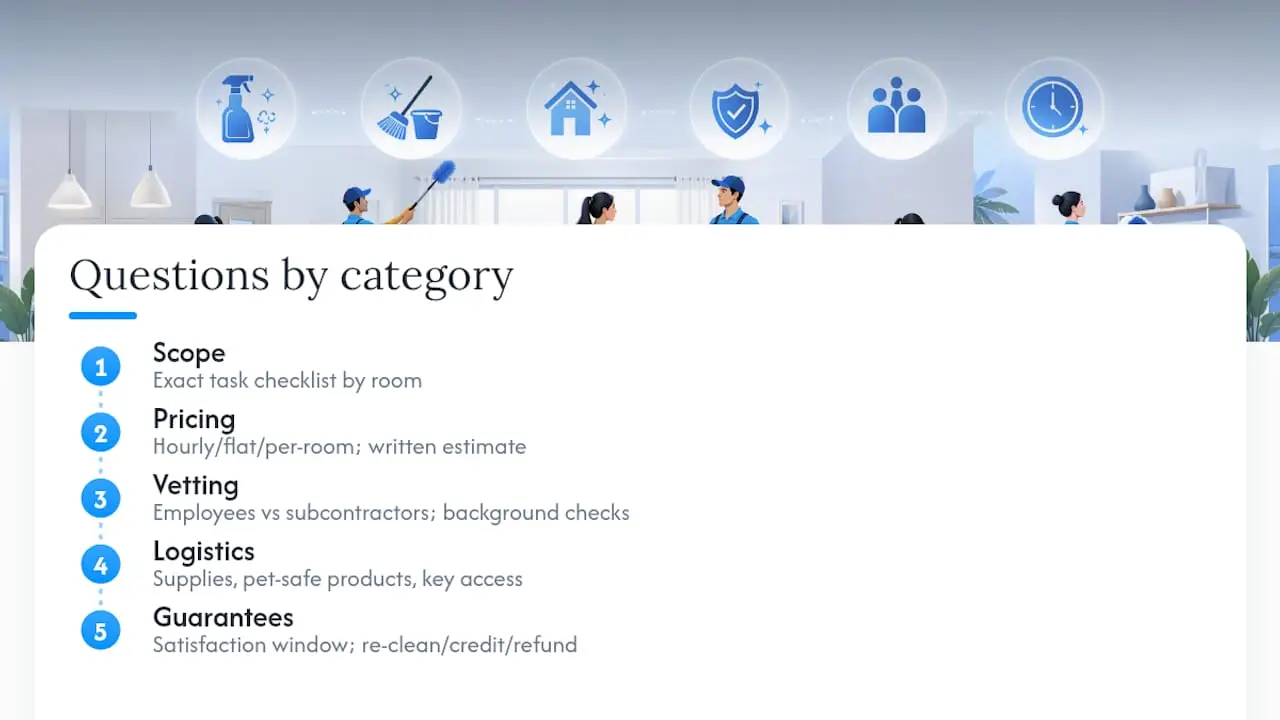
Calling five companies and asking the same random questions to each one wastes your time and theirs. A better approach: work through five categories in order, because each one filters out a different kind of problem. Scope tells you what you’re paying for. Price tells you what it costs. Vetting tells you who’s coming into your home. Logistics tells you how the day actually goes. Guarantees tell you what happens if something goes wrong.
1. Scope of work
Ask exactly what’s in a standard clean versus what counts as an add-on. Interior of the oven, inside the fridge, baseboards, window tracks, and inside cabinets are the usual extras that get left out of a “standard” price. A good answer comes with a checklist you can keep, room by room. A vague answer (“we clean everything”) is your cue to ask a sharper follow-up: “Can you send me the exact task list for a standard clean in writing?”
2. Pricing and the estimate
Ask whether pricing is hourly, flat rate, or per room, and whether the quote you’re getting is written. Flat rates are common for standard and recurring cleans; hourly billing shows up more with unpredictable jobs like a first-time deep clean in a home that hasn’t been touched in months. A trustworthy company provides a written, itemized quote that lists scope, included tasks, and any add-on charges before you commit. If they only quote a number over the phone with no scope attached, ask directly: “Can you email me that estimate with the task list included?”
3. Vetting and trust
Ask whether the cleaners are employees or subcontractors, and what kind of background check they run. This matters more than most people realize, because screening practices vary widely between companies, and a subcontractor model often means less consistency and less accountability. Ask for specifics: county-level check, national database, sex offender registry, identity verification. A company that names its screening method is confident in it. A company that says “we check everyone” with no detail probably means a basic search, at best. Follow up with: “Who runs your background checks, and what does the check actually include?”
4. Logistics and pets
Ask whether they bring all their own supplies or expect you to provide them, and whether they can use pet-safe or low-VOC products on request. Also ask how they handle key access if you won’t be home. A confident answer names a specific method, lockbox, smart lock code, or a keyed-and-logged system, rather than a vague “we’ll figure it out.”
5. Guarantees and damage policy
Ask what happens if you’re not satisfied, and what happens if something gets damaged. A clear satisfaction guarantee names a response window, usually 24 to 48 hours, and specifies whether the remedy is a re-clean, a credit, or a refund. If the answer is “just call us and we’ll handle it,” ask the obvious next question: “What’s your written re-clean policy, and how many days do I have to report an issue?”
How To Read the Answers You Get Back
The questions matter less than how a company answers them. A provider that hesitates, deflects, or gives you a “trust us” instead of specifics is telling you something, even if they don’t mean to.
Red flags worth walking away from:
- Refuses to email a COI, or only offers to “show” it during the visit
- Gives you a phone quote with no written scope, ever, even after you ask twice
- Gets vague or defensive when you ask about background checks
- Can’t tell you whether the same cleaner or team will return each visit
- Has no answer for what happens if something breaks
Positive signals worth weighing heavily:
- Sends the COI directly from the insurer, same day, no pushback
- Emails an itemized quote before you book, unprompted
- Names the actual background-check method (county records, national database, ID verification) rather than saying “we check everyone”
- States a specific re-clean window in writing, not “we’ll make it right”
- References across multiple review platforms show a consistent pattern of punctuality and communication, not just isolated five-star posts
Pro Tip: If an answer sounds rehearsed but light on detail, ask it a second way. “Who issues your background checks, county-level or a national database?” gets you a real answer where “do you background check your staff?” often just gets a “yes.”
Pricing, Written Estimates, and Cancellation Terms
Hourly pricing tends to show up for irregular jobs, deep cleans, and first-time visits where nobody knows yet how long the home will take. Flat-rate pricing is standard for recurring cleans once a company has seen your space and can estimate the time reliably. Per-room pricing is less common but shows up with some apartment-focused services.
Whatever the model, a real written estimate should include:
- The full scope of work, task by task
- An estimated visit length or team size
- Every add-on listed separately with its own price
- Payment terms, including when payment is due
- Cancellation notice period and any late-cancellation fee
Watch for a quote that’s just a flat number with no attached scope. A best-practice onboarding step is getting the estimate in writing with the scope attached, since verbal numbers with no scope are the single most common source of billing disputes. Also watch for automatic recurring contracts with no clear way to opt out, or cancellation fees that only get mentioned after you’ve already signed up.
Access, Pets, and Product Preferences
Before the first visit, confirm three practical things: who supplies the cleaning products, how the cleaner will get into your home, and what happens with your pets during the visit.
- Ask directly whether they bring their own supplies or expect yours, and get pet-safe or low-VOC product use confirmed in writing if that matters to your household
- Confirm the key-handling method, lockbox, smart code, or a logged key system, and ask what the backup plan is if a cleaner runs late or can’t make it
- If you have a dog or cat, mention it upfront; ask whether the cleaner is comfortable around animals or whether you should crate or separate them during the visit
A company that trains its staff on chemical safety around pets and children tends to cause far fewer accidental treatment issues, since OSHA’s hazard communication standards exist precisely because product misuse on delicate surfaces or around sensitive household members is a real, common risk.
Insurance, Bonding, and What Happens if Something Breaks
Ask for the certificate of insurance emailed directly from the insurer, not a screenshot from the company itself. Check the policy dates and the per-occurrence coverage limit before you book, especially for a first-time deep clean where more items get moved and handled.
- General liability covers injury or broad property damage during the visit
- Workers’ compensation protects you if a cleaner is injured in your home
- Treatment-risk coverage is different from both. It specifically covers damage caused to the item being cleaned, the wrong chemical on a marble counter, a bleach stain on a rug, which general liability often doesn’t touch
If something does get damaged, ask what the process looks like: report the same day, photograph the damage, and find out whether the company files a claim with its insurer directly or handles reimbursement itself. Ask for a rough timeline before you need it, not after.
Roughly a third of insurance disputes in service industries trace back to policies that were never actually verified before the work started, which is exactly why the COI request belongs at the top of your list, not somewhere you get to eventually.
Your First Visit Checklist Before You Commit
- Request a one-time trial clean with a written, itemized scope and an estimated visit length or team size attached.
- Confirm who’s actually coming, whether it’s the same cleaner or team on future visits, and what the backup plan is if that person is out.
- Get the re-clean policy in writing before the trial, not after you’re already unhappy with the result.
- Take photos of a few rooms before the cleaner arrives, so you have a clear before-and-after if a dispute ever comes up.
- Save every email, the COI, and the written estimate in one folder. You’ll want them if anything goes sideways later.
What Actually Moved the Needle When I Was Vetting Cleaners
The scripted questions matter less than how quickly you get a real answer. “Could you email a certificate of insurance and an itemized estimate for my two-bedroom apartment?” tends to separate serious companies from the rest within one reply.
Tone matters too. A company that answers fast, in writing, without you having to chase it down twice, is telling you more about how the actual cleaning day will go than any answer to a specific question ever will.
— Local
How Pure Homes Cleaning Fits This Checklist
Pure Homes Cleaning is built around the exact things this checklist asks for, not around vague promises. Booking happens online, with a written scope attached to your quote before you commit to anything. Cleaning plans are customizable across routine cleaning, deep cleaning, and move-in or move-out service, and eco-friendly product options are available for households that want pet-safe or low-VOC cleaning without having to ask twice.
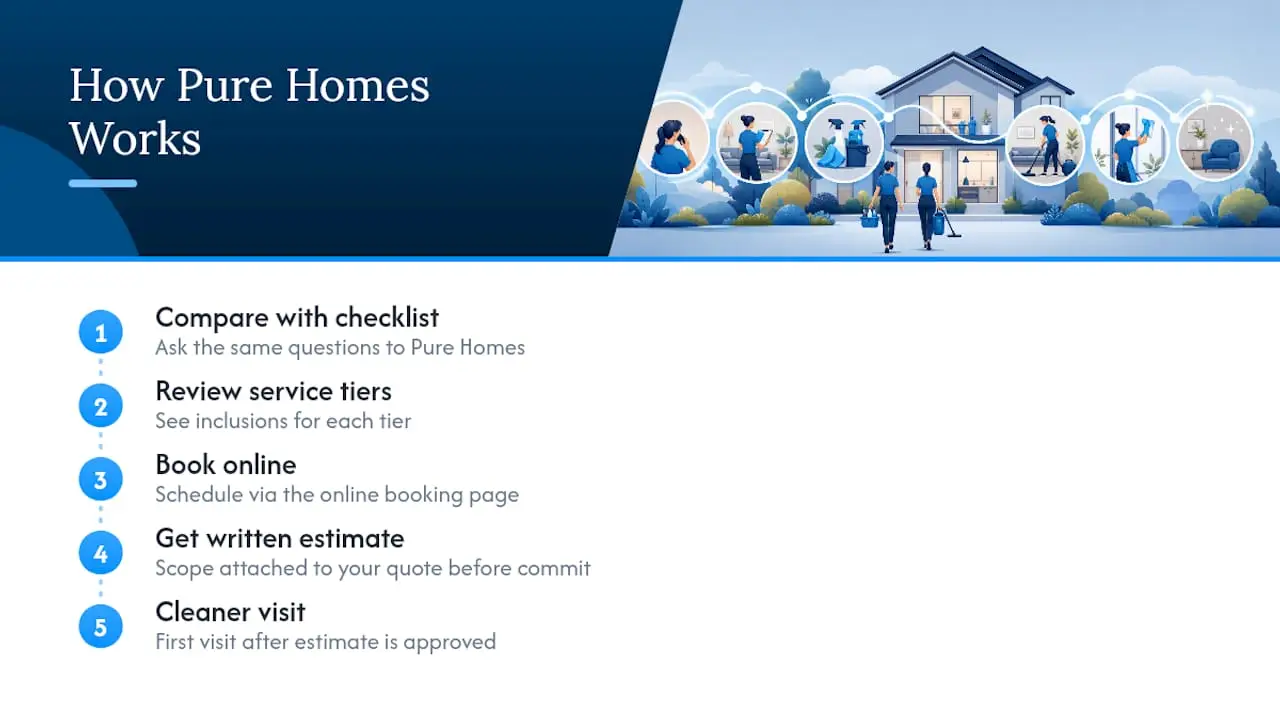
If you’re comparing providers using the questions above, ask Pure Homes Cleaning the same ones. Check the full range of services to see what’s included at each tier, then book a first visit through the online booking page and get your written estimate before the cleaner ever sets foot in your home.
Sources
- How to Choose a Cleaning Service You Can Trust
- 17 Go-To Questions You Should Ask a House Cleaning Service
- Cleaning business insurance overview (Insureon)
- Key Housekeeping Interview Questions to Ask Before Hiring
FAQ
What Is the 5-5-5 Rule for Cleaning?
The 5-5-5 rule is a home decluttering method (five items to keep, five to toss, five to donate) rather than a formal cleaning-industry standard, so treat any specific claim about it with caution and ask a cleaning company directly what routine they follow.
How Much Do You Tip for a $200 Cleaning?
A common range is 15% to 20% of the total bill, which on a $200 clean works out to roughly $30 to $40, though tipping is always optional and not required to keep good service.
Is $20 an Hour Good Pay for House Cleaning?
Pay varies significantly by region and whether the cleaner is an employee or a subcontractor, so it’s more useful to ask a company how their staff are paid and classified than to judge a single hourly figure in isolation.
How Do I Ask My Cleaner To Do a Better Job?
Be specific and give a written checklist of exactly what you want covered, since vague feedback like “clean better” rarely changes results. Providers with a documented scope, the kind Pure Homes Cleaning provides at booking, make this easier because you can point directly to what was missed against what was promised in writing.