
A reasonable cleaning cancellation policy requires 24 to 48 hours’ notice before you can cancel or reschedule without a charge. Late cancellations typically bring a flat fee (often $50) or 25 to 100% of the appointment cost, and no-shows usually mean the full job gets billed. If a charge feels off, ask for the written policy and proof before you pay. The scripts and templates below help you cancel clean or push back on a fee that doesn’t add up.
TL;DR:
- Cancellation fees should be clearly disclosed upfront and generally range from $50 flat fee or 25% to 50% of the job if canceled within 24 to 48 hours.
- Last-minute cancellations or no-shows typically result in full charges, especially when the cleaner has already arrived or the slot was locked in.
- Offering specific alternative times in your cancellation message increases the likelihood of waivers or reduced fees, particularly for emergency cancellations.
- Providers enforce stricter policies on deep and move-out cleans due to higher prep and staffing costs, with some states providing additional consumer protections.
- Disputing unexpected fees is easier when you have written proof, and refunds are usually issued if the provider cancels or if you can demonstrate the fee was not properly disclosed.
Table of Contents
- Standard Notice Windows and Fee Structures
- What Happens When You Cancel, No-Show, or Get Locked Out
- How to Cancel or Reschedule Without Getting Charged
- Are Cancellation Fees Legal in the US?
- How to Dispute or Negotiate a Cancellation Fee
- Sample Cancellation Policy Templates You Can Use
- Lock-Out and No-Access Situations
- Recurring Contracts: Termination Notice and Early-Termination Fees
- How Cancellation Fees Get Charged and Refunded
- Independent Cleaners vs. Cleaning Companies: Policy Differences
- How Cancellations Affect Scheduling and Availability
- Your Rights Under Federal Consumer Protection Rules
- Why Clear Policies Protect Everyone, Not Just the Provider
- How Pure Homes Cleaning Handles Cancellations
- Templates and Guidance Used for This Article
- Sources
- FAQ
Standard Notice Windows and Fee Structures
Most residential cleaners set their cancellation window at 24 hours. That gives them enough runway to fill the slot with another client or reroute a team member without eating the loss. Higher-demand providers, or jobs that require more prep, often stretch that to 48 or even 72 hours.
Fee models generally fall into three camps, and industry guidance on cancellation policies breaks them down clearly:
- Flat fee: A fixed charge, commonly $50, regardless of job size.
- Percentage fee: Usually 25% to 50% of the appointment price for cancellations inside the notice window.
- Full charge: The entire job cost, typically reserved for same-day no-shows or lock-outs.
Deep cleans and move-out jobs tend to carry the strictest terms due to higher preparation time, special supplies, and staffing needs, so a late cancellation costs the provider more in lost labor and wasted product, as explained in Why Apartment Carpets Need Professional Cleaning. Providers enforce these fees mainly to protect payroll. When a cleaner shows up to a locked door, they still lose paid hours they could have spent on another job.
What Happens When You Cancel, No-Show, or Get Locked Out
The outcome of a cancellation depends almost entirely on timing. Here’s how the most common scenarios typically play out:
- Cancel outside the notice window. You cancel 25 hours before a job requiring 24 hours’ notice. No fee applies, and you rebook whenever works.
- Cancel inside the notice window. You cancel eight hours before a scheduled clean. Expect the flat fee or a percentage charge, per whatever the provider’s terms state.
- No-show or lock-out. The cleaner arrives and can’t get in, or you’re not there to let them in. This almost always triggers the full appointment charge, since the time was already blocked off.
- Provider-initiated cancellation. A cleaner cancels on you due to illness or scheduling conflict. Reputable companies handle this with a same-week reschedule or a service credit, not a fee to you.
The pattern is consistent: the closer to appointment time you cancel, the more it costs, and a locked door counts as a completed slot even though no cleaning happened.
How to Cancel or Reschedule Without Getting Charged
Timing and clarity are what save you money here. Send your message as early as possible, and always include your booking reference and at least two alternative times you’d accept instead.
- Note your booking ID or confirmation number.
- Propose two or three replacement time slots, not just “sometime next week.”
- Use whichever channel gets a fast reply: phone, text, email, or the provider’s app.
- Ask for a confirmation reply so you have a written record.
A script for canceling inside the window: “Hi, I need to cancel my [date] appointment (booking #____). I know this is inside your notice window. Could we reschedule for [date/time] instead, or is a courtesy waiver possible since this is a first-time change?”
For a genuine same-day emergency: “I’m so sorry for the short notice. An emergency came up and I can’t be home for today’s cleaning. Can we move this to [date] this week?”
Pro Tip: Offering a specific reschedule date in the same message you send to cancel makes providers far more likely to waive the fee. It signals you’re not disappearing as a customer, just moving the appointment.
Are Cancellation Fees Legal in the US?
Fees disclosed to you before booking are generally enforceable, the same way a restaurant can charge a no-show fee if you agreed to it when reserving a table. The FTC’s Cooling-Off Rule mostly covers door-to-door sales and rarely applies to a cleaning appointment you scheduled yourself.
Some states layer on extra protections. New York and Massachusetts, for example, have consumer contract rules that can affect service agreements above certain dollar thresholds, so a large recurring contract might get more scrutiny than a single $150 clean.
If a fee shows up that wasn’t disclosed, or contradicts what the provider’s own posted terms say, don’t just pay it. Escalate in this order:
- Request the written policy in writing.
- Ask for an itemized bill showing exactly what you’re being charged for.
- If the numbers still don’t match, dispute the charge with your bank or card issuer.
- For a pattern of unfair billing, contact your state’s consumer protection office.
How to Dispute or Negotiate a Cancellation Fee
Getting a fee waived or reduced comes down to moving fast and keeping proof. Follow these four steps in order:
- Check the paperwork. Pull up your original booking confirmation and compare it against the provider’s posted cancellation terms.
- Gather your evidence. Screenshots, timestamped texts, emails, and your booking reference all matter if this goes to a dispute.
- Contact the provider directly and stay polite. Offer a fair trade: a credit toward your next clean, an immediate rebook, or ask plainly for a one-time courtesy waiver.
- If they refuse and the charge looks unauthorized, file a dispute with your card issuer or reach out to your state’s consumer protection office.
Pro Tip: Providers waive fees far more often for customers who show proof of an emergency and ask calmly than for those who argue over the phone. A brief, factual message beats a heated call almost every time.
Written agreements make this whole process smoother on both sides. Service-agreement templates that spell out cancellation and billing terms cut down on disputes because both parties agreed to the same numbers in advance.
Sample Cancellation Policy Templates You Can Use
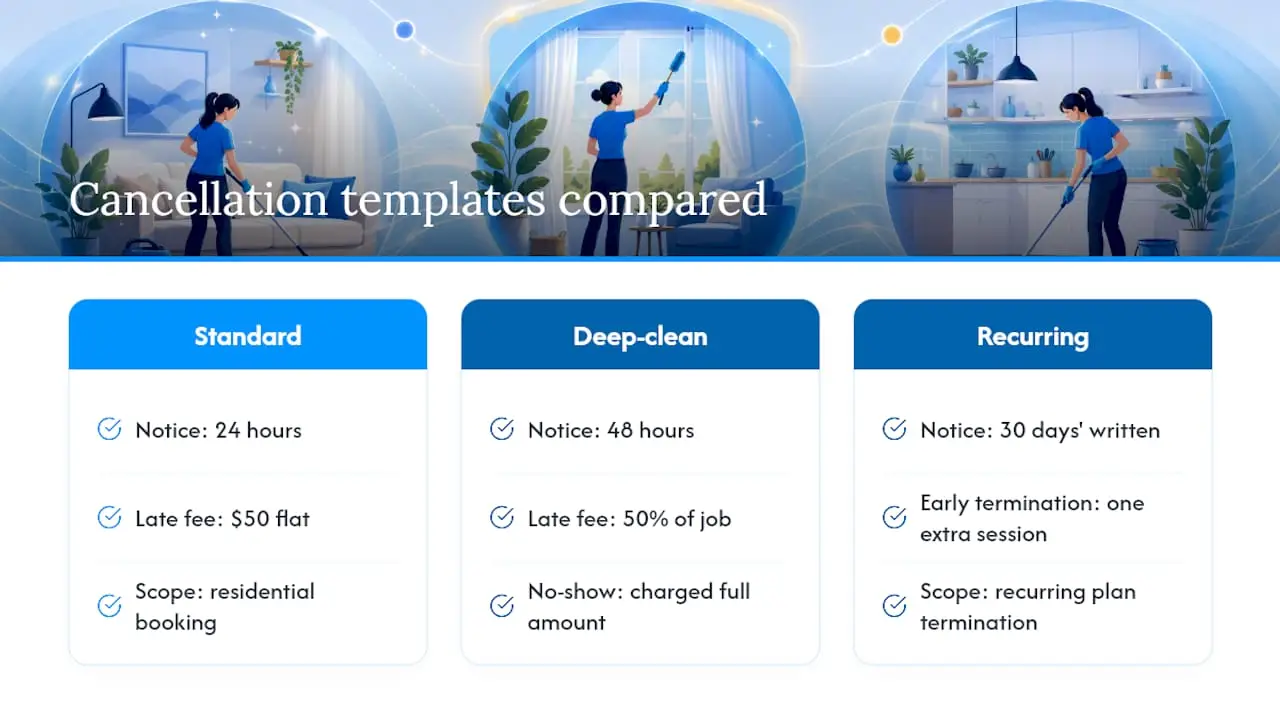
Comparing a provider’s actual terms against a clean template makes it obvious whether their policy is standard or unusually strict. Here are three you can reference or send to a provider when asking for clarification:
Template A: Standard residential booking
“Cancellations made less than 24 hours before the scheduled appointment are subject to a $50 flat fee. Cancellations made 24 hours or more in advance incur no charge.”
Template B: Deep clean or move-out appointment
“This appointment requires 48 hours’ notice for cancellation or rescheduling. Cancellations inside that window are charged 50% of the total job cost. No-shows are charged the full amount.”
Housecall Pro’s contract guide uses similar language in its templates, with a 24-hour baseline and a $50 example fee as the industry starting point.
Template C: Recurring cleaning plan termination
“Either party may terminate this recurring service agreement with 30 days’ written notice. Early termination without notice requires payment for one additional session at the standard rate.”
Before you confirm a booking, it’s fair to ask the provider whether they’ll accept a modified version of their clause, especially around notice length if your schedule tends to shift.
Lock-Out and No-Access Situations
A lock-out happens when the cleaner arrives at the scheduled time and cannot get inside due to access issues such as missing keys or changed codes. From the provider’s perspective, this is treated like a no-show: the time slot was blocked, the team drove there, and no work occurred.
Most providers charge the full appointment price for a lock-out, the same as a same-day cancellation. That can feel harsh if you simply forgot, but consider what the cleaner lost: travel time, fuel, and a paid hour they could have spent on a different job that would have actually paid out.
A few things reduce your risk of a lock-out fee entirely. Some providers offer a grace period, typically 10 to 15 minutes, where the cleaner will wait or try to reach you before marking the visit as failed. Others allow you to leave a spare key, a garage code, or a smart lock code on file so access never depends on you being physically present.
If a lock-out happens because of something the provider mishandled (a wrong address, a missed calendar update, a code that was never updated on their end), that’s not on you, and a reasonable company should reschedule at no charge rather than billing you for their error. Always ask what caused the access failure before assuming the fee is fair. Keep a copy of any access instructions you sent, along with timestamps, in case you need to show the provider had what they needed to get in.
Recurring Contracts: Termination Notice and Early-Termination Fees
Cancelling one appointment and ending an ongoing cleaning plan are two different problems with two different rule sets. A one-off cancellation affects a single visit. Terminating a recurring plan, weekly, biweekly, or monthly, affects a standing arrangement the provider has built into their route and staffing.
Most recurring agreements require 14 to 30 days’ written notice before you can end the plan without penalty. That window exists because providers plan staffing and routes around recurring clients weeks in advance. Pull a client out with no warning, and the company is left with an open slot on that day it may not be able to fill.
Early-termination fees, when they exist, usually take one of two forms. Some providers charge a flat penalty, similar to breaking a lease early. Others simply require payment for one additional session at your normal rate, treating the missing notice period as a session you still owe.
Watch for one common trap in recurring contracts: discounted rates tied to a minimum commitment. If you signed up for a lower biweekly rate because you agreed to a six-month term, ending early might mean the provider retroactively bills you the difference between your discounted rate and the standard one-time rate for sessions already completed. That clause should be spelled out clearly in your agreement. If it isn’t, ask before you sign.
Always get your notice period and any early-termination terms in writing before starting a recurring plan, not after you’ve decided to leave.
How Cancellation Fees Get Charged and Refunded
Two collection methods dominate the residential cleaning industry: card-on-file and invoicing. Card-on-file means the provider stores your payment method when you book and automatically charges it the moment a cancellation fee is triggered, sometimes within minutes of your cancellation going through. Invoicing means you get a bill after the fact and have a few days to pay it manually.
Card-on-file is faster for the provider and more common with app-based booking systems, but it also means you should know exactly what triggers a charge before you hand over a card number. Ask directly: does canceling inside the window charge me instantly, or does someone review it first? A provider that can’t answer that clearly is a small warning sign.
Refunds and credits work differently depending on who canceled and why. If the provider cancels on you, most reputable companies issue either a full refund or a credit toward a future booking, whichever you prefer. If you canceled and were charged a fee you believe was applied incorrectly, that’s not typically a refund situation, it’s a dispute, and you’d follow the escalation steps covered earlier rather than simply requesting your money back.
One detail worth confirming before you book: whether a credit expires. Some providers issue credits that vanish after 60 or 90 days if unused, which matters if your schedule is unpredictable. Ask for that detail in writing, the same way you’d ask about the cancellation fee itself.
Independent Cleaners vs. Cleaning Companies: Policy Differences
The size and structure of who you hire changes how strict, and how flexible, their cancellation terms tend to be. An independent cleaner working solo often runs a tighter margin. If you cancel on them last minute, there’s no backup team member to shift onto another job, so their entire day’s income for that slot disappears. Many independents compensate by keeping fees simple, sometimes just asking for a flat rate if you cancel same-day, but they may also be less willing to negotiate since they don’t have office staff to review your case.
Larger cleaning companies usually have more moving parts: dispatch software, multiple crews, and a written policy that applies uniformly across all customers. That structure means less room for one-off exceptions on paper, but it also often means more consistent enforcement, and sometimes more channels to appeal through (a phone line, an app, a dedicated customer service contact) if you think a fee was applied wrong.
Neither structure is inherently better for you as a customer. An independent cleaner might waive a fee out of goodwill faster than a company’s policy allows, but a company is more likely to have the fee, the notice window, and the dispute process spelled out clearly before you ever book. If flexibility matters more to you, ask directly how firm their policy is. If consistency and a paper trail matter more, a company with a posted set of cleaning services and clear terms tends to be the safer bet.
How Cancellations Affect Scheduling and Availability
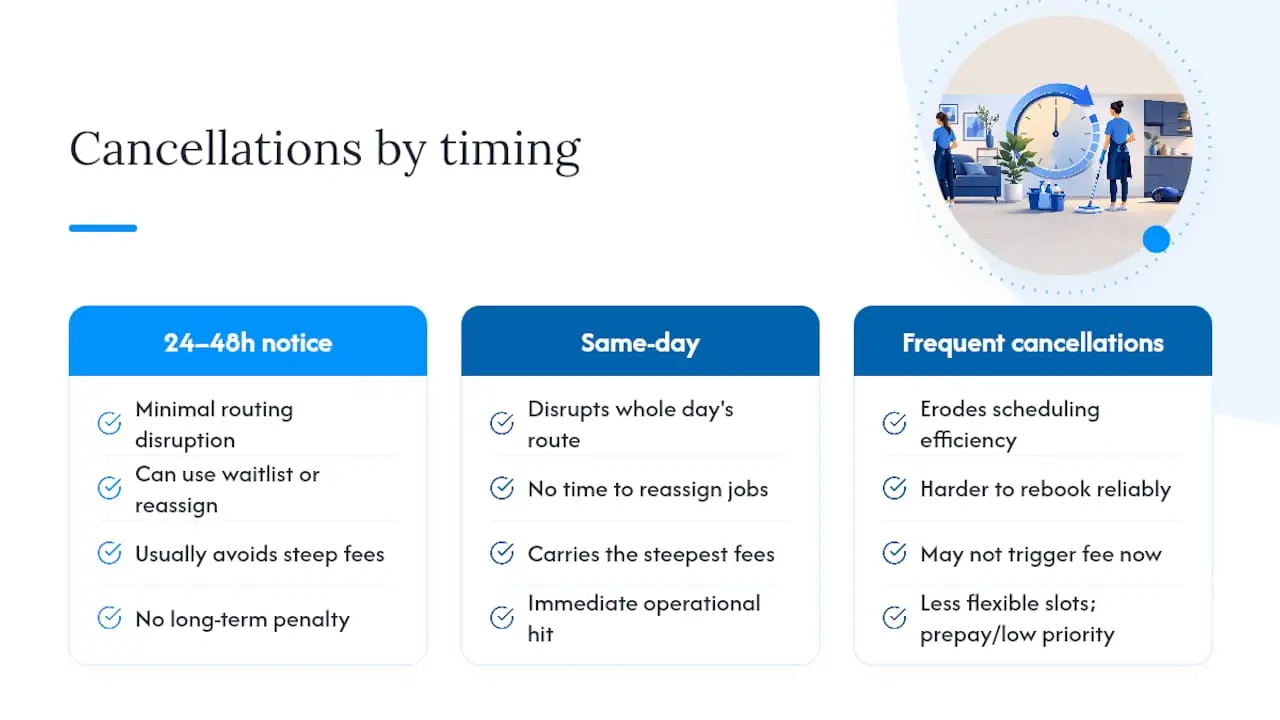
A single last-minute cancellation rarely looks like a big deal from the customer’s side. From the provider’s side, it can knock out an entire day’s plan. Cleaning teams typically get routed geographically, one cleaner or crew handles several appointments clustered in the same neighborhood to cut down on drive time. Pull one job out of that route with no warning, and the whole day’s efficiency takes a hit.
This is part of why notice windows exist at all, beyond just protecting the provider’s income. A 24 to 48 hour buffer gives dispatchers enough time to slot in a different client from a waitlist, shift a crew to a nearby job, or adjust the day’s route so nobody’s driving in circles for a canceled slot. Same-day cancellations don’t give anyone that runway, which is exactly why they carry the steepest fees.
Frequent cancellations also affect you directly over time, even if you never get charged a fee. Providers track cancellation history per customer. A client who reschedules constantly or cancels often may find themselves offered less flexible time slots, moved further down a priority list during high-demand seasons, or in rare cases, asked to prepay before future bookings are confirmed. It’s not punitive so much as practical: providers protect their schedule the same way you’d protect your calendar from someone who constantly no-shows on plans.
Booking systems that show real-time availability, rather than requiring a phone call to check, tend to reduce this friction on both sides since you can see open slots and pick one that actually works for your week.
Your Rights Under Federal Consumer Protection Rules
Federal consumer protection law gives you real but limited leverage here. The Federal Trade Commission enforces rules against deceptive or unfair business practices broadly, which means a provider can’t advertise “no cancellation fees” and then charge you one, or bury a fee in fine print you were never shown. That’s a deception issue the FTC’s general authority covers, separate from the narrower Cooling-Off Rule.
What federal law does not typically give you is a blanket right to cancel a scheduled home service without any consequence. Once you agreed to disclosed terms at booking, whether verbally, by checking a box online, or by signing a contract, those terms generally hold up. Your strongest protection isn’t a right to cancel penalty-free. It’s the right to see clear terms before you agree to anything, and to dispute a charge that doesn’t match what you were shown.
That’s exactly why the escalation path matters more than any single rule: request the written policy, compare it to the charge, and dispute through your card issuer if the numbers don’t line up. State consumer protection offices can step in for repeated or larger-scale violations, but for a single disputed cleaning fee, your card issuer’s dispute process is usually the fastest route to a resolution.
Why Clear Policies Protect Everyone, Not Just the Provider
A cancellation policy isn’t there to trap customers. It exists because cleaning income depends on a filled schedule, and a policy that’s actually enforced protects the people showing up to do the work as much as it protects the business. The providers worth booking with are the ones who post their terms plainly and let you see them before you commit to anything.
When you’re comparing companies, look for one that publishes clear terms and offers straightforward online booking with transparent invoicing. That combination tells you more about how a company treats disputes than any glowing review ever will.
— Local
How Pure Homes Cleaning Handles Cancellations
The provider posts cancellation and rescheduling terms clearly before you confirm an appointment, so you’re never guessing what a late change might cost. Rather than treating every cancellation the same, the approach favors flexibility: where a fee applies, you’re often offered the option of a credit toward a future cleaning instead of a flat charge, especially for a first-time schedule conflict.
You can review the full range of standard, deep, and move-out cleaning options on the services page before booking, so you know exactly which notice window and terms apply to your specific job. Online booking shows real-time availability, which cuts down on the back-and-forth that often leads to last-minute cancellations in the first place. If you have questions about how a fee or credit would apply to your situation, reach out before you book. Ready to see open slots for your home? Book your cleaning now and check the current policy terms during checkout.
Templates and Guidance Used for This Article
The sample clauses and legal notes above draw on Housecall Pro’s contract guide and Consumershield’s service-agreement template. Readers wanting full downloadable versions or state-specific contract language should review those directly.
Sources
- Cleaning Service Contract Guide (+Free Template & Sample)
- Cleaning Service Agreement Template — Free Professional Contract
- Cleaning Service Cancellation Policies: What Customers Should Expect
FAQ
What Is a Reasonable Cancellation Policy?
A 24 to 48 hour notice window with a flat fee (often $50) or a percentage charge for late cancellations counts as standard and fair for residential cleaning.
How Do I Politely Cancel a Cleaning Service?
Contact the provider as early as possible with your booking reference and two or three alternative times you could reschedule to, rather than just canceling outright.
Do I Legally Have to Pay a Cancellation Fee?
If the fee was disclosed to you before booking and matches the provider’s written policy, it’s generally enforceable; if it wasn’t disclosed, ask for documentation and consider disputing it.
Do Cleaning Companies Charge a Cancellation Fee?
Most do, typically a flat fee or a percentage of the job for late cancellations, and the full job cost for same-day no-shows or lock-outs. Purehomescleaning posts its terms upfront so you can check them before booking.