For most busy homeowners, a professional house cleaner offers the best mix of thorough results and low management effort. A private housekeeper works better for households that need daily hands-on help with laundry, errands, and organizing. “Maid” is mostly a leftover marketing term today. The sections below break down what each role actually covers, what it costs, and how to hire the right one.
TL;DR:
- Hiring a professional cleaning company reduces liability risks and guarantees backup coverage if your regular cleaner is sick or unavailable.
- Private housekeepers generally charge hourly or flat rates, but their employment costs may cause the total expense to surpass that of a company, especially factoring in taxes.
- Most house cleaners focus on scheduled or one-time cleaning tasks, while housekeepers handle ongoing household chores like laundry, errands, and light organizing.
- The term “maid” is mostly outdated; modern roles are better described as house cleaners or housekeepers, with regional and cultural differences influencing expectations.
- The choice depends primarily on whether you need deep cleaning services or daily household management to determine the right role for your situation.
Table of Contents
- Maid vs House Cleaner vs Housekeeper: What Each Role Actually Does
- Which Should You Hire: A Side-by-Side Look
- What Does It Cost to Hire a Cleaner or Housekeeper?
- Why a Vetted Cleaning Company Solves the Common Tradeoffs
- Do “Maid” and “Housekeeper” Mean the Same Thing Everywhere?
- What Legal Protections Apply to Each Role?
- Common Misconceptions About Maids, Housekeepers, and Cleaners
- How Does Hiring Help Change Life Inside Your Home?
- The Practical Take on Choosing Between These Roles
- How Pure Homes Cleaning Removes the Guesswork
- Sources
- FAQ
Maid vs House Cleaner vs Housekeeper: What Each Role Actually Does
The word “maid” comes from an older domestic-service tradition and has largely faded from professional use. Most companies now use “house cleaner” or “cleaning professional” instead, since the term carries outdated, gendered connotations that don’t match how modern cleaning businesses operate. You’ll still see “maid service” in casual conversation and in some company names, but it usually just means a scheduled cleaning company.
House cleaner — hired for scheduled or one-time visits, working from a set checklist.
- Typically does: vacuuming, mopping, dusting, kitchen and bathroom sanitizing, trash removal.
- Typically does not: laundry, dishes, errands, childcare, or pet care (some offer these as paid add-ons).
- Usually brings their own supplies and equipment on scheduled visits, and companies commonly handle laundry or dishes only as an extra service.
Housekeeper — a more consistent, ongoing presence directed by the homeowner.
- Typically does: laundry, ironing, meal prep, organizing, occasional errands, alongside light cleaning.
- Typically does not: heavy deep cleaning, carpet shampooing, or exterior work.
- Often works several days a week and follows a flexible task list set day to day, with the homeowner supplying most cleaning products.
“Maid” — functionally overlaps with house cleaner in today’s market, though the label sometimes implies a live-in or highly personal arrangement from an earlier era.
Which Should You Hire: A Side-by-Side Look
The real decision hinges on scope, oversight, and how much you want to manage. A house cleaner needs almost no direction once a checklist exists. A housekeeper needs ongoing guidance, since that role typically requires more homeowner-led scheduling and task management. Reliability differs too: a company-employed cleaner comes with backup coverage if someone calls in sick, while a private housekeeper leaves you without a fallback plan.
Here’s how three common households typically land:
- Busy family with young kids — a recurring house cleaning service, biweekly or weekly, handles the baseline mess without adding another person to manage.
- Occasional deep-clean need (moving, spring-cleaning, hosting) — a one-time deep clean or move-in/move-out service fits better than ongoing help.
- Household needing errands, laundry, and daily support — a private housekeeper makes more sense despite the added management.
Watch for red flags either way: no proof of insurance, vague pricing, or no replacement plan if your regular cleaner cancels.
Pro Tip: Ask any provider what happens if your assigned cleaner is out sick. A one-person setup with no backup means a canceled visit; a company with a trained bench means someone else shows up on schedule.
What Does It Cost to Hire a Cleaner or Housekeeper?
Pricing shapes differ by role. House cleaning companies typically bill per visit or hourly, with deep-clean surcharges added for first-time visits or heavily soiled homes. Private housekeepers often charge hourly or a flat weekly rate, negotiated directly.
Taxes matter more than most homeowners expect. If you pay a private housekeeper directly and control their schedule and methods, the IRS may classify you as a household employer, which triggers payroll tax obligations. Once that threshold applies, the after-tax cost of a private hire can exceed what it first appears to be, since a cleaning company absorbs those employment costs itself.
Before hiring anyone, run through this checklist:
- Confirm liability insurance and bonding coverage.
- Ask about background checks for anyone entering your home.
- Get the replacement policy in writing (what happens if your cleaner is unavailable).
- Request at least two references or verified reviews.
- Clarify what’s included versus billed as an extra (inside fridge, windows, laundry).
To prepare for a visit, clear clutter from floors and counters, secure pets, and leave notes for any special instructions. Most cleaners bring their own equipment unless you’ve arranged otherwise.
Why a Vetted Cleaning Company Solves the Common Tradeoffs
Private hires leave you managing insurance, taxes, and backup coverage alone. A company-run service shifts that burden onto the business, which is why professional cleaning companies typically carry insurance and coordinate backup crews that individual housekeepers can’t match. Pure Homes Cleaning runs on that model: recurring cleaning, deep cleaning, and move-in/move-out service, all with eco-friendly products and online booking. If your regular cleaner is out, a trained replacement fills the slot instead of you losing the appointment entirely.
Do “Maid” and “Housekeeper” Mean the Same Thing Everywhere?
Not quite, and the differences show up more in region and household culture than in any formal rulebook. In parts of the American South and in many households with live-in help, “maid” still implies a more personal, often live-in relationship, closer to historical domestic service. In most metro areas today, including Washington, DC and its suburbs, the term has softened into a generic stand-in for any paid house cleaning help, formal or not.
Housekeeper carries different weight depending on context too. In hospitality, a housekeeper is someone who cleans hotel rooms on a strict schedule with almost no personal interaction with guests. In a private home, the same title implies daily or near-daily contact, direction from the homeowner, and tasks well beyond cleaning, like errands or meal prep. That’s a meaningfully different job even though the title is identical.
Cultural background also shapes expectations. Households from cultures with a longer tradition of domestic staff sometimes expect a housekeeper to take on child supervision or cooking duties that would be considered outside scope elsewhere. Immigrant-heavy metro areas, including the DC region, often see hybrid arrangements that blend housekeeper and nanny duties into one role, which can create confusion when comparing pay rates or job postings. None of this is standardized, so it pays to spell out exact duties in writing regardless of what title you use.
What Legal Protections Apply to Each Role?
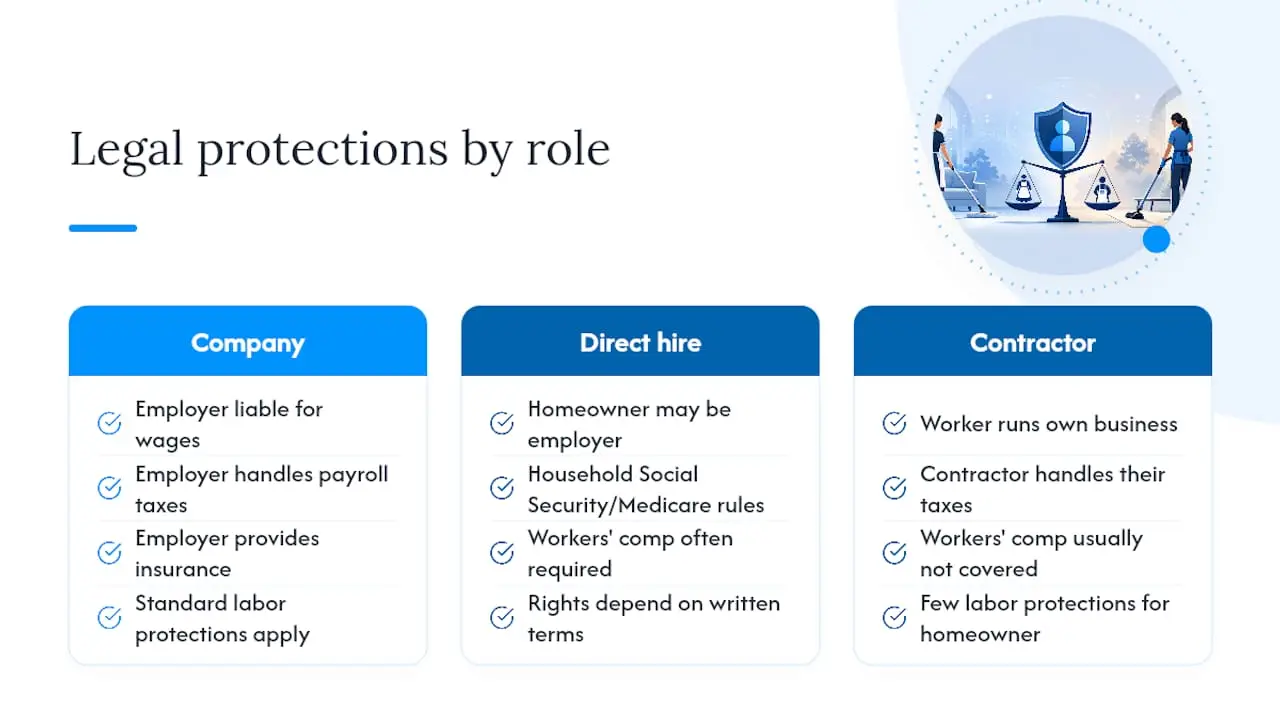
The legal picture changes sharply depending on who employs the worker. A house cleaner employed by a cleaning company is that company’s responsibility for wages, insurance, and payroll taxes. You’re the customer, not the employer, so you carry no employment liability.
Hire a housekeeper directly and set their schedule and methods yourself, and you may become a household employer under IRS rules. That status can trigger Social Security, Medicare, and unemployment tax obligations once pay crosses the federal threshold, and it also means you’re responsible for workers’ compensation coverage in many states if the person is injured on your property. Skipping this step isn’t just a paperwork risk. It can leave you personally liable for medical costs or back taxes.
Labor rights differ too. Employees of a cleaning company have access to whatever benefits, overtime protections, and grievance processes that company offers under standard labor law. A privately hired housekeeper depends entirely on whatever arrangement you put in writing, since there’s no employer HR department to appeal to. Independent contractors occupy a gray area; misclassifying an employee as a contractor to avoid tax obligations is a real legal exposure for homeowners, not just a technicality. If you’re hiring directly and unsure which category applies, a quick consult with a tax professional or the IRS household employer guidance is worth the hour it takes.
Common Misconceptions About Maids, Housekeepers, and Cleaners
The biggest myth is that all three roles are interchangeable job titles for the same work. They’re not, and treating them as synonyms is how homeowners end up disappointed. Someone booking a “maid service” expecting daily laundry and meal prep will be frustrated when a scheduled house cleaning crew shows up, cleans for two hours, and leaves.
Another persistent stereotype: that hiring any of these roles signals wealth or excess. In reality, a biweekly house cleaning visit costs less than many recurring subscription services once you account for the hours it saves. The image of live-in domestic staff as an upper-class luxury doesn’t match how most households actually use cleaning help today, which is closer to outsourcing a chore than staffing a household.
There’s also a lingering assumption that housekeeping work requires no real skill. Anyone who has tried to remove hard water stains from a shower or restore grout after months of neglect knows that’s false. Professional cleaners follow specific techniques for different surfaces and materials, and CDC guidance on disinfecting surfaces makes clear that effective sanitizing takes more than wiping a counter with a rag. Finally, some homeowners assume a house cleaner will notice and fix anything that looks off, from a loose cabinet hinge to a moldy grout line. That’s outside the standard scope, and expecting it without discussing it upfront is one of the more common sources of friction between clients and cleaners.
How Does Hiring Help Change Life Inside Your Home?
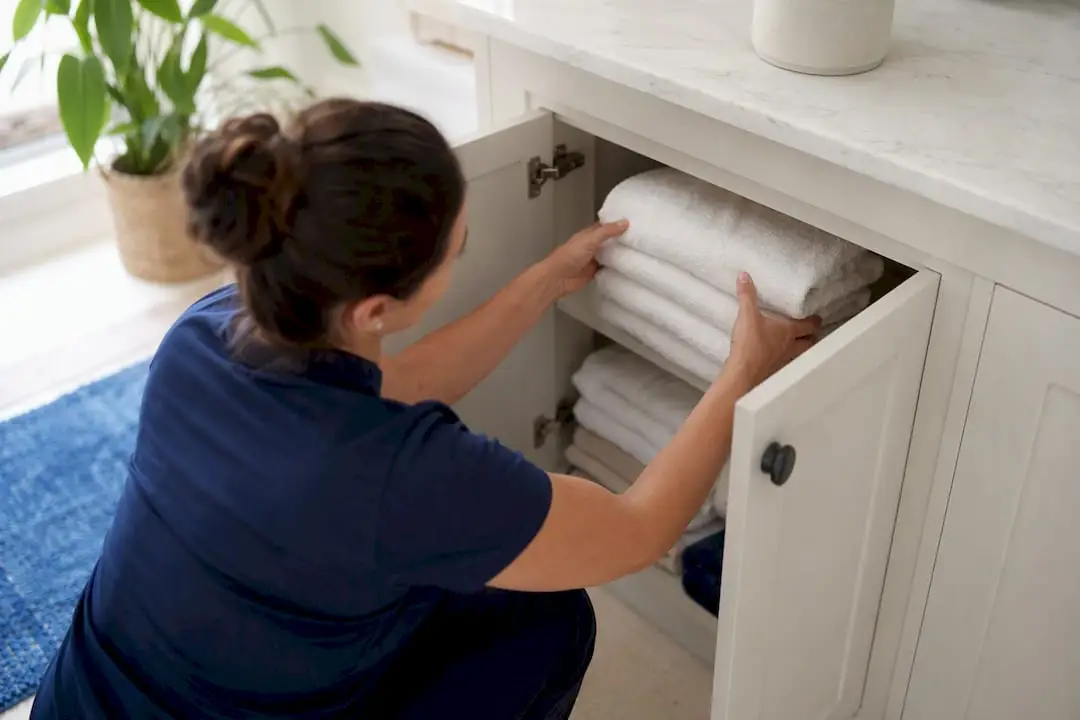
Bringing someone into your home on a regular basis changes the rhythm of the household, even when the work itself is straightforward. A house cleaner on a two-hour biweekly visit barely registers; you’re often not even home when the work happens. A housekeeper who’s there most weekdays is a different story. Their presence affects what rooms feel private, how you dress around the house, and whether conversations happen behind closed doors.
Kids and pets adjust differently too. Younger children sometimes treat a recurring housekeeper as a familiar fixture, almost like an extended family member, which can blur boundaries if roles aren’t clear from the start. Pets react to scheduling changes and unfamiliar routines, so a consistent cleaner (same person, same day) tends to cause less disruption than a rotating crew.
Privacy concerns scale with access. A house cleaner working from a checklist while you’re at work has limited exposure to personal spaces beyond what’s necessary to clean. A housekeeper who does laundry, organizes closets, or preps meals sees far more of daily life, from mail on the counter to what’s in the medicine cabinet. That’s not a reason to avoid hiring help. It’s a reason to set clear boundaries early, whether that means designating off-limits rooms, locking a home office, or simply having a conversation about what feels comfortable. Most friction in these relationships comes from unspoken assumptions, not bad intent on either side.
The Practical Take on Choosing Between These Roles
Most homeowners overthink the maid versus housekeeper decision when the real question is simpler: do you need deep cleaning on a schedule, or daily help running a household? Pick based on that, not the label on the job posting.
— Local
How Pure Homes Cleaning Removes the Guesswork
Choosing between a house cleaner and a housekeeper often comes down to one thing: who handles the headaches when something goes wrong. Purehomescleaning is built to remove that burden entirely. Instead of managing insurance, vetting a stranger, or scrambling for a backup when your regular cleaner is sick, you get a trained crew, consistent quality, and a replacement on standby if your usual team can’t make it.

Purehomescleaning covers recurring cleaning, deep cleaning, and move-in/move-out service across Washington, DC and the surrounding area, using eco-friendly products on every visit. Every job comes with the kind of operational backup a private hire can’t offer: trained substitutes, insured staff, and a consistent checklist so your home looks the same way every time, not just whenever the person shows up. Check out the full house cleaning services lineup to see what’s included, or book a cleaning online in a few minutes and skip the back-and-forth entirely.
Sources
This guide draws on Angi’s housekeeper vs. house cleaner breakdown, Care, CDC home disinfecting guidance, and IRS household-employer tax rules.
- Care
- Housekeeper vs. Cleaner (practitioner perspective)
- CDC — When and how to clean and disinfect your home
FAQ
Is a Maid the Same as a House Cleaner?
Functionally, yes in most modern contexts. “Maid” is an older term that’s largely been replaced by “house cleaner” in professional marketing and job postings.
What’s the Main Difference Between a Housekeeper and a Cleaner?
A housekeeper typically works more hours under homeowner direction and handles laundry, errands, and organizing, while a house cleaner follows a defined checklist during scheduled visits.
Do I Need to Pay Taxes if I Hire a Housekeeper Directly?
Possibly. If you control a housekeeper’s schedule and methods and pay them above the federal threshold, IRS household-employer rules may require you to withhold payroll taxes.
Is It Cheaper to Hire a Private Housekeeper or a Cleaning Company?
A private housekeeper’s hourly rate often looks lower upfront, but once you factor in employment taxes, insurance, and lost time managing schedules, a company like Purehomescleaning frequently costs less in total effort and risk.
What Should I Ask Before Hiring a Cleaning Service?
Ask about insurance and bonding, background checks, their replacement policy if your regular cleaner is unavailable, and whether supplies are included in the price.