

Tipping house cleaners is optional, not required, but it’s common practice and genuinely appreciated when the work is good. For one-time or deep cleans, a fair benchmark is 15 to 20 percent of the bill; for recurring service, most homeowners leave $10 to $20 per visit. Always check the cleaning company’s own tipping policy first, since some already factor gratuity into staff pay.
TL;DR:
- Tips for one-time deep cleans should be 15 to 20 percent of the total bill, especially for complex or time-consuming jobs.
- For recurring visits, flat tips of $10 to $20 are standard, with higher tips reserved for weekly or very long-term arrangements.
- If the cleaning is inadequate or service was poor, skip the tip and contact the company directly to address issues.
- Cash tips go directly to independent cleaners or team members, while company employees may pool tips depending on the business structure.
- Bonus year-end gifts or referrals are alternative ways to show appreciation, especially if you prefer not to tip per visit.
Table of Contents
- Do You Tip House Cleaners, and How Much?
- When Should You Tip More (or Skip It)?
- Who Actually Gets the Tip, and How Do You Pay It?
- Alternatives to Tipping and General Etiquette
- Our Take on Tipping House Cleaners
- Ready to Book a Cleaning You Won’t Second-Guess?
- Sources
- FAQ
Do You Tip House Cleaners, and How Much?
The honest answer is: nobody’s going to fault you for skipping it, but almost everyone leaves something. Industry guidance typically points to two separate scales depending on the type of job, and mixing them up is the most common mistake homeowners make.
For a one-time deep clean, calculate a percentage. Care puts the standard range at 15 to 20 percent of the total bill, with 20 percent or more reserved for jobs that ran long, tackled serious grime, or involved extra requests like inside-oven cleaning or baseboard scrubbing. For recurring cleanings, most people switch to a flat amount instead of recalculating a percentage every visit. Otesse recommends $10 to $20 per visit for regular service, with the higher end going to weekly cleanings where the relationship (and the cleaner’s familiarity with your home) builds over time.
Here’s what that looks like on typical bills:
| Bill Amount | Percentage Tip Range | Flat Alternative |
|---|---|---|
| Moderate one-time clean | Around fifteen to twenty percent of total | About twenty to thirty dollars |
| Larger or deep clean | Around fifteen to twenty percent of total | About fifty to seventy-five dollars |
So is $20 a good tip? For a recurring biweekly visit, yes, it sits comfortably in the standard range. For a $200 one-time deep clean, $20 is on the low end. It’s not insulting, but it’s closer to 10 percent than the 15 to 20 percent most guides recommend.
Use percentage-based tipping when the job is complex, long, or unusual (move-outs, first-time deep cleans, post-renovation cleanups). Use flat per-visit tipping when:
- The cleaning is routine and recurring (weekly or biweekly)
- The same person or team comes every time
- You want predictable budgeting rather than recalculating math each visit
When Should You Tip More (or Skip It)?
Certain situations call for going above the standard range, and a few call for skipping the tip entirely until something gets fixed.
Holiday and year-end bonuses are their own category, separate from per-visit tips. For a regular cleaner, the customary bonus is roughly the cost of one full cleaning session, given once a year rather than added to every visit. Queen of Maids notes this is one of the most consistent recommendations across the cleaning industry, and it tends to matter more to cleaners than any single per-visit bump.
Bump your tip higher, closer to 20 percent or beyond, in these situations:
- Move-out or move-in cleanings, which usually take longer and involve harder grime
- Post-construction or renovation cleanups
- A home that is unusually dirty (pet accidents, hoarding-adjacent clutter, months of neglect)
- Short-notice or emergency bookings where the cleaner rearranged their schedule for you
Pro Tip: If a cleaner comes through on short notice to save your closing date or open house, treat that like a favor, not a routine job. A $10 to $15 bump on top of your usual tip acknowledges the inconvenience.
If the service itself was poor, don’t use the tip as your only feedback mechanism. Skip it for that visit and contact the company directly to request a redo or a partial refund. A missed tip rarely communicates what actually went wrong.
Who Actually Gets the Tip, and How Do You Pay It?
Before you hand over cash, figure out who you’re actually paying. An independent cleaner keeps 100 percent of whatever you give them. A company employee may or may not, depending on how that business structures pay and tip distribution.
- Ask directly, “Does the tip go to you, or does it get pooled with the company?” Most cleaners will tell you straight.
- If a team of two or three shows up, either split the tip evenly between them or leave one labeled envelope and let them divide it themselves.
- Confirm with the company whether tips get distributed to the specific staff who worked, especially if you’re paying through a booking platform rather than handing over cash.
On payment method:
- Cash is still the most direct way to make sure the money reaches the person who cleaned your home, with no processing delay or company handling in between.
- Venmo, Zelle, or in-app tipping at checkout work fine if the cleaner or company confirms they accept it.
- Canary Clean’s Austin guide points out that digital tipping is gaining ground, but cash remains the lowest-friction option when you want zero ambiguity about where it ends up.
Alternatives to Tipping and General Etiquette
Cash isn’t the only way to show appreciation, and skipping it entirely isn’t automatically rude.
If you can’t or don’t want to tip in cash, consider:
- Leaving a detailed public review naming the cleaner or team by name
- Referring friends or neighbors directly to the company
- A year-end bonus instead of per-visit tips
- A small gift or useful cleaning supplies during the holidays
Not tipping isn’t inherently a breach of etiquette, particularly for company-employed staff who already earn a competitive wage as part of that business’s pay structure. Where it becomes an issue is when service was clearly lacking and you say nothing at all. In that case, Queen of Maids advises contacting the company directly rather than letting a withheld tip do the talking, since that gives them a chance to fix the problem and make it right.
One more thing worth a quick mention: if you pay an independent cleaner regularly and the total adds up over the year, ask a tax professional whether that arrangement needs to be reported on your end.
Our Take on Tipping House Cleaners
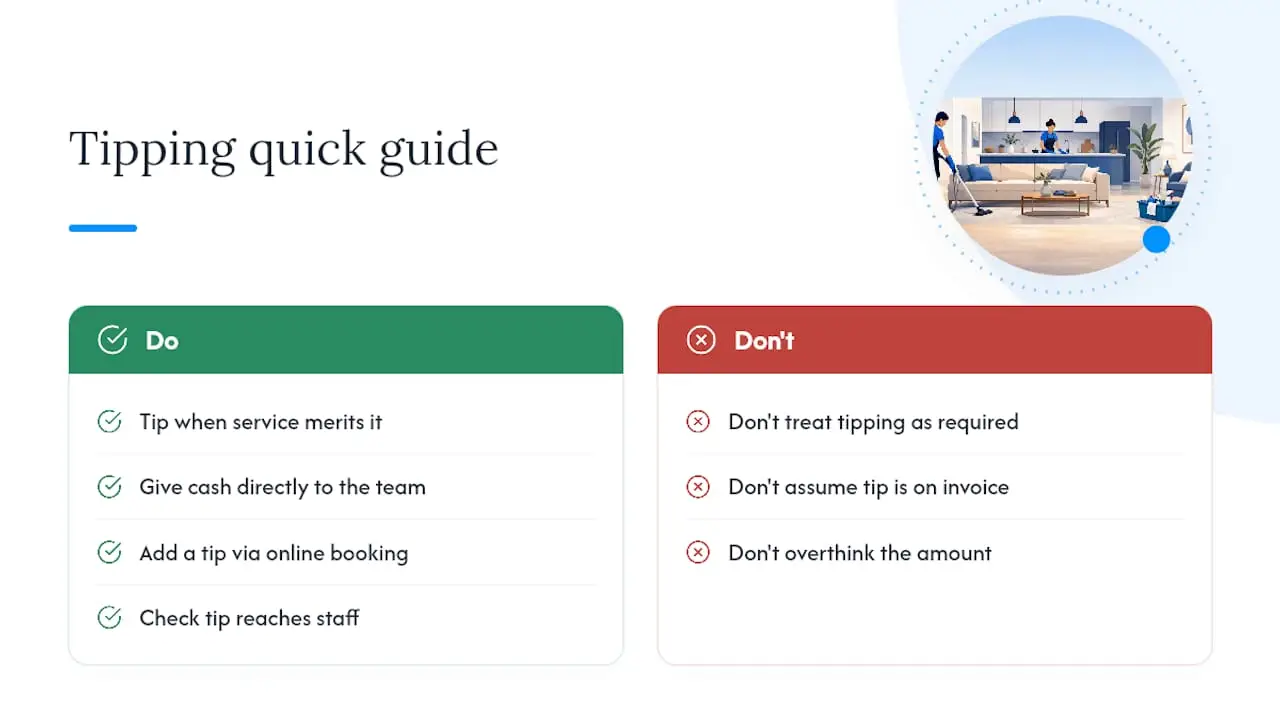
Homeowners overthink this more than they need to. Tipping house cleaners isn’t a test you can fail, and it isn’t a hidden fee disguised as etiquette. It’s a way to say the work was worth it, which is exactly how most service tipping in the U.S. functions.
At Purehomescleaning, we offer routine, deep, and move-in/move-out cleaning across Washington, DC and the surrounding area, and we’re upfront that tipping is appreciated but never expected or built into your invoice. Clients can leave cash directly with their cleaning team or add a tip during online booking, and we make sure any tip left through the platform reaches the staff who actually did the work. If you’re weighing whether to hire help at all, our house cleaning services page lays out exactly what’s included in each visit.
— Local
Ready to Book a Cleaning You Won’t Second-Guess?
If you’ve been putting off hiring help because you’re not sure what a cleaning actually costs, or whether tipping adds an awkward extra decision, Purehomescleaning removes both problems. Our service plans list routine, deep, and move-in/move-out cleaning with transparent pricing upfront, so there’s no guessing what a $200 or $500 job actually covers before your team arrives.
When you book online, you choose your frequency (one-time, weekly, or biweekly), and you can add a tip at checkout if you want to, though it’s entirely optional and never assumed. We handle staff pay directly, so cleaners aren’t relying on tips to make a fair wage, and any tip you do leave goes straight to the person or team who cleaned your home. Head to our booking page to check availability in your neighborhood and get your first cleaning on the calendar.
Sources
This guide draws on Care.com’s tipping benchmarks, Otesse’s percent and flat-rate ranges, Queen of Maids’ company-policy guidance, and Cleaning.
- Care
- How to Tip House Cleaners | Otesse
- Should You Tip Your House Cleaner? (And How Much?) | Queen of Maids
FAQ
How much do you tip for a $200 cleaning?
At 15 to 20 percent, that’s about $30. If you’d rather use a flat amount for a smaller recurring job, $10 to $20 is a reasonable alternative.
Is it rude to not tip a housekeeper?
No. Tipping is optional and appreciated, but skipping it isn’t a breach of etiquette, especially for company-employed staff already earning a set wage.
How much do you tip a house cleaner if your bill is $500?
Using the standard 15 to 20 percent range, that works out to about $50 to $75, with the higher end fitting deep cleans or larger homes.
Is $20 a good tip for housekeeping?
It depends on the job. For a recurring biweekly visit, $20 fits comfortably in the standard range. For a one-time $200 deep clean, it’s on the low side compared to the usual 15 to 20 percent guideline.
What if the cleaning wasn’t done well?
Skip the tip for that visit and contact the company directly to request a fix. Companies like Purehomescleaning would rather hear about an issue and correct it than have a client simply withhold a tip.