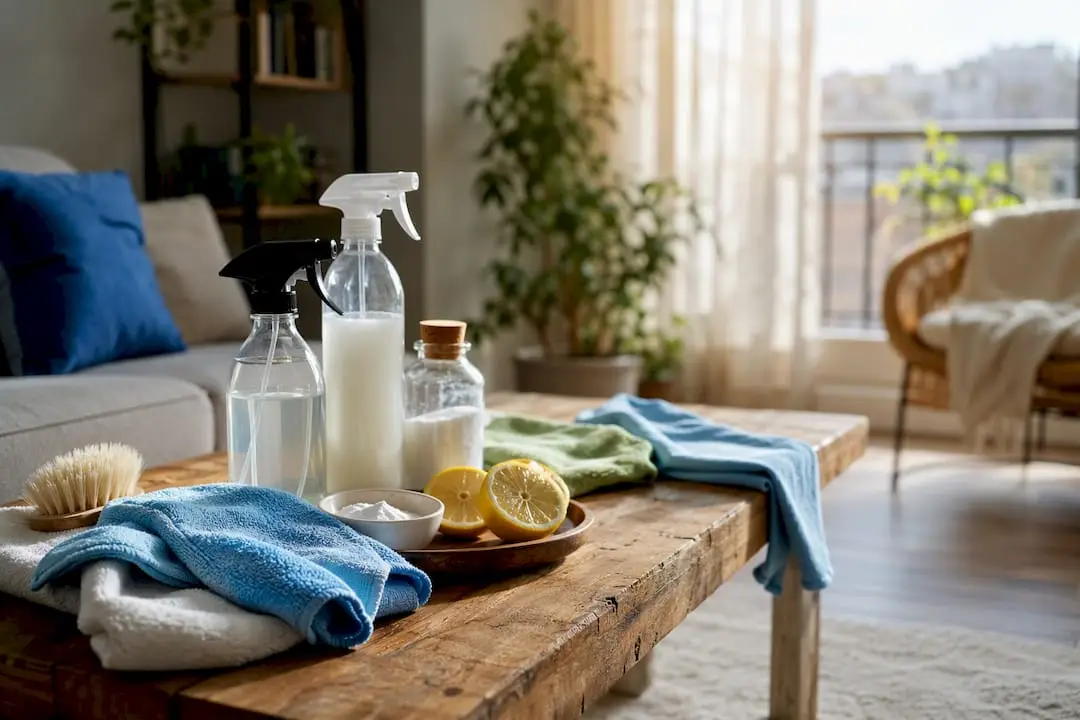
Eco-friendly house cleaning means using products and methods that cut chemical exposure and environmental harm without sacrificing a clean home. The fastest way to start is threefold: pick products certified by EPA Safer Choice or the Design for the Environment (DfE) program, lean on microfiber and steam tools for everyday grime, and keep vinegar and baking soda on hand for routine jobs. One caveat worth knowing upfront: vinegar-based DIY mixes are not registered disinfectants, so they’re not the right call when you actually need to kill germs, not just lift dirt.
TL;DR:
- Certified products under EPA Safer Choice or DfE standards ensure ingredient safety and improved packaging, but DIY vinegar mixes are not effective disinfectants against pathogens.
- Routine cleaning should prioritize microfiber and steam tools, proper dilution, and ventilation, as prolonged use of concentrated solutions increases chemical residues.
- Avoid relying on vague “green” claims; seek verified labels and avoid aerosols, fragrance-heavy formulas, and untested ingredients to prevent indoor air quality issues.
- For situations requiring disinfection, use EPA-registered or DfE-certified products and follow label contact time, especially after handling raw food or illness-related cleaning.
- Reusable tools, refillable concentrates, and biodegradable chemicals reduce environmental impact and long-term costs compared to conventional chemical cleaners.
Table of Contents
- Eco Friendly House Cleaning Tips for Every Room
- Reading Cleaning Labels: Ecolabels That Actually Mean Something
- DIY Cleaner Recipes That Work, and Where They Fall Short
- How to Spot Greenwashing and Clean Safely
- Cleaning vs. Disinfecting: When You Actually Need Both
- Buying Smarter: Concentrates, Packaging, and Tools Worth Owning
- The Environmental Cost of Conventional Cleaners
- Disposing of Cleaning Supplies Without Making a Mess of It
- Cost Comparison: Eco-Friendly vs. Conventional Cleaning
- What Certification Should Look Like When You Hire a Cleaning Service
- The Payoff of Sticking With Green Cleaning Long-Term
- Pure Homes Cleaning’s Approach to Eco-Friendly Cleaning
- Book Eco-Friendly House Cleaning With Pure Homes Cleaning
- Where to Verify Products and Safety Guidance
- Sources
- FAQ
Eco Friendly House Cleaning Tips for Every Room
Green cleaning works best as a system, not a single swap. Here’s how it plays out room by room, plus the habits that make the whole routine stick.
- Kitchen. Cut grease with a warm water and dish soap solution instead of solvent-heavy degreasers, and flush drains weekly with baking soda followed by hot water rather than caustic drain openers.
- Bathroom. Vinegar dissolves mineral deposits on faucets and showerheads, while a baking soda paste handles scouring tubs and grout without scratching. Skip aerosol sprays here. Bathrooms are small, poorly ventilated spaces where fumes concentrate fast.
- Living areas. Dust with a damp microfiber cloth instead of a dry rag, which just scatters particles back into the air, and vacuum with a HEPA-filter machine to trap allergens rather than recirculate them.
- Floors. Cold-water formulas clean as well as hot-water ones for most floor types and use less energy. Reusable mop pads cut down on disposable wipes, and a small steam cleaner works well on sealed tile or stone (skip it on unsealed natural stone or hardwood).
- Routine habits. Dilute concentrates according to the label rather than eyeballing it, spot test any new product on a hidden patch of fabric or grout, and ventilate the room while you work. Rotate which products you keep on hand instead of stockpiling five half-used bottles of the same category.
The dilution habit matters more than people think. Using double the recommended concentration doesn’t clean better, it just means more chemical residue on the surface and a faster-empty bottle.
Reading Cleaning Labels: Ecolabels That Actually Mean Something
Most “green” claims on a bottle are marketing, not verification. A handful of certifications actually require independent testing.
- EPA Safer Choice / DfE: Products carrying this label go through ingredient-by-ingredient review for human and environmental safety, plus performance testing so they still clean effectively. The EPA strengthened these standards in 2024, adding tighter packaging rules including recyclability and minimum post-consumer recycled content.
- Green Seal: An independent nonprofit certification covering toxicity, VOC limits, and packaging, commonly seen on commercial-grade cleaners.
- NSF: Known mostly for food-safety certification, but its consumer guidance also flags which household basics (vinegar, baking soda, lemon) hold up for general cleaning.
Quick label test: Skip anything relying on vague terms like “natural” or “eco” with no seal to back it up. Favor pump sprays over aerosols, fragrance-free formulas, and labels that spell out actual ingredients instead of hiding behind “proprietary blend.”
DIY Cleaner Recipes That Work, and Where They Fall Short
A few homemade mixes handle most routine jobs well:
- All-purpose spray: One part castile soap to ten parts water, plus a few drops of essential oil if you want scent.
- Scouring paste: Baking soda mixed with just enough water to form a paste, ideal for tubs, sinks, and stovetops.
- Gentle degreaser: Equal parts white vinegar and water for countertops and stovetop grease film.
- Deodorizer: Lemon juice diluted in water, wiped on cutting boards or inside the fridge.
Pro Tip: Mix DIY cleaners in small batches you’ll use within a day or two. Vinegar solutions lose potency over time, and there’s no upside to having a gallon of premixed spray sitting under the sink.
Here’s the limit that matters most: vinegar and similar DIY cleaners are not EPA-registered disinfectants and don’t reliably meet the 5-log pathogen reduction standard that real disinfection requires. Lab testing on six alternative cleaners found vinegar, baking soda, and borax remove some soils but generally underperform commercial cleaners on both soil removal and microbial reduction, even with extra scrubbing.
One rule overrides everything else: never mix vinegar or ammonia with bleach. The reaction releases toxic chlorine or chloramine gas. Store any homemade mix in a clearly labeled container, never a repurposed food jar, and only make what you’ll use soon.
How to Spot Greenwashing and Clean Safely
“Plant-based,” “natural,” and “non-toxic” are not regulated terms. A product can say all three and still contain irritants or a formula no third party has ever reviewed.
- Look past the front label; check for an actual seal (Safer Choice, DfE, Green Seal) rather than marketing copy.
- Choose pump sprays over aerosols and fragrance-free formulas when anyone in the home has asthma or sensitivities.
- Rinse cleaned surfaces where residue could transfer to food or skin.
- Crack a window or run a fan while cleaning, especially in bathrooms and kitchens.
Pro Tip: Store concentrated cleaners on a shelf, not under the sink where kids or pets have easy access, and keep the original labeled container so you never lose track of dilution instructions.
Cleaning vs. Disinfecting: When You Actually Need Both
Cleaning removes dirt and some germs. Disinfecting kills a specific, higher percentage of pathogens, and it’s only necessary in certain situations.
- Someone in the household is sick.
- You just handled raw meat or poultry.
- You’re cleaning a diapering or pet-waste area.
For those cases, use an EPA-registered disinfectant or DfE-certified option and follow the label’s contact time, meaning how long the surface has to stay visibly wet for the product to work. Outside of those scenarios, thorough cleaning followed by drying handles the job just fine.
Buying Smarter: Concentrates, Packaging, and Tools Worth Owning
Concentrated cleaners cost more per bottle but less per use, since you’re diluting rather than buying pre-mixed water. Refill systems cut packaging waste further.
- Favor recyclable containers or ones made with post-consumer recycled content.
- Choose pump bottles over aerosols; aerosols use propellants and can’t be refilled.
- Look for refillable bottle programs, increasingly common with certified brands.
- Invest once in quality microfiber cloths and reusable mop pads instead of restocking disposables monthly.
- A compact steam cleaner pays for itself over time on sealed tile, showers, and stovetops.
Natural cleaning solution guides offer additional recipe ideas if you want to expand your DIY rotation beyond the basics above.
The Environmental Cost of Conventional Cleaners
Conventional cleaning products carry an environmental footprint that starts before the bottle ever reaches your sink. Many contain petroleum-derived surfactants, synthetic fragrances, and chlorine-based compounds that don’t break down quickly once they go down the drain. Wastewater treatment plants aren’t built to filter out every synthetic chemical, so residues can end up in rivers and groundwater.
Aerosol cans add another layer: the propellants inside contribute volatile organic compounds (VOCs) to indoor air, and the cans themselves are harder to recycle than a standard bottle. Multiply that across millions of households doing a weekly clean, and the cumulative load adds up fast, even if no single spray bottle looks like much on its own.
Eco-friendly alternatives address this on two fronts. Certified products under Safer Choice and DfE must meet biodegradability and low-VOC criteria, so what goes down the drain breaks down faster and pollutes less. DIY staples like vinegar and baking soda are inherently biodegradable and carry no packaging footprint beyond what you already have in the pantry.
The tradeoff is real, though: greener formulas sometimes need more scrubbing to match a harsh solvent’s cutting power. That’s a fair trade for most routine cleaning, where the soil isn’t stubborn enough to need industrial-strength chemistry in the first place.
Disposing of Cleaning Supplies Without Making a Mess of It
Even eco-friendly products need proper disposal, because “green” doesn’t always mean “pour it down the drain without thinking.”
Most DIY mixes, vinegar and water, baking soda paste, diluted castile soap, are safe to rinse down a household drain in small quantities since they’re already biodegradable. Commercial cleaners are a different story: check the label for disposal instructions, and never combine leftover cleaners from different bottles in one container before tossing them, since incompatible chemicals can react even in small amounts.
Empty spray bottles and jugs typically go in curbside recycling if they’re rinsed out and the plastic type is accepted locally, check the recycling number stamped on the bottom. Pump-spray mechanisms often aren’t recyclable and should be removed before the bottle goes in the bin. Aerosol cans need to be fully empty before recycling; a can with leftover pressurized product belongs in household hazardous waste collection, not curbside pickup.
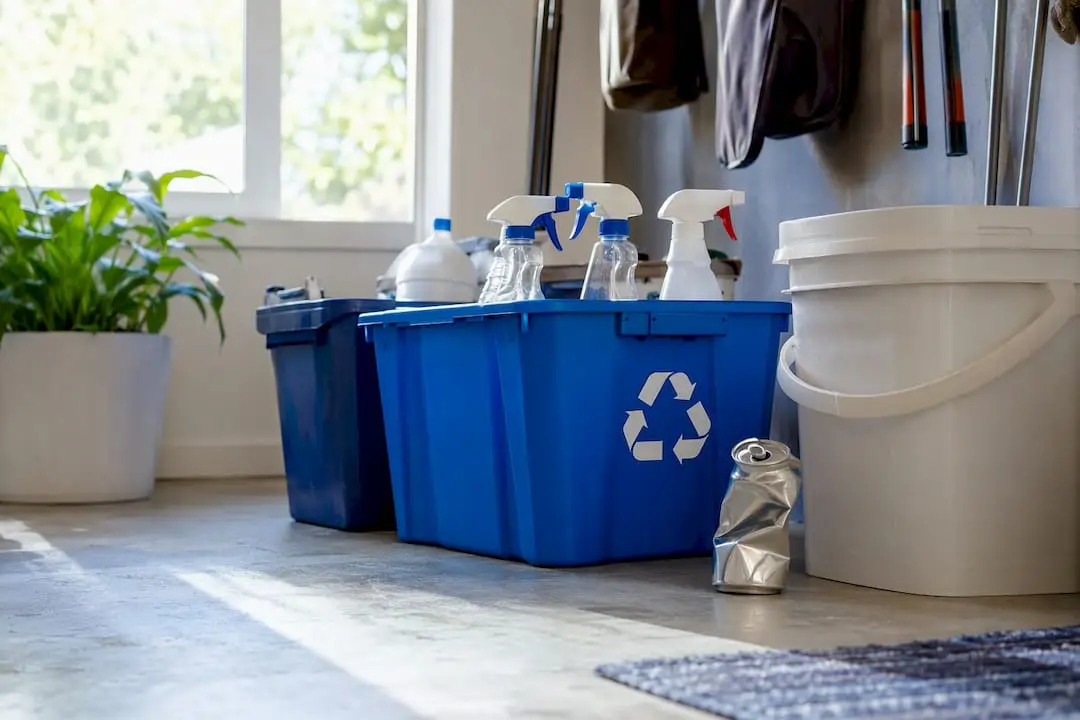
To minimize waste going forward, buy concentrates you dilute at home rather than pre-mixed sprays, and reuse a single labeled spray bottle for your DIY mixes instead of buying a new one every time. Microfiber cloths and reusable mop pads cut down on paper towel and disposable wipe waste, and they hold up for hundreds of washes before they need replacing.
Cost Comparison: Eco-Friendly vs. Conventional Cleaning
The math on green cleaning depends heavily on whether you’re buying certified commercial products or mixing your own.
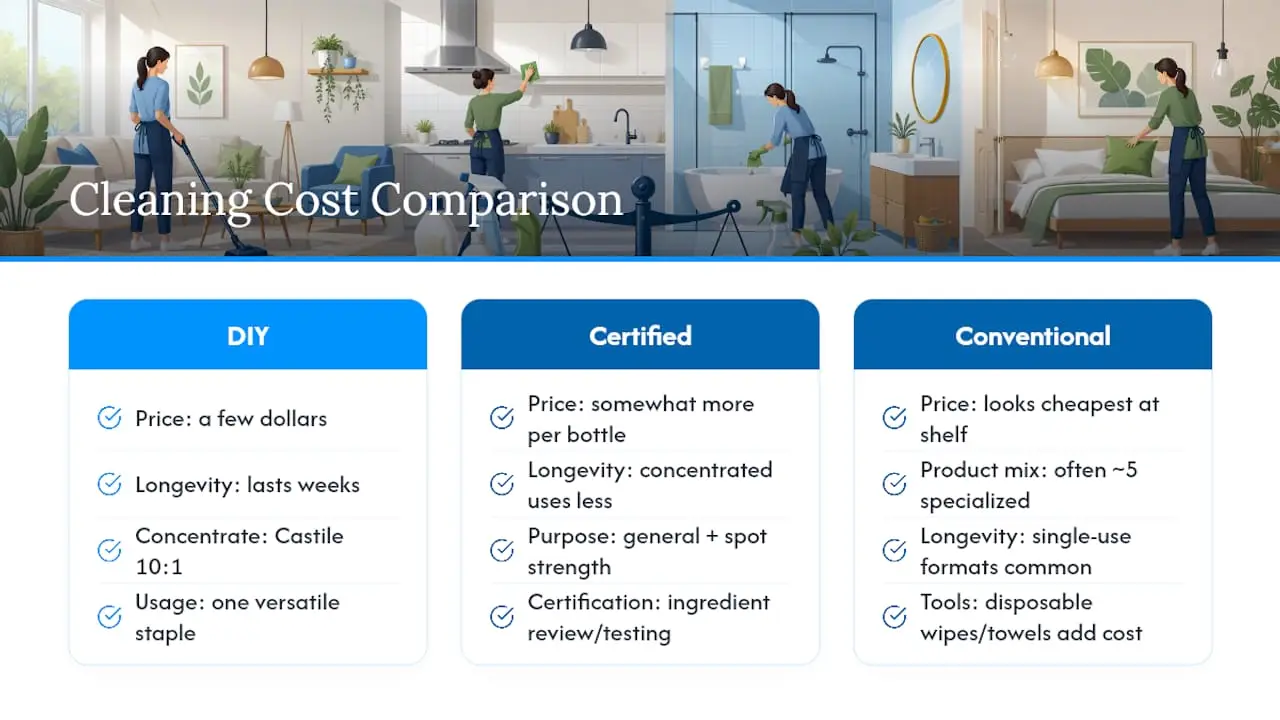
DIY staples are the cheapest option by a wide margin. A box of baking soda and a jug of white vinegar cost a few dollars and last for weeks of regular use across multiple rooms. Castile soap concentrate stretches even further since it’s diluted ten to one for an all-purpose spray.
Certified commercial products (Safer Choice, DfE, Green Seal) usually cost somewhat more per bottle than a generic store-brand cleaner, though concentrated formulas narrow that gap since you use less per application. The premium reflects the ingredient review and testing that goes into certification, not just fancier packaging.
Conventional cleaners often look cheapest at the shelf, but that comparison misses a few things. Buying five specialized products (one for glass, one for bathrooms, one for floors) costs more overall than one versatile all-purpose cleaner plus a few DIY staples that cover the same ground. Disposable wipes and paper towels also add a recurring cost that reusable microfiber cloths eliminate after the first purchase.
For most households, a mixed approach wins on cost: DIY basics for daily wiping and light jobs, one or two certified commercial products for anything that needs more cutting power, and reusable tools instead of disposables. Where the calculation shifts is time. Scrubbing longer to match a harsh chemical’s performance has a cost too, just not one that shows up on a receipt.
What Certification Should Look Like When You Hire a Cleaning Service
If you’re handing cleaning off to a professional, the same label literacy applies to the company as it does to a bottle of spray. Ask what products the crew uses and whether they carry Safer Choice or DfE certification, not just a claim of being “green” on the website.
A credible green cleaning service should be able to name its certified product lines specifically, not gesture vaguely at “eco-friendly practices.” It should also train staff on correct dilution ratios, since even a certified product loses its safety and performance edge if it’s mixed wrong. Consistency matters here: a homeowner mixing DIY vinegar spray can eyeball it, but a company cleaning dozens of homes a week needs standardized measurements to keep results reliable across every visit.
Ask, too, about how the company handles jobs that actually require disinfecting, like a home recovering from illness, versus routine cleaning. A service that treats every visit identically, whether it’s a light dusting or a post-illness deep clean, isn’t matching the method to the need.
Pure Homes Cleaning’s service offerings reflect this kind of tiered approach: routine cleaning for weekly upkeep, deep cleaning when a home needs more intensive attention, and move-in/move-out service for a full reset between tenants, all built around certified eco-friendly products rather than a one-size-fits-all chemical cart.
The Payoff of Sticking With Green Cleaning Long-Term
The health case for eco-friendly cleaning isn’t about one spray bottle. It’s about cumulative exposure over months and years of wiping the same counters and mopping the same floors.
Conventional cleaners often rely on VOCs and synthetic fragrances that off-gas into indoor air every time they’re used. Indoor air quality problems build slowly. A household cleaning with harsh aerosols weekly is adding a small, repeated dose of airborne irritants that conventional ventilation doesn’t always clear before the next cleaning session. Switching to fragrance-free, low-VOC certified products or DIY basics removes that recurring dose entirely rather than just reducing it once.
For households with asthma, allergies, infants, or elderly residents, this adds up faster. Fewer synthetic fragrances mean fewer asthma triggers. Skipping aerosols means less airborne particulate settling on surfaces kids touch. None of this requires giving up a clean home, it requires being deliberate about what’s actually in the bottle.
There’s also a behavioral payoff that’s easy to overlook: once a household builds the habit of checking for a Safer Choice or DfE seal instead of trusting a “natural” claim, that scrutiny extends to other purchases too. Green cleaning often becomes the entry point for broader shifts in how a family shops, not just an isolated swap under the kitchen sink.
Pure Homes Cleaning’s Approach to Eco-Friendly Cleaning
Pure Homes Cleaning builds every service tier, routine, deep, and move-in/move-out, around eco-friendly products and practices, so homeowners in Washington, DC, Virginia, and Maryland don’t have to choose between a clean home and a safer one. A trained cleaning professional keeps dilution consistent and handles products safely in ways that are hard to replicate on a rushed weeknight.
— Local
Book Eco-Friendly House Cleaning With Pure Homes Cleaning
Pure Homes Cleaning is the alternative to spending your Saturday scrubbing grout with vinegar and hoping it’s enough. If everything above sounds right in theory but exhausting in practice, that’s exactly the gap professional service closes. Pure Homes Cleaning offers routine standard cleaning, deep cleaning, and move-in/move-out service across Washington, DC, Virginia, and Maryland, all built around eco-friendly products and customizable plans that match your household’s actual needs rather than a generic checklist.

Booking takes a few minutes online, and plans flex around how often you need service and how deep each visit should go. New clients can browse the full range of cleaning services to see what’s included at each tier, then book a cleaning online and pick a date that works.
Where to Verify Products and Safety Guidance
Check the EPA Safer Choice product search before buying, review NSF’s green cleaner guidance for DIY caveats, and consult CDC-linked research on the limits of alternative disinfecting methods.
Sources
- CDC-cited study on household cleaning alternatives
- Identifying Greener Cleaning Products | US EPA
- Green or Natural Cleaners | NSF
- Hard surface cleaning performance of six alternative cleaners | The Cleaning Institute
FAQ
How can I deep clean my house without chemicals?
Combine microfiber cloths, a HEPA vacuum, steam for sealed floors, and DIY staples like baking soda paste and vinegar spray for most surfaces. For situations that require actual disinfection, use an EPA-registered or DfE-certified disinfectant instead of a chemical-free substitute.
What is the most eco-friendly cleaner?
There’s no single “most” eco-friendly cleaner, but products certified under EPA Safer Choice or DfE are independently reviewed for ingredient safety and packaging sustainability, making them the most verifiable choice on store shelves.
What are some eco-friendly cleaning ideas?
Use damp microfiber instead of dry dusting, dilute castile soap for an all-purpose spray, scrub with a baking soda paste instead of abrasive powders, and switch aerosol air fresheners for open windows and ventilation.
Is vinegar a good disinfectant?
Vinegar cleans effectively on many surfaces but is not an EPA-registered disinfectant and doesn’t reliably achieve the pathogen reduction levels required for true disinfection, so it’s not a substitute when disinfecting is actually necessary.
Is it worth hiring a professional eco-friendly cleaning service?
For deep cleans or households with infants, elderly residents, or anyone immunocompromised, a trained professional using certified products often balances effectiveness and safety better than DIY alone, which is where a service like Pure Homes Cleaning fits in.